 Add to Chrome
 Add to Firefox
 Add to Edge
Agentic Authoring of Interactive Multiview Visualizations in Genomics
May 29, 2026
Diverse genomics data, scientific questions, and analysis tasks typically demand highly specialized visualizations. Therefore, users often must customize or author new ones tailored to their data. Existing tools are usually either limited in customization or require substantial learning or programming, and even expressive tools assume visualization expertise many users lack. Agentic and large language model (LLM) approaches are increasingly applied to complex scientific tasks, including visualization. Natural-language conversational interfaces offer a promising path to democratizing the authoring of complex visualizations. In the context of genomics, these approaches face additional challenges: genomics visualizations typically integrate heterogeneous data types and are composed of multiple linked interactive views. These challenges motivate more structured LLM-based schemes. We first characterize where vanilla LLM generation succeeds and fails for genomics visualization, identifying eight quality dimensions. We then compare six schemes--direct generation, a fixed pipeline, and four agentic configurations varying in the number of specialist agents and the presence of a reviewer--across 159 cases spanning three levels of query ambiguity and specification complexity. All schemes use the Gosling visualization grammar as structured output. Agentic iteration substantially improves perceived quality over both baselines, while more complex agent architectures yield no additional benefit. We discuss implications for designing agentic systems for domain-specific visualization authoring. All supplemental materials are available at https://osf.io/uqe83.

MITI Minimum Information guidelines for highly multiplexed tissue images
Aug 21, 2021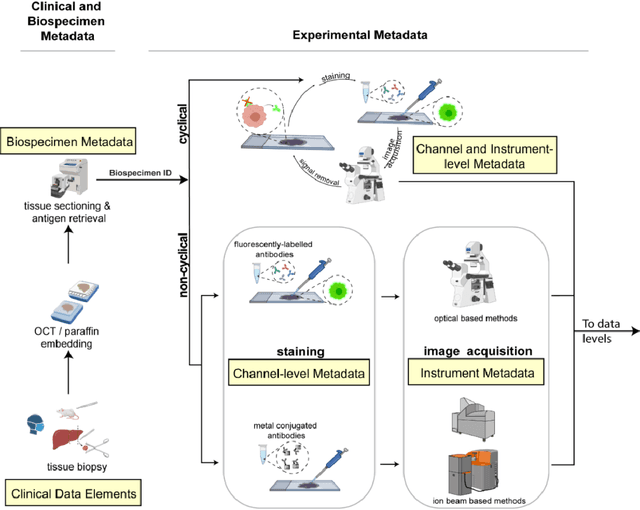
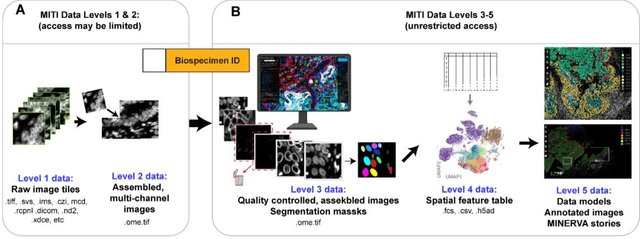
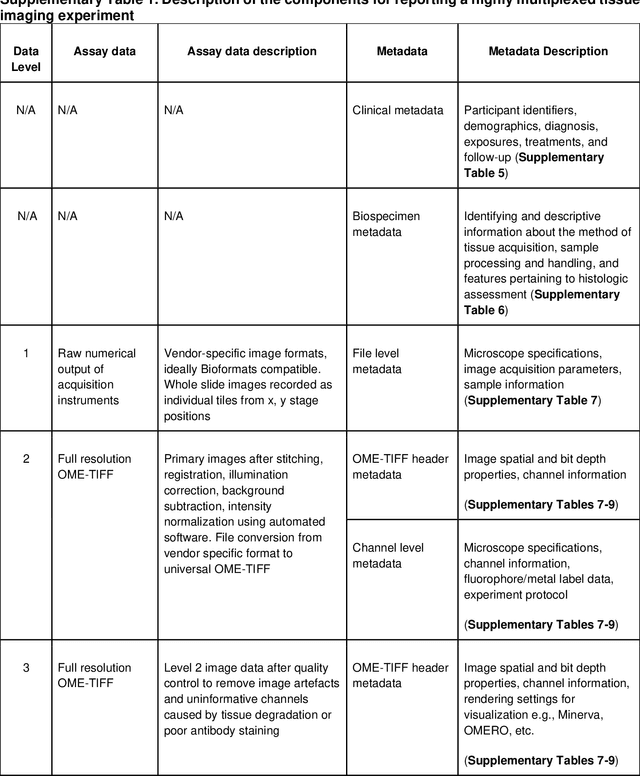
The imminent release of atlases combining highly multiplexed tissue imaging with single cell sequencing and other omics data from human tissues and tumors creates an urgent need for data and metadata standards compliant with emerging and traditional approaches to histology. We describe the development of a Minimum Information about highly multiplexed Tissue Imaging (MITI) standard that draws on best practices from genomics and microscopy of cultured cells and model organisms.