 Add to Chrome
 Add to Firefox
 Add to Edge
Strain-Parameterized Coupled Dynamics and Dual-Camera Visual Servoing for Aerial Continuum Manipulators
Mar 24, 2026
Tendon-driven aerial continuum manipulators (TD-ACMs) combine the maneuverability of uncrewed aerial vehicles (UAVs) with the compliance of lightweight continuum robots (CRs). Existing coupled dynamic modeling approaches for TD-ACMs incur high computational costs and do not explicitly account for aerial platform underactuation. To address these limitations, this paper presents a generalized dynamic formulation of a coupled TD-ACM with an underactuated base. The proposed approach integrates a strain-parameterized Cosserat rod model with a rigid-body model of the UAV into a unified Lagrangian ordinary differential equation (ODE) framework on $\mathrm{SE}(3)$, thereby eliminating computationally intensive symbolic derivations. Building upon the developed model, a robust dual-camera image-based visual servoing (IBVS) scheme is introduced. The proposed controller mitigates the field-of-view (FoV) limitations of conventional IBVS, compensates for attitude-induced image motion caused by UAV lateral dynamics, and incorporates a low-level adaptive controller to address modeling uncertainties with formal stability guarantees. Extensive simulations and experimental validation on a compact custom-built prototype demonstrate the effectiveness and robustness of the proposed framework in real-world scenarios.

Deep Visual Servoing of an Aerial Robot Using Keypoint Feature Extraction
Mar 29, 2025

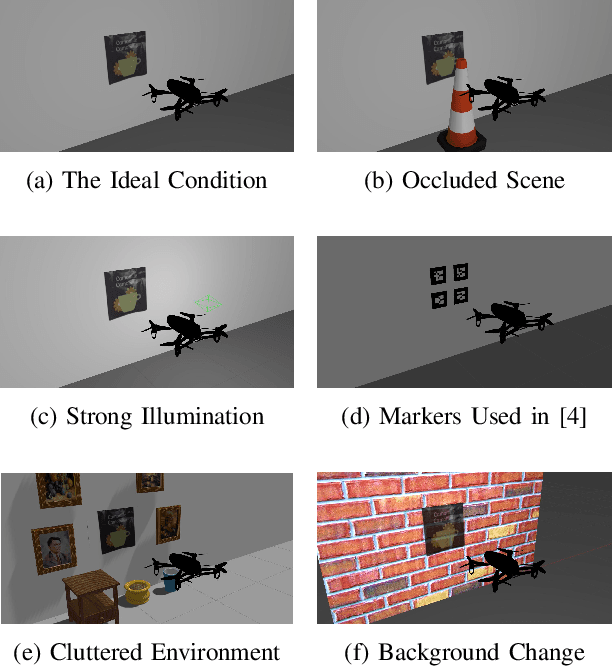
The problem of image-based visual servoing (IBVS) of an aerial robot using deep-learning-based keypoint detection is addressed in this article. A monocular RGB camera mounted on the platform is utilized to collect the visual data. A convolutional neural network (CNN) is then employed to extract the features serving as the visual data for the servoing task. This paper contributes to the field by circumventing not only the challenge stemming from the need for man-made marker detection in conventional visual servoing techniques, but also enhancing the robustness against undesirable factors including occlusion, varying illumination, clutter, and background changes, thereby broadening the applicability of perception-guided motion control tasks in aerial robots. Additionally, extensive physics-based ROS Gazebo simulations are conducted to assess the effectiveness of this method, in contrast to many existing studies that rely solely on physics-less simulations. A demonstration video is available at https://youtu.be/Dd2Her8Ly-E.