 Add to Chrome
 Add to Firefox
 Add to Edge
Mechanistic Steering of LLMs Reveals Layer-wise Feature Vulnerabilities in Adversarial Settings
Apr 25, 2026
Large language models (LLMs) can still be jailbroken into producing harmful outputs despite safety alignment. Existing attacks show this vulnerability, but not the internal mechanisms that cause it. This study asks whether jailbreak success is driven by identifiable internal features rather than prompts alone. We propose a three-stage pipeline for Gemma-2-2B using the BeaverTails dataset. First, we extract concept-aligned tokens from adversarial responses via subspace similarity. Second, we apply three feature-grouping strategies (cluster, hierarchical-linkage, and single-token-driven) to identify SAE feature subgroups for the aligned tokens across all 26 model layers. Third, we steer the model by amplifying the top features from each identified subgroup and measure the change in harmfulness score using a standardized LLM-judge scoring protocol. In all three approaches, the features in the layers [16-25] were relatively more vulnerable to steering. All three methods confirmed that mid to later layer feature subgroups are more responsible for unsafe outputs. These results provide evidence that the jailbreak vulnerability in Gemma-2-2B is localized to feature subgroups of mid to later layers, suggesting that targeted feature-level interventions may offer a more principled path to adversarial robustness than current prompt-level defenses.

Human-Readable Adversarial Prompts: An Investigation into LLM Vulnerabilities Using Situational Context
Dec 20, 2024


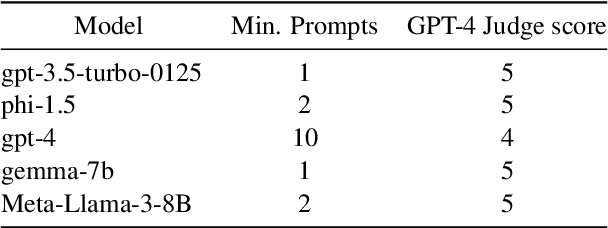
Previous research on LLM vulnerabilities often relied on nonsensical adversarial prompts, which were easily detectable by automated methods. We address this gap by focusing on human-readable adversarial prompts, a more realistic and potent threat. Our key contributions are situation-driven attacks leveraging movie scripts to create contextually relevant, human-readable prompts that successfully deceive LLMs, adversarial suffix conversion to transform nonsensical adversarial suffixes into meaningful text, and AdvPrompter with p-nucleus sampling, a method to generate diverse, human-readable adversarial suffixes, improving attack efficacy in models like GPT-3.5 and Gemma 7B. Our findings demonstrate that LLMs can be tricked by sophisticated adversaries into producing harmful responses with human-readable adversarial prompts and that there exists a scope for improvement when it comes to robust LLMs.
Human-Interpretable Adversarial Prompt Attack on Large Language Models with Situational Context
Jul 25, 2024



Previous research on testing the vulnerabilities in Large Language Models (LLMs) using adversarial attacks has primarily focused on nonsensical prompt injections, which are easily detected upon manual or automated review (e.g., via byte entropy). However, the exploration of innocuous human-understandable malicious prompts augmented with adversarial injections remains limited. In this research, we explore converting a nonsensical suffix attack into a sensible prompt via a situation-driven contextual re-writing. This allows us to show suffix conversion without any gradients, using only LLMs to perform the attacks, and thus better understand the scope of possible risks. We combine an independent, meaningful adversarial insertion and situations derived from movies to check if this can trick an LLM. The situations are extracted from the IMDB dataset, and prompts are defined following a few-shot chain-of-thought prompting. Our approach demonstrates that a successful situation-driven attack can be executed on both open-source and proprietary LLMs. We find that across many LLMs, as few as 1 attempt produces an attack and that these attacks transfer between LLMs.
Change Management using Generative Modeling on Digital Twins
Sep 21, 2023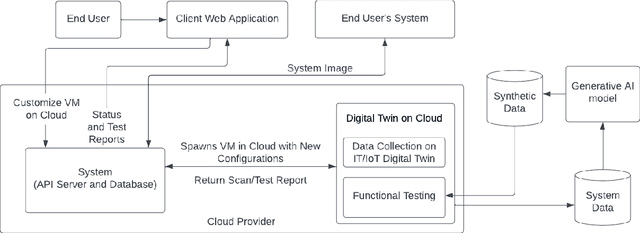
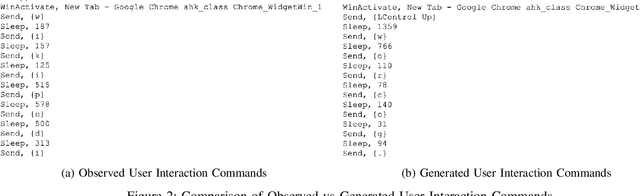
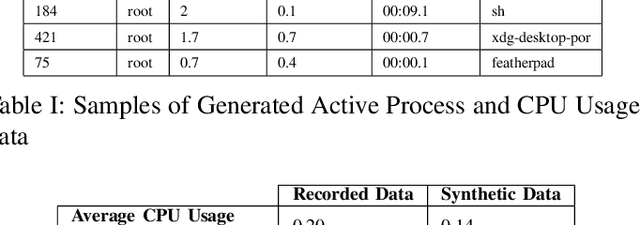
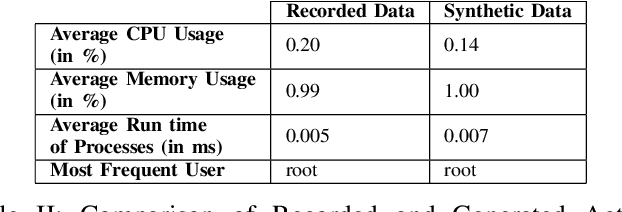
A key challenge faced by small and medium-sized business entities is securely managing software updates and changes. Specifically, with rapidly evolving cybersecurity threats, changes/updates/patches to software systems are necessary to stay ahead of emerging threats and are often mandated by regulators or statutory authorities to counter these. However, security patches/updates require stress testing before they can be released in the production system. Stress testing in production environments is risky and poses security threats. Large businesses usually have a non-production environment where such changes can be made and tested before being released into production. Smaller businesses do not have such facilities. In this work, we show how "digital twins", especially for a mix of IT and IoT environments, can be created on the cloud. These digital twins act as a non-production environment where changes can be applied, and the system can be securely tested before patch release. Additionally, the non-production digital twin can be used to collect system data and run stress tests on the environment, both manually and automatically. In this paper, we show how using a small sample of real data/interactions, Generative Artificial Intelligence (AI) models can be used to generate testing scenarios to check for points of failure.