 Add to Chrome
 Add to Firefox
 Add to Edge
Sustainable Transfer Learning for Adaptive Robot Skills
Apr 08, 2026
Learning robot skills from scratch is often time-consuming, while reusing data promotes sustainability and improves sample efficiency. This study investigates policy transfer across different robotic platforms, focusing on peg-in-hole task using reinforcement learning (RL). Policy training is carried out on two different robots. Their policies are transferred and evaluated for zero-shot, fine-tuning, and training from scratch. Results indicate that zero-shot transfer leads to lower success rates and relatively longer task execution times, while fine-tuning significantly improves performance with fewer training time-steps. These findings highlight that policy transfer with adaptation techniques improves sample efficiency and generalization, reducing the need for extensive retraining and supporting sustainable robotic learning.
* Published in RAAD 2025 (Springer). 7 pages, 5 figures

Dynamic collision avoidance for multiple robotic manipulators based on a non-cooperative multi-agent game
Feb 28, 2021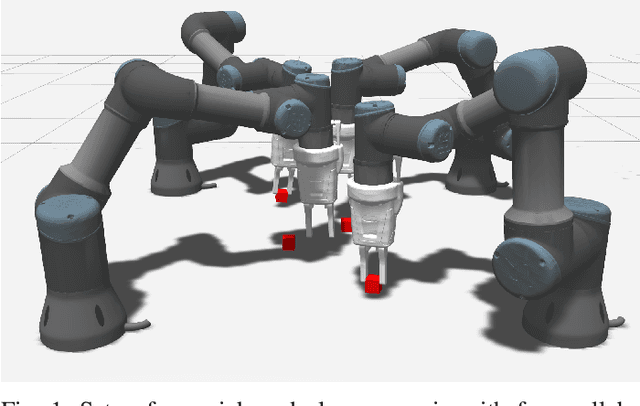
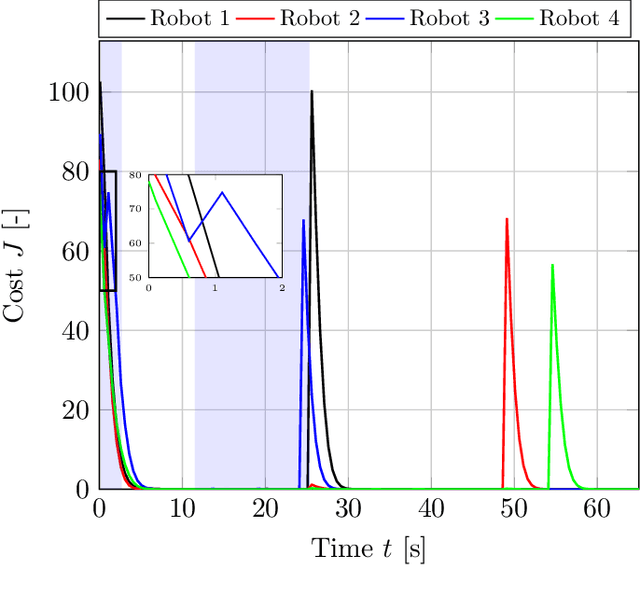
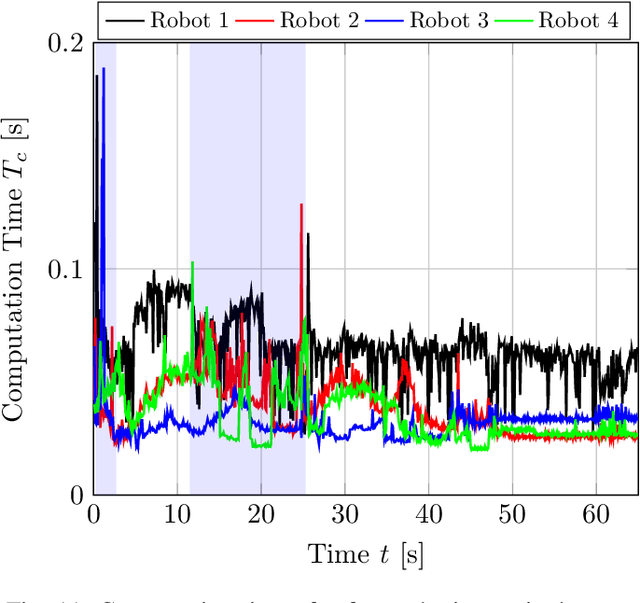
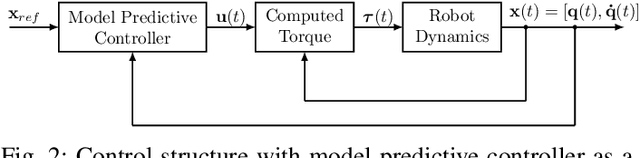
A flexible operation of multiple robotic manipulators in a shared workspace requires an online trajectory planning with static and dynamic collision avoidance. In this work, we propose a real-time capable motion control algorithm, based on non-linear model predictive control, which accounts for static and dynamic collision avoidance. The proposed algorithm is formulated as a non-cooperative game, where each robot is considered as an agent. Each agent optimizes its own motion and accounts for the predicted movement of surrounding agents. We propose a novel approach to formulate the dynamic collision constraints. Additionally, we account for deadlocks that might occur in a setup of multiple robotic manipulators. We validate our algorithm on a pick and place scenario for four collaborative robots operating in a common workspace in the simulation environment Gazebo. The robots are controlled by the Robot Operating System (ROS). We demonstrate, that our approach is real-time capable and, due to the distributed nature of the approach, easily scales to an arbitrary number of robot manipulators in a shared workspace.
Flatness Based Control of an Industrial Robot Joint Using Secondary Encoders
Jan 13, 2021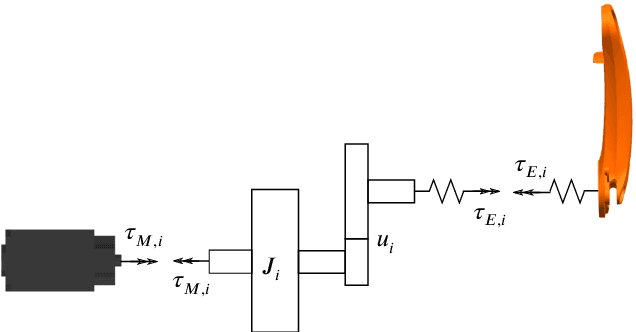
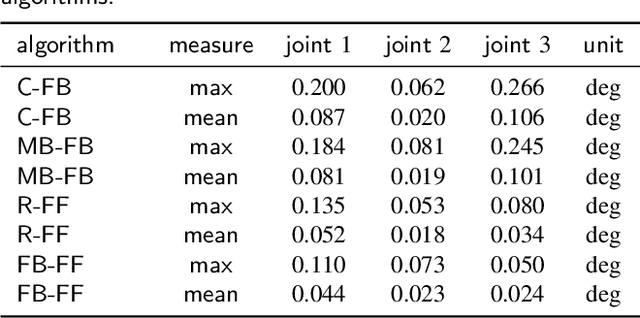
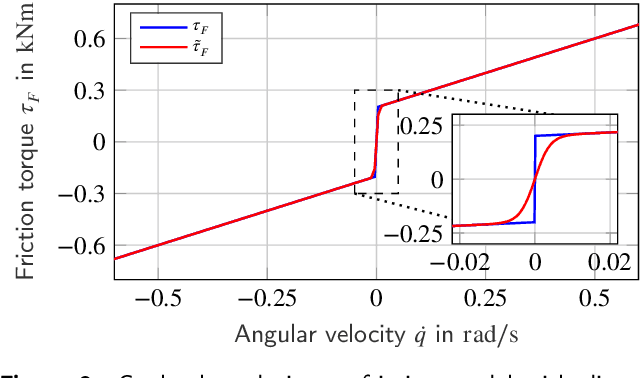
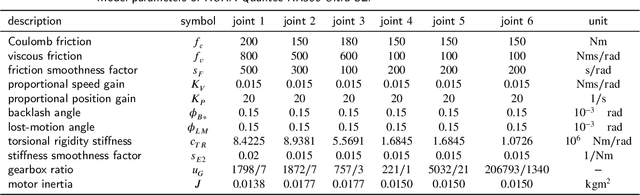
Due to their compliant structure, industrial robots without precision-enhancing measures are only to a limited extent suitable for machining applications. Apart from structural, thermal and bearing deformations, the main cause for compliant structure is backlash of transmission drives. This paper proposes a method to improve trajectory tracking accuracy by using secondary encoders and applying a feedback and a flatness based feed forward control strategy. For this purpose, a novel nonlinear, continuously differentiable dynamical model of a flexible robot joint is presented. The robot joint is modeled as a two-mass oscillator with pose-dependent inertia, nonlinear friction and nonlinear stiffness, including backlash. A flatness based feed forward control is designed to improve the guiding behaviour and a feedback controller, based on secondary encoders, is implemented for disturbance compensation. Using Automatic Differentiation, the nonlinear feed forward controller can be computed in a few microseconds online. Finally, the proposed algorithms are evaluated in simulations and experimentally on a real KUKA Quantec KR300 Ultra SE.