 Add to Chrome
 Add to Firefox
 Add to Edge
An LLM-Based Assistance System for Intuitive and Flexible Capability-Based Planning
May 27, 2026
In modern industry, dynamic environments and the complexity of modular and reconfigurable resources require automated planning of process sequences. Capability-based planning approaches address this by automatically generating plans from semantic knowledge models that describe resource functions in a machine-interpretable form. Their practical use, however, remains limited: solver feedback, especially in the case of unsatisfiability, is difficult to interpret, and the knowledge models require adaptation as operational conditions change or requests become infeasible. This paper presents a hybrid assistance system that augments an existing capability-based Satisfiability Modulo Theories (SMT) planning approach with an Large Language Model (LLM)-based layer for natural-language interaction, explanation, and adaptation. Formal planning correctness remains with the symbolic planner, while the LLM layer handles natural-language access and flexible knowledge model adaptation under explicit Human-in-the-Loop (HitL) approval. The system decomposes into four components: Capability Grounding, Symbolic Planning, Result Interpretation, and Planning Adaptation, realized as a routed agentic workflow in which a central router delegates to five specialized agents. The system is evaluated on a modular production system across four scenario types. Of 23 test cases, 9 of 10 knowledge queries and all 4 satisfiable planning cases were handled correctly, 3 of 4 unsatisfiable cases produced concrete repair proposals, and all 5 adaptive planning scenarios resolved into satisfiable plans through iterative, user-approved knowledge model modifications. The findings confirm that combining formal planning with LLM-based assistance substantially improves accessibility and adaptability in industrial automation.

Capability-Driven Skill Generation with LLMs: A RAG-Based Approach for Reusing Existing Libraries and Interfaces
May 06, 2025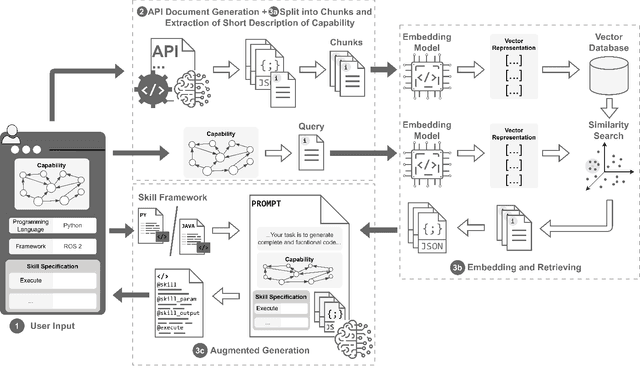
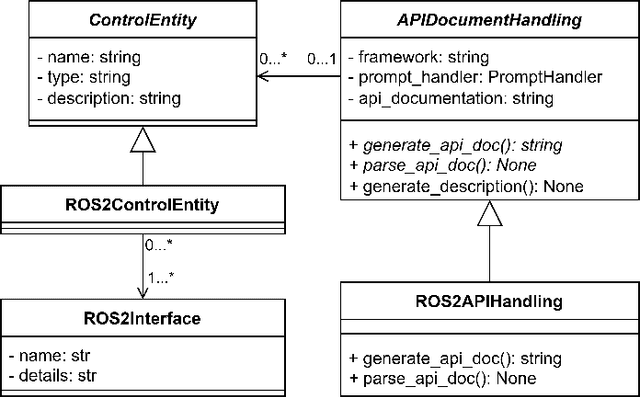
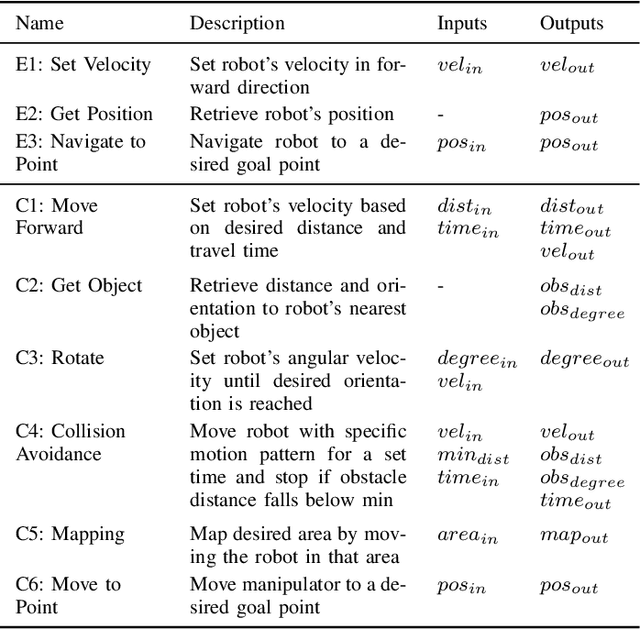

Modern automation systems increasingly rely on modular architectures, with capabilities and skills as one solution approach. Capabilities define the functions of resources in a machine-readable form and skills provide the concrete implementations that realize those capabilities. However, the development of a skill implementation conforming to a corresponding capability remains a time-consuming and challenging task. In this paper, we present a method that treats capabilities as contracts for skill implementations and leverages large language models to generate executable code based on natural language user input. A key feature of our approach is the integration of existing software libraries and interface technologies, enabling the generation of skill implementations across different target languages. We introduce a framework that allows users to incorporate their own libraries and resource interfaces into the code generation process through a retrieval-augmented generation architecture. The proposed method is evaluated using an autonomous mobile robot controlled via Python and ROS 2, demonstrating the feasibility and flexibility of the approach.