 Add to Chrome
 Add to Firefox
 Add to Edge
AI-Driven Phase Identification from X-ray Hyperspectral Imaging of cycled Na-ion Cathode Materials
Mar 08, 2026
Na-ion batteries have emerged as viable candidates for large-scale energy storage applica- tions due to resource abundance and cost advantages. The constraints imposed on their performance and durability, for instance, by complex phase transformations in positive electrode materials during electrochemical cycling, can be addressed and are thus not detrimental to their development. However, diffusion-limited Na-ion transport can drive spatially heterogeneous phase nucleation and propagation, leading to multiphase coexis- tence and locally non-uniform electrochemical activity, generating complex reaction path- ways that challenge both mechanistic understanding and predictive material optimization. These challenges can be addressed by investigating single-crystalline regions of materials, i.e. down to the scale of individual particles, although such analyses are often constrained by energetically and/or spatially sparse hyperspectral datasets. Here, we developed an AI-driven method to process hyperspectral data under sparse sampling conditions and generate multiphase maps with nanometer-scale resolution over a micrometer-scale field of view. We applied this processing on scanning transmission X-ray microscopy (STXM) data to determine the distribution and coexistence of phases in individual particles of NaxV2(PO4)2F3 cathode materials, at different states of charge. The methodology relies on a workflow which combines a Gaussian mixture variational autoencoder (GMVAE) algorithm with the Pearson corre- lation coefficient to identify the sodium content and map their spatial distribution. Our approach reveals nanoscale phase heterogeneity and evolution within individual particles, and improves the reliability of phase detection by identifying ambiguity zones, false assign- ments, and transition phases localized at grain boundaries.

Unsupervised Multi-Clustering and Decision-Making Strategies for 4D-STEM Orientation Mapping
Mar 09, 2025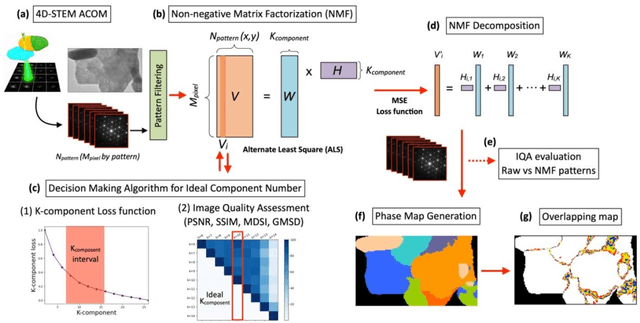
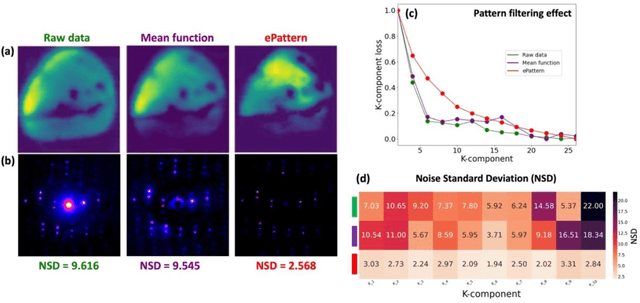
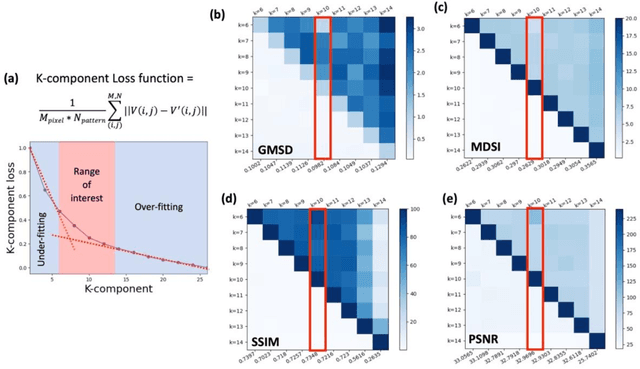

This study presents a novel integration of unsupervised learning and decision-making strategies for the advanced analysis of 4D-STEM datasets, with a focus on non-negative matrix factorization (NMF) as the primary clustering method. Our approach introduces a systematic framework to determine the optimal number of components (k) required for robust and interpretable orientation mapping. By leveraging the K-Component Loss method and Image Quality Assessment (IQA) metrics, we effectively balance reconstruction fidelity and model complexity. Additionally, we highlight the critical role of dataset preprocessing in improving clustering stability and accuracy. Furthermore, our spatial weight matrix analysis provides insights into overlapping regions within the dataset by employing threshold-based visualization, facilitating a detailed understanding of cluster interactions. The results demonstrate the potential of combining NMF with advanced IQA metrics and preprocessing techniques for reliable orientation mapping and structural analysis in 4D-STEM datasets, paving the way for future applications in multi-dimensional material characterization.
Adaptative Diffraction Image Registration for 4D-STEM to optimize ACOM Pattern Matching
May 03, 2023The technique known as 4D-STEM has recently emerged as a powerful tool for the local characterization of crystalline structures in materials, such as cathode materials for Li-ion batteries or perovskite materials for photovoltaics. However, the use of new detectors optimized for electron diffraction patterns and other advanced techniques requires constant adaptation of methodologies to address the challenges associated with crystalline materials. In this study, we present a novel image processing method to improve pattern matching in the determination of crystalline orientations and phases. Our approach uses sub-pixelar adaptative image processing to register and reconstruct electron diffraction signals in large 4D-STEM datasets. By using adaptive prominence and linear filters such as mean and gaussian blur, we are able to improve the quality of the diffraction pattern registration. The resulting data compression rate of 103 is well-suited for the era of big data and provides a significant enhancement in the performance of the entire ACOM data processing method. Our approach is evaluated using dedicated metrics, which demonstrate a high improvement in phase recognition. Our results demonstrate that this data preparation method not only enhances the quality of the resulting image but also boosts the confidence level in the analysis of the outcomes related to determining crystal orientation and phase. Additionally, it mitigates the impact of user bias that may occur during the application of the method through the manipulation of parameters.