 Add to Chrome
 Add to Firefox
 Add to Edge
Phyelds: A Pythonic Framework for Aggregate Computing
Mar 31, 2026
Aggregate programming is a field-based coordination paradigm with over a decade of exploration and successful applications across domains including sensor networks, robotics, and IoT, with implementations in various programming languages, such as Protelis, ScaFi (Scala), and FCPP (C++). A recent research direction integrates machine learning with aggregate computing, aiming to support large-scale distributed learning and provide new abstractions for implementing learning algorithms. However, existing implementations do not target data science practitioners, who predominantly work in Python--the de facto language for data science and machine learning, with a rich and mature ecosystem. Python also offers advantages for other use cases, such as education and robotics (e.g., via ROS). To address this gap, we present Phyelds, a Python library for aggregate programming. Phyelds offers a fully featured yet lightweight implementation of the field calculus model of computation, featuring a Pythonic API and an architecture designed for seamless integration with Python's machine learning ecosystem. We describe the design and implementation of Phyelds and illustrate its versatility across domains, from well-known aggregate computing patterns to federated learning coordination and integration with a widely used multi-agent reinforcement learning simulator.

Proximity-based Self-Federated Learning
Jul 17, 2024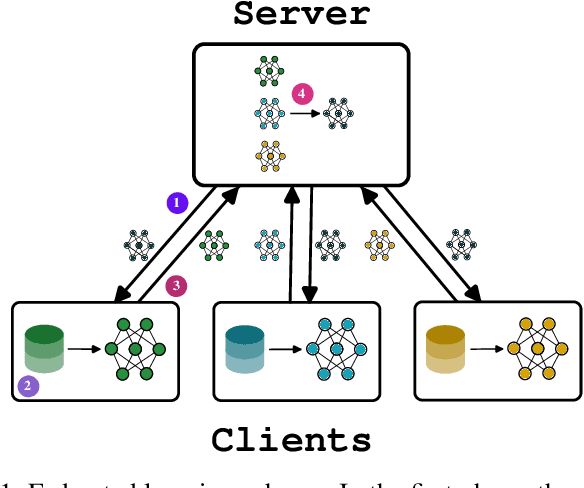


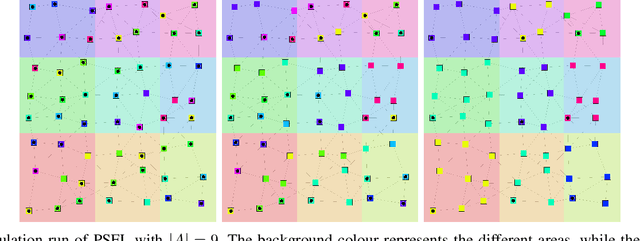
In recent advancements in machine learning, federated learning allows a network of distributed clients to collaboratively develop a global model without needing to share their local data. This technique aims to safeguard privacy, countering the vulnerabilities of conventional centralized learning methods. Traditional federated learning approaches often rely on a central server to coordinate model training across clients, aiming to replicate the same model uniformly across all nodes. However, these methods overlook the significance of geographical and local data variances in vast networks, potentially affecting model effectiveness and applicability. Moreover, relying on a central server might become a bottleneck in large networks, such as the ones promoted by edge computing. Our paper introduces a novel, fully-distributed federated learning strategy called proximity-based self-federated learning that enables the self-organised creation of multiple federations of clients based on their geographic proximity and data distribution without exchanging raw data. Indeed, unlike traditional algorithms, our approach encourages clients to share and adjust their models with neighbouring nodes based on geographic proximity and model accuracy. This method not only addresses the limitations posed by diverse data distributions but also enhances the model's adaptability to different regional characteristics creating specialized models for each federation. We demonstrate the efficacy of our approach through simulations on well-known datasets, showcasing its effectiveness over the conventional centralized federated learning framework.