 Add to Chrome
 Add to Firefox
 Add to Edge
ECLASS-Augmented Semantic Product Search for Electronic Components
Apr 21, 2026
Efficient semantic access to industrial product data is a key enabler for factory automation and emerging LLM-based agent workflows, where both human engineers and autonomous agents must identify suitable components from highly structured catalogs. However, the vocabulary mismatch between natural-language queries and attribute-centric product descriptions limits the effectiveness of traditional retrieval approaches, e.g., BM25. In this work, we present a systematic evaluation of LLM-assisted dense retrieval for semantic product search on industrial electronic components, and investigate the integration of hierarchical semantics from the ECLASS standard into embedding-based retrieval. Our results show that dense retrieval combined with re-ranking substantially outperforms classical lexical methods and foundation model web-search baselines. In particular, the proposed approach achieves a Hit_Rate@5 of 94.3 %, compared to 31.4 % for BM25 on expert queries, while also exceeding foundation model baselines in both effectiveness and efficiency. Furthermore, augmenting product representations with ECLASS semantics yields consistent performance gains across configurations, demonstrating that standardized hierarchical metadata provides a crucial semantic bridge between user intent and sparse product descriptions.

Investigation of the Impact of Synthetic Training Data in the Industrial Application of Terminal Strip Object Detection
Mar 06, 2024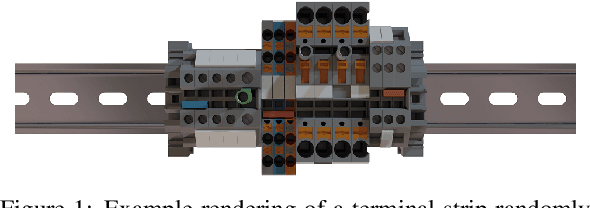
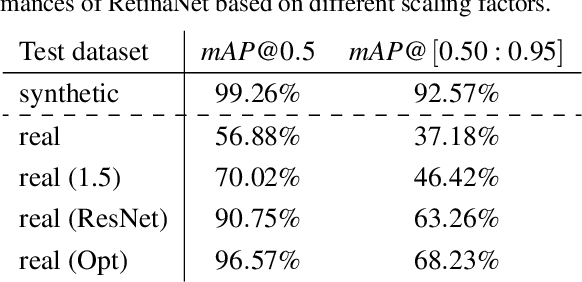
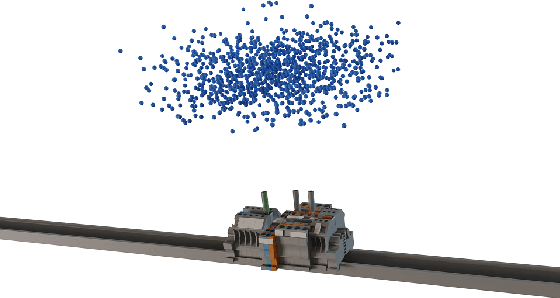
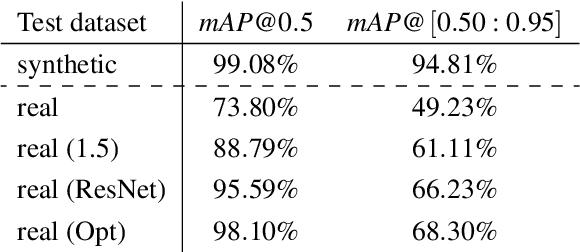
In industrial manufacturing, numerous tasks of visually inspecting or detecting specific objects exist that are currently performed manually or by classical image processing methods. Therefore, introducing recent deep learning models to industrial environments holds the potential to increase productivity and enable new applications. However, gathering and labeling sufficient data is often intractable, complicating the implementation of such projects. Hence, image synthesis methods are commonly used to generate synthetic training data from 3D models and annotate them automatically, although it results in a sim-to-real domain gap. In this paper, we investigate the sim-to-real generalization performance of standard object detectors on the complex industrial application of terminal strip object detection. Combining domain randomization and domain knowledge, we created an image synthesis pipeline for automatically generating the training data. Moreover, we manually annotated 300 real images of terminal strips for the evaluation. The results show the cruciality of the objects of interest to have the same scale in either domain. Nevertheless, under optimized scaling conditions, the sim-to-real performance difference in mean average precision amounts to 2.69 % for RetinaNet and 0.98 % for Faster R-CNN, qualifying this approach for industrial requirements.