 Add to Chrome
 Add to Firefox
 Add to Edge
Pretraining Language Models on Historical Text
Jun 02, 2026
We introduce TypewriterLM, a 7.24B History language model (LM) trained exclusively on English text predating 1913. Developing History LMs requires addressing challenges in data quality and availability, preventing temporal leakage, designing temporally consistent post-training pipelines, and constructing reliable evaluations. To address these issues, we construct TypewriterCorpus, a 54B-token historical corpus collected from diverse archival and linguistically annotated sources with extensive data cleaning and leakage mitigation procedures. Furthermore, we introduce lexically grounded instructing tuning, a post-training framework that constraints responses to remain directly grounded in historical source documents. Using this framework we construct two historical instruction tuning datasets: History-LIMA and History-SelfInstruct. To evaluate capability and temporal consistency, we introduce History-Event, a benchmark suite for evaluating competence, temporal grounding and data leakage. We release TypewriterLM and all associated resources to support future research on historical language models.

Towards the AI Historian: Agentic Information Extraction from Primary Sources
Apr 04, 2026AI is supporting, accelerating, and automating scientific discovery across a diverse set of fields. However, AI adoption in historical research remains limited due to the lack of solutions designed for historians. In this technical progress report, we introduce the first module of Chronos, an AI Historian under development. This module enables historians to convert image scans of primary sources into data through natural-language interactions. Rather than imposing a fixed extraction pipeline powered by a vision-language model (VLM), it allows historians to adapt workflows for heterogeneous source corpora, evaluate the performance of AI models on specific tasks, and iteratively refine workflows through natural-language interaction with the Chronos agent. The module is open-source and ready to be used by historical researchers on their own sources.
Multimodal LLMs for Historical Dataset Construction from Archival Image Scans: German Patents (1877-1918)
Dec 22, 2025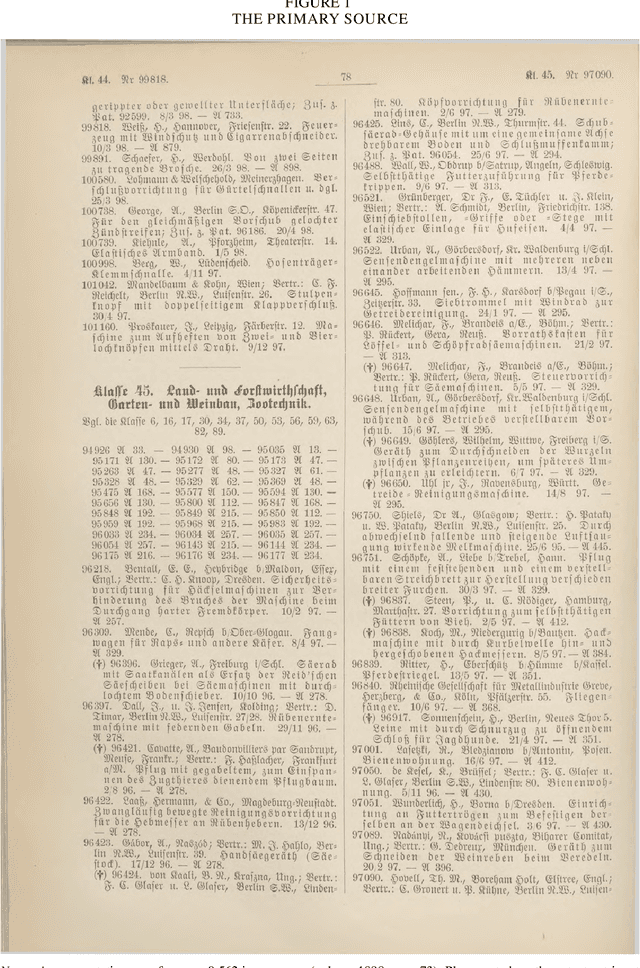
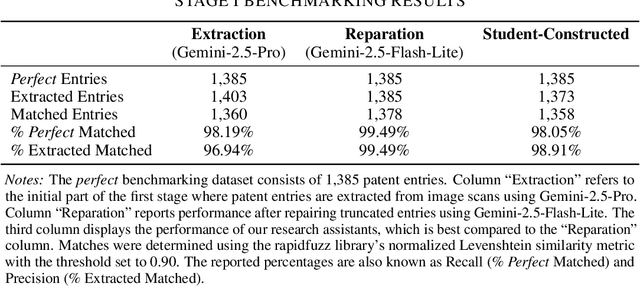
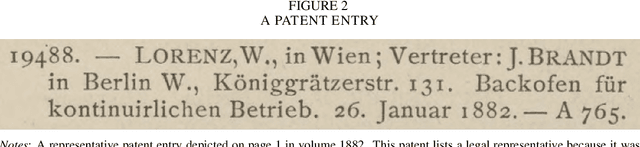
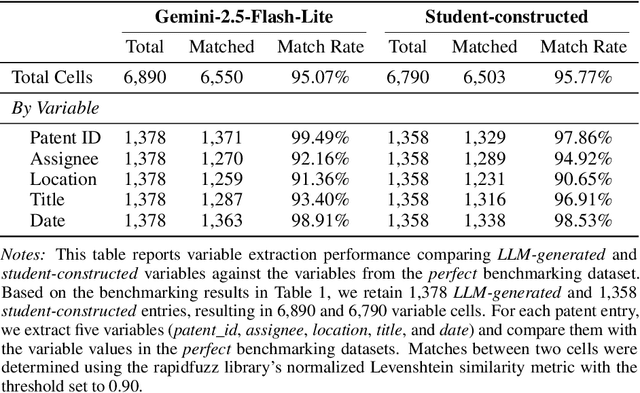
We leverage multimodal large language models (LLMs) to construct a dataset of 306,070 German patents (1877-1918) from 9,562 archival image scans using our LLM-based pipeline powered by Gemini-2.5-Pro and Gemini-2.5-Flash-Lite. Our benchmarking exercise provides tentative evidence that multimodal LLMs can create higher quality datasets than our research assistants, while also being more than 795 times faster and 205 times cheaper in constructing the patent dataset from our image corpus. About 20 to 50 patent entries are embedded on each page, arranged in a double-column format and printed in Gothic and Roman fonts. The font and layout complexity of our primary source material suggests to us that multimodal LLMs are a paradigm shift in how datasets are constructed in economic history. We open-source our benchmarking and patent datasets as well as our LLM-based data pipeline, which can be easily adapted to other image corpora using LLM-assisted coding tools, lowering the barriers for less technical researchers. Finally, we explain the economics of deploying LLMs for historical dataset construction and conclude by speculating on the potential implications for the field of economic history.
Multimodal LLMs for OCR, OCR Post-Correction, and Named Entity Recognition in Historical Documents
Apr 01, 2025We explore how multimodal Large Language Models (mLLMs) can help researchers transcribe historical documents, extract relevant historical information, and construct datasets from historical sources. Specifically, we investigate the capabilities of mLLMs in performing (1) Optical Character Recognition (OCR), (2) OCR Post-Correction, and (3) Named Entity Recognition (NER) tasks on a set of city directories published in German between 1754 and 1870. First, we benchmark the off-the-shelf transcription accuracy of both mLLMs and conventional OCR models. We find that the best-performing mLLM model significantly outperforms conventional state-of-the-art OCR models and other frontier mLLMs. Second, we are the first to introduce multimodal post-correction of OCR output using mLLMs. We find that this novel approach leads to a drastic improvement in transcription accuracy and consistently produces highly accurate transcriptions (<1% CER), without any image pre-processing or model fine-tuning. Third, we demonstrate that mLLMs can efficiently recognize entities in transcriptions of historical documents and parse them into structured dataset formats. Our findings provide early evidence for the long-term potential of mLLMs to introduce a paradigm shift in the approaches to historical data collection and document transcription.