 Add to Chrome
 Add to Firefox
 Add to Edge
Eardrum sound pressure prediction from ear canal reflectance based on the inverse solution of Webster's horn equation
Nov 16, 2025
To derive ear canal transfer functions for individualized equalization algorithms of in-ear hearing systems, individual ear canal models are needed. In a one-dimensional approach, this requires the estimation of the individual area function of the ear canal. The area function can be effectively and reproducibly calculated as the inverse solution of Webster's horn equation by finite difference approximation of the time domain reflectance. Building upon previous research, the present study further investigates the termination of the approximation at an optimal spatial resolution, addressing the absence of higher frequencies in typical ear canal measurements and enhancing the accuracy of the inverse solution. Compared to the geometric reference, more precise area functions were achieved by extrapolating simulated input impedances of ear canal geometries up to a frequency of 3.5 MHz, corresponding to 0.1 mm spatial resolution. The low pass of the previous work was adopted but adjusted for its cut-off frequency depending on the highest frequency of the band-limited input impedance. Robust criteria for terminating the area function at the approximated ear canal length were found. Finally, three-dimensional simulated and measured ear canal transfer impedances were replicated well employing the previously introduced and herein validated one-dimensional electro-acoustic model fed by the area functions.

Using a one-dimensional finite-element approximation of Webster's horn equation to estimate individual ear canal acoustic transfer from input impedances
Apr 14, 2023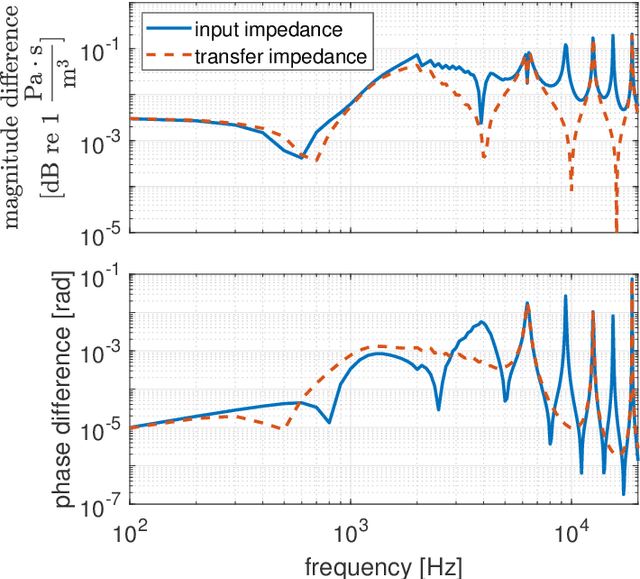
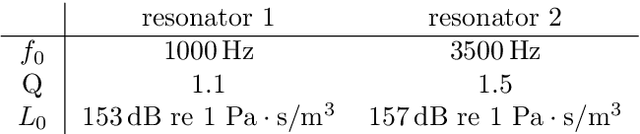
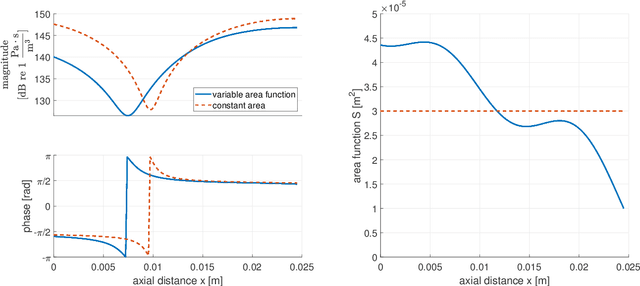
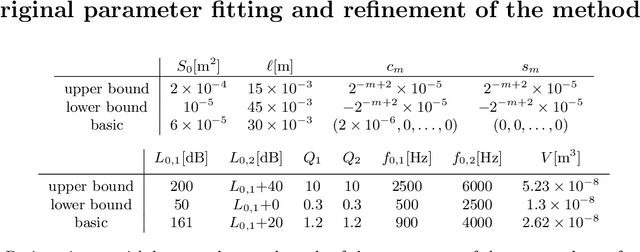
In many applications, knowledge of the sound pressure transfer to the eardrum is important. The transfer is highly influenced by the shape of the ear canal and its acoustic properties, such as the acoustic impedance at the eardrum. Invasive procedures to measure the sound pressure at the eardrum are usually elaborate or costly. In this work, we propose a numerical method to estimate the transfer impedance at the eardrum given only input impedance measurements at the ear canal entrance by using one-dimensional first-order finite elements and Nelder-Mead optimization algorithm. Estimations on the area function of the ear canal and the acoustic impedance at the eardrum are achieved. Results are validated through numerical simulations on ten different ear canal geometries and three different acoustic impedances at the eardrum using synthetically generated data from three-dimensional finite element simulations.