 Add to Chrome
 Add to Firefox
 Add to Edge
Sterilizable Scene Graph Generation for Operating Rooms
Aug 17, 2026
Scene graph generation from surgical video enables a holistic and structured understanding of surgical scenes by modeling objects and their semantic relationships. Despite recent advances, state-of-the-art approaches rely on large, parameter-heavy deep learning models that are impractical for deployment in the operating room (OR) due to hardware footprint, hygiene constraints, latency, and data privacy concerns. To the best of our knowledge, this is the first scene graph generation method built on NCAs and the first NCA framework capable of learning structured representations. We introduce SG-NCA, a lightweight scene graph generation framework based on Neural Cellular Automata (NCA), designed for inference in fanless devices critical for OR hygiene protocols. SG-NCA is the first scene graph generation combining NCA-based multiclass segmentation for efficient object detection and feature extraction with a lightweight relation predictor. We evaluate SG-NCA on videos of cataract surgery and cholecystectomy, demonstrating performance comparable to established baselines while requiring 55x fewer parameters. We showcase deployment on fanless edge devices better suited for the OR and demonstrate downstream applications such as surgical video captioning, highlighting SG-NCA's potential for affordable, privacy-preserving, and OR-ready intraoperative scene understanding.

OctreeNCA: Single-Pass 184 MP Segmentation on Consumer Hardware
Aug 09, 2025Medical applications demand segmentation of large inputs, like prostate MRIs, pathology slices, or videos of surgery. These inputs should ideally be inferred at once to provide the model with proper spatial or temporal context. When segmenting large inputs, the VRAM consumption of the GPU becomes the bottleneck. Architectures like UNets or Vision Transformers scale very poorly in VRAM consumption, resulting in patch- or frame-wise approaches that compromise global consistency and inference speed. The lightweight Neural Cellular Automaton (NCA) is a bio-inspired model that is by construction size-invariant. However, due to its local-only communication rules, it lacks global knowledge. We propose OctreeNCA by generalizing the neighborhood definition using an octree data structure. Our generalized neighborhood definition enables the efficient traversal of global knowledge. Since deep learning frameworks are mainly developed for large multi-layer networks, their implementation does not fully leverage the advantages of NCAs. We implement an NCA inference function in CUDA that further reduces VRAM demands and increases inference speed. Our OctreeNCA segments high-resolution images and videos quickly while occupying 90% less VRAM than a UNet during evaluation. This allows us to segment 184 Megapixel pathology slices or 1-minute surgical videos at once.
Distribution-Aware Replay for Continual MRI Segmentation
Jul 30, 2024


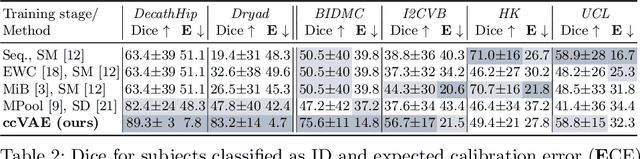
Medical image distributions shift constantly due to changes in patient population and discrepancies in image acquisition. These distribution changes result in performance deterioration; deterioration that continual learning aims to alleviate. However, only adaptation with data rehearsal strategies yields practically desirable performance for medical image segmentation. Such rehearsal violates patient privacy and, as most continual learning approaches, overlooks unexpected changes from out-of-distribution instances. To transcend both of these challenges, we introduce a distribution-aware replay strategy that mitigates forgetting through auto-encoding of features, while simultaneously leveraging the learned distribution of features to detect model failure. We provide empirical corroboration on hippocampus and prostate MRI segmentation.