 Add to Chrome
 Add to Firefox
 Add to Edge
Graph-of-Differences: Anatomy-Structured Difference Alignment for Medical Image Re-Identification
Jun 19, 2026
Medical image re-identification (MedReID) enables longitudinal patient linkage but remains vulnerable to shortcut learning and often produces decisions that clinicians cannot audit against named anatomy. We propose Graph-of-Differences (GoD), which grounds identity comparisons in explicit anatomical structure. Each image is represented as an anatomy graph whose nodes correspond to named anatomical regions; given an image pair, soft node correspondence is established, and differences are computed over matched anatomy. A graph-level difference alignment objective ties these anatomy-matched differences to the global backbone difference, ensuring the retrieval signal is anchored in homologous structures rather than arbitrary spatial tokens. Explanations are defined over named graph nodes and quantitatively audited via node insertion/deletion tests, replacing unstable pixel heatmaps with verifiable structure-level evidence. On internal benchmarks, GoD improves Rank-1 by +7.1 pp on fundus and +3.1 pp on CXR over a strong frozen-backbone baseline, with further gains on zero-shot external transfers confirming that anatomy grounding improves both accuracy and generalization. Code is available at https://github.com/GenMI-Lab/GoD.git.

PROTON: Prototype-Based Test-Time Online OOD Detection for Medical VLMs
Jun 18, 2026Medical vision-language models (VLMs) enable zero-shot clinical image classification, yet reliably detecting out-of-distribution (OOD) inputs at deployment remains an open problem. No static scoring method works across all shift types: Maximum Concept Matching (MCM) on FLAIR achieves 76.4% AUROC for far-OOD but only 42.4% for covariate shifts such as ultra-wide-field fundus images, effectively random. We trace this to a structural mismatch: covariate-shifted inputs are indistinguishable from in-distribution samples in softmax space, yet occupy distinct regions in the VLM embedding space. To exploit this untapped signal, we propose PROTON (PROtotype-based Test-time ONline OOD detection), a lightweight post-hoc module that maintains an online prototype bank from high-confidence test predictions and adaptively fuses prototype distance with MCM scoring via stream-level variance statistics, requiring no model modification, training data, or prompt engineering. On the ophthalmology benchmark FLAIR + FIVES, PROTON improves MCM by +23.9 AUROC on covariate shift, +8.8 on semantic shift, and +8.1 on far-OOD, making it the only zero-shot method to improve all three without hierarchical prompts or labeled data. Code is available at https://github.com/GenMI-Lab/PROTON, and the project page is available at https://genmi-lab.github.io/PROTON.
A Controlled Benchmark of Visual State-Space Backbones with Domain-Shift and Boundary Analysis for Remote-Sensing Segmentation
Apr 20, 2026Visual state-space models (SSMs) are increasingly promoted as efficient alternatives to Vision Transformers, yet their practical advantages remain unclear under fair comparison because existing studies rarely isolate encoder effects from decoder and training choices. We present a strictly controlled benchmark of representative visual SSM families, including VMamba, MambaVision, and Spatial-Mamba, for remote-sensing semantic segmentation, in which only the encoder varies across experiments. Evaluated on LoveDA and ISPRS Potsdam under a unified 4-stage feature interface and a fixed lightweight decoder, the benchmark reveals three main findings, intra-family scaling yields only modest gains, cross-domain generalization is strongly asymmetric, and boundary delineation is the dominant failure mode under distribution shift. Although visual SSMs achieve favorable accuracy-efficiency trade-offs relative to the controlled CNN and Transformer baselines considered here, the results suggest that future improvements are more likely to come from robustness-oriented design and boundary-aware decoding than from encoder scaling alone. By isolating encoder behavior under a unified and reproducible protocol, this study establishes a practical reference benchmark for the design and evaluation of future Mamba-based segmentation backbones
Mamba-FCS: Joint Spatio- Frequency Feature Fusion, Change-Guided Attention, and SeK Loss for Enhanced Semantic Change Detection in Remote Sensing
Aug 11, 2025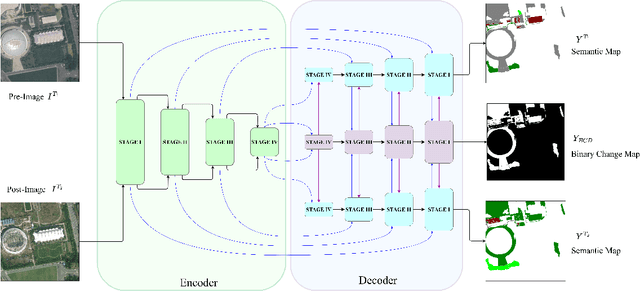
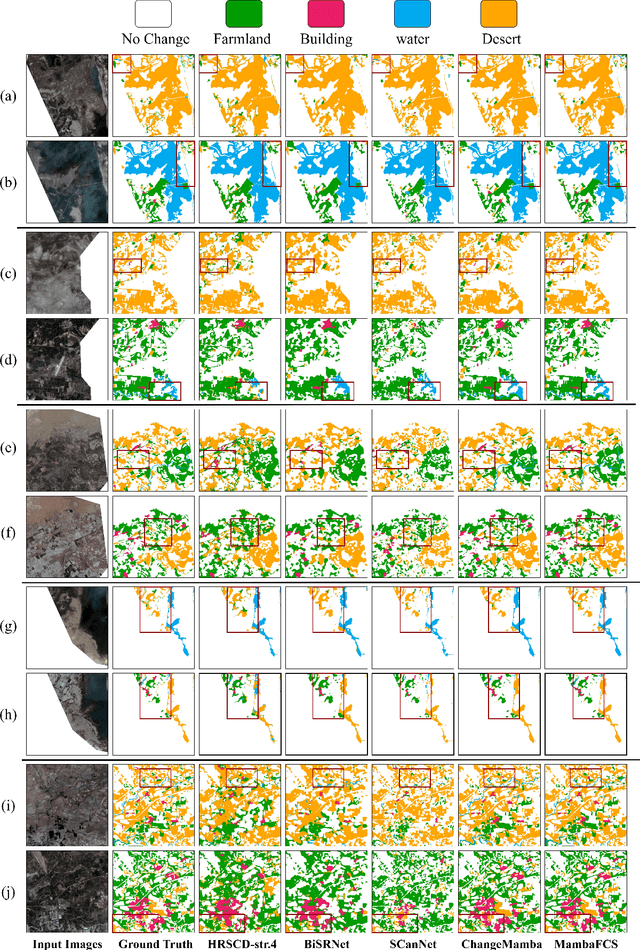
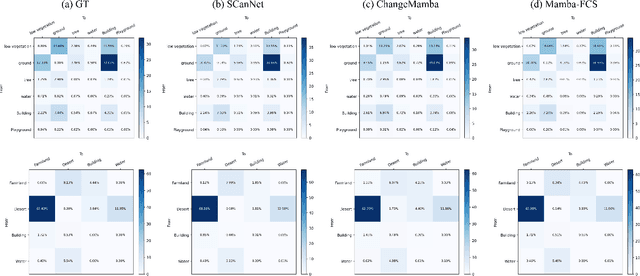
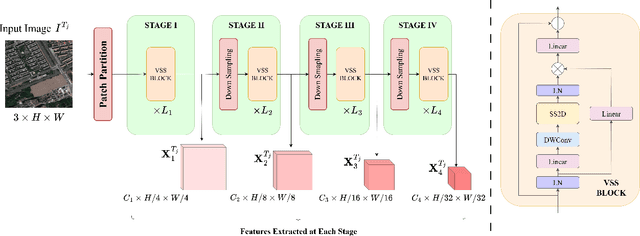
Semantic Change Detection (SCD) from remote sensing imagery requires models balancing extensive spatial context, computational efficiency, and sensitivity to class-imbalanced land-cover transitions. While Convolutional Neural Networks excel at local feature extraction but lack global context, Transformers provide global modeling at high computational costs. Recent Mamba architectures based on state-space models offer compelling solutions through linear complexity and efficient long-range modeling. In this study, we introduce Mamba-FCS, a SCD framework built upon Visual State Space Model backbone incorporating, a Joint Spatio-Frequency Fusion block incorporating log-amplitude frequency domain features to enhance edge clarity and suppress illumination artifacts, a Change-Guided Attention (CGA) module that explicitly links the naturally intertwined BCD and SCD tasks, and a Separated Kappa (SeK) loss tailored for class-imbalanced performance optimization. Extensive evaluation on SECOND and Landsat-SCD datasets shows that Mamba-FCS achieves state-of-the-art metrics, 88.62% Overall Accuracy, 65.78% F_scd, and 25.50% SeK on SECOND, 96.25% Overall Accuracy, 89.27% F_scd, and 60.26% SeK on Landsat-SCD. Ablation analyses confirm distinct contributions of each novel component, with qualitative assessments highlighting significant improvements in SCD. Our results underline the substantial potential of Mamba architectures, enhanced by proposed techniques, setting a new benchmark for effective and scalable semantic change detection in remote sensing applications. The complete source code, configuration files, and pre-trained models will be publicly available upon publication.
Precision Spatio-Temporal Feature Fusion for Robust Remote Sensing Change Detection
Jul 15, 2025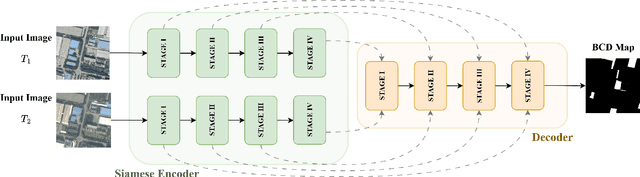
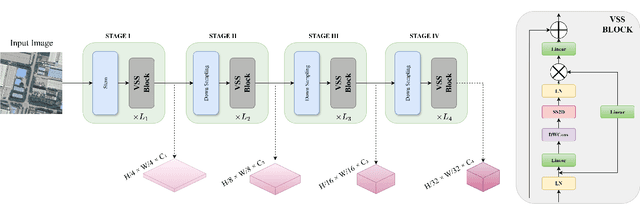
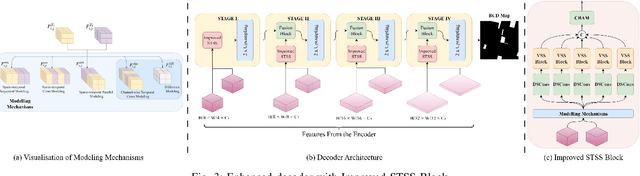
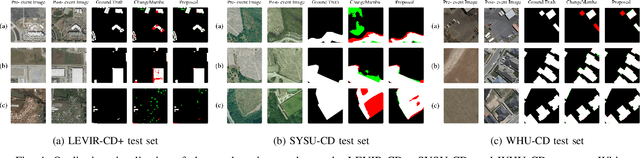
Remote sensing change detection is vital for monitoring environmental and urban transformations but faces challenges like manual feature extraction and sensitivity to noise. Traditional methods and early deep learning models, such as convolutional neural networks (CNNs), struggle to capture long-range dependencies and global context essential for accurate change detection in complex scenes. While Transformer-based models mitigate these issues, their computational complexity limits their applicability in high-resolution remote sensing. Building upon ChangeMamba architecture, which leverages state space models for efficient global context modeling, this paper proposes precision fusion blocks to capture channel-wise temporal variations and per-pixel differences for fine-grained change detection. An enhanced decoder pipeline, incorporating lightweight channel reduction mechanisms, preserves local details with minimal computational cost. Additionally, an optimized loss function combining Cross Entropy, Dice and Lovasz objectives addresses class imbalance and boosts Intersection-over-Union (IoU). Evaluations on SYSU-CD, LEVIR-CD+, and WHU-CD datasets demonstrate superior precision, recall, F1 score, IoU, and overall accuracy compared to state-of-the-art methods, highlighting the approach's robustness for remote sensing change detection. For complete transparency, the codes and pretrained models are accessible at https://github.com/Buddhi19/MambaCD.git