 Add to Chrome
 Add to Firefox
 Add to Edge
Machine Learning on Heterogeneous, Edge, and Quantum Hardware for Particle Physics (ML-HEQUPP)
Feb 24, 2026
The next generation of particle physics experiments will face a new era of challenges in data acquisition, due to unprecedented data rates and volumes along with extreme environments and operational constraints. Harnessing this data for scientific discovery demands real-time inference and decision-making, intelligent data reduction, and efficient processing architectures beyond current capabilities. Crucial to the success of this experimental paradigm are several emerging technologies, such as artificial intelligence and machine learning (AI/ML) and silicon microelectronics, and the advent of quantum algorithms and processing. Their intersection includes areas of research such as low-power and low-latency devices for edge computing, heterogeneous accelerator systems, reconfigurable hardware, novel codesign and synthesis strategies, readout for cryogenic or high-radiation environments, and analog computing. This white paper presents a community-driven vision to identify and prioritize research and development opportunities in hardware-based ML systems and corresponding physics applications, contributing towards a successful transition to the new data frontier of fundamental science.

Reducing Simulation Dependence in Neutrino Telescopes with Masked Point Transformers
Oct 02, 2025Machine learning techniques in neutrino physics have traditionally relied on simulated data, which provides access to ground-truth labels. However, the accuracy of these simulations and the discrepancies between simulated and real data remain significant concerns, particularly for large-scale neutrino telescopes that operate in complex natural media. In recent years, self-supervised learning has emerged as a powerful paradigm for reducing dependence on labeled datasets. Here, we present the first self-supervised training pipeline for neutrino telescopes, leveraging point cloud transformers and masked autoencoders. By shifting the majority of training to real data, this approach minimizes reliance on simulations, thereby mitigating associated systematic uncertainties. This represents a fundamental departure from previous machine learning applications in neutrino telescopes, paving the way for substantial improvements in event reconstruction and classification.
Learning Efficient Representations of Neutrino Telescope Events
Oct 17, 2024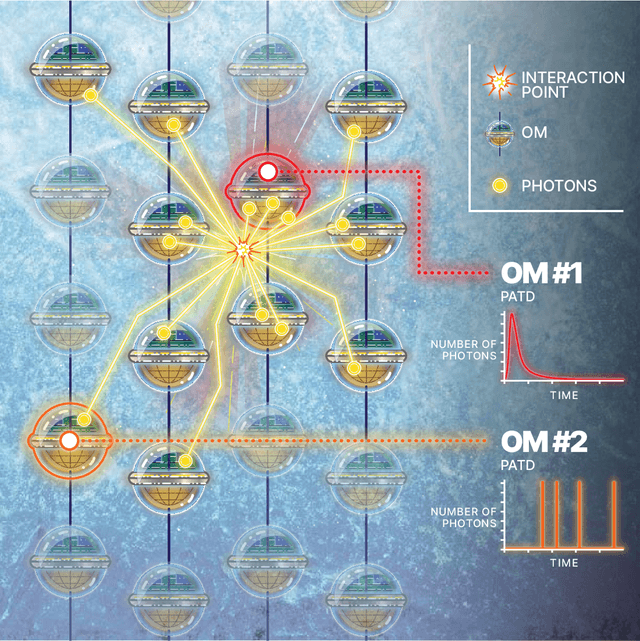
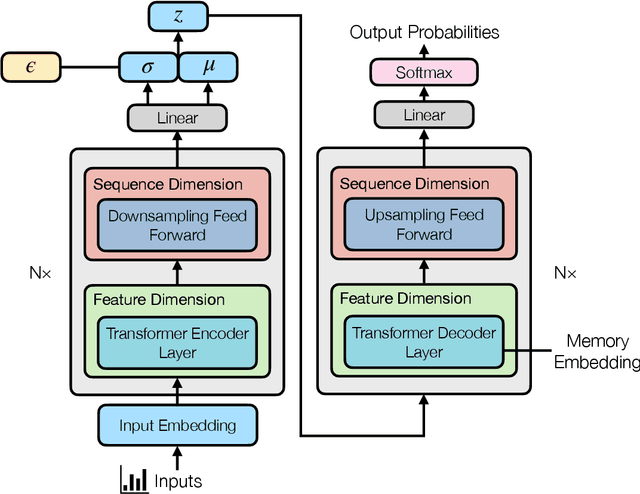
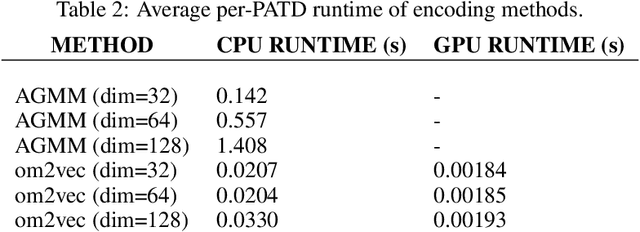
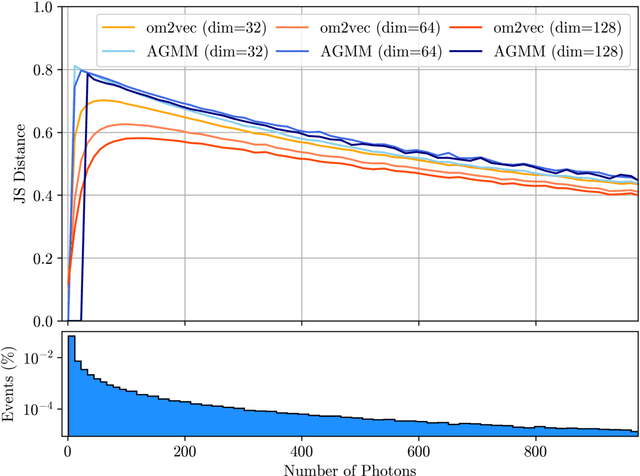
Neutrino telescopes detect rare interactions of particles produced in some of the most extreme environments in the Universe. This is accomplished by instrumenting a cubic-kilometer volume of naturally occurring transparent medium with light sensors. Given their substantial size and the high frequency of background interactions, these telescopes amass an enormous quantity of large variance, high-dimensional data. These attributes create substantial challenges for analyzing and reconstructing interactions, particularly when utilizing machine learning (ML) techniques. In this paper, we present a novel approach, called om2vec, that employs transformer-based variational autoencoders to efficiently represent neutrino telescope events by learning compact and descriptive latent representations. We demonstrate that these latent representations offer enhanced flexibility and improved computational efficiency, thereby facilitating downstream tasks in data analysis.
Enhancing Events in Neutrino Telescopes through Deep Learning-Driven Super-Resolution
Aug 16, 2024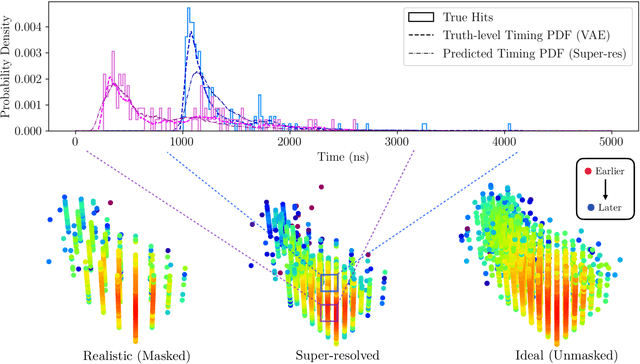
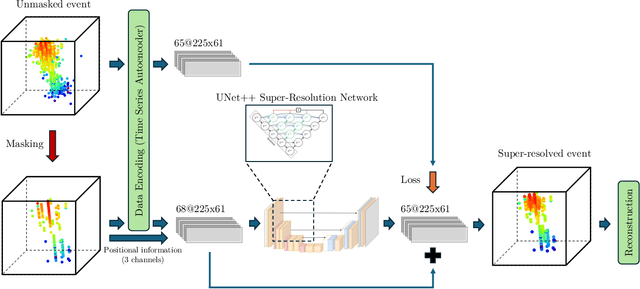
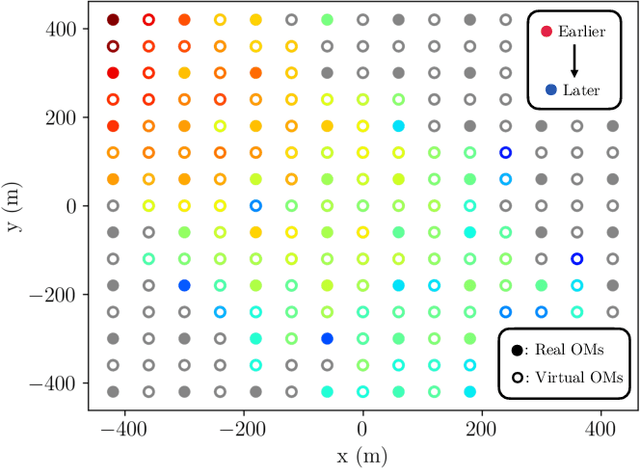
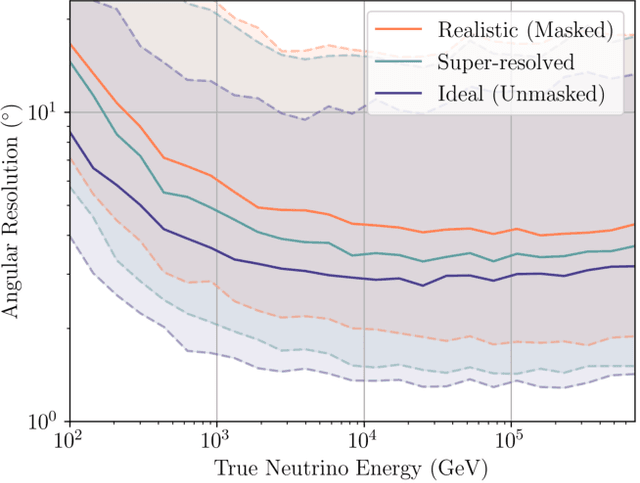
Recent discoveries by neutrino telescopes, such as the IceCube Neutrino Observatory, relied extensively on machine learning (ML) tools to infer physical quantities from the raw photon hits detected. Neutrino telescope reconstruction algorithms are limited by the sparse sampling of photons by the optical modules due to the relatively large spacing ($10-100\,{\rm m})$ between them. In this letter, we propose a novel technique that learns photon transport through the detector medium through the use of deep learning-driven super-resolution of data events. These ``improved'' events can then be reconstructed using traditional or ML techniques, resulting in improved resolution. Our strategy arranges additional ``virtual'' optical modules within an existing detector geometry and trains a convolutional neural network to predict the hits on these virtual optical modules. We show that this technique improves the angular reconstruction of muons in a generic ice-based neutrino telescope. Our results readily extend to water-based neutrino telescopes and other event morphologies.