 Add to Chrome
 Add to Firefox
 Add to Edge
Tracing the Chain: Deep Learning for Stepping-Stone Intrusion Detection
Apr 09, 2026
Stepping-stone intrusions (SSIs) are a prevalent network evasion technique in which attackers route sessions through chains of compromised intermediate hosts to obscure their origin. Effective SSI detection requires correlating the incoming and outgoing flows at each relay host at extremely low false positive rates -- a stringent requirement that renders classical statistical methods inadequate in operational settings. We apply ESPRESSO, a deep learning flow correlation model combining a transformer-based feature extraction network, time-aligned multi-channel interval features, and online triplet metric learning, to the problem of stepping-stone intrusion detection. To support training and evaluation, we develop a synthetic data collection tool that generates realistic stepping-stone traffic across five tunneling protocols: SSH, SOCAT, ICMP, DNS, and mixed multi-protocol chains. Across all five protocols and in both host-mode and network-mode detection scenarios, ESPRESSO substantially outperforms the state-of-the-art DeepCoFFEA baseline, achieving a true positive rate exceeding 0.99 at a false positive rate of $10^{-3}$ for standard bursty protocols in network-mode. We further demonstrate chain length prediction as a tool for distinguishing malicious from benign pivoting, and conduct a systematic robustness analysis revealing that timing-based perturbations are the primary vulnerability of correlation-based stepping-stone detectors.

p-FP: Extraction, Classification, and Prediction of Website Fingerprints with Deep Learning
Apr 02, 2018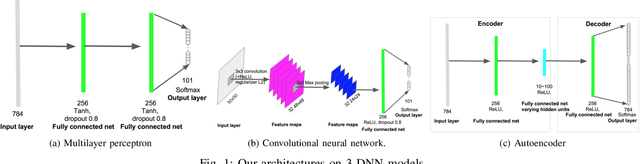
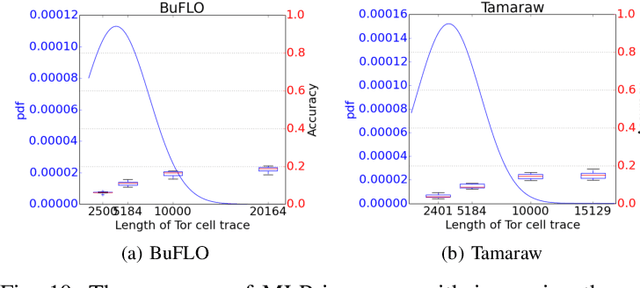
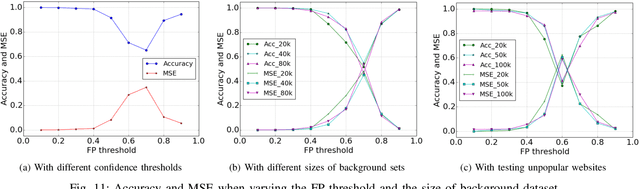
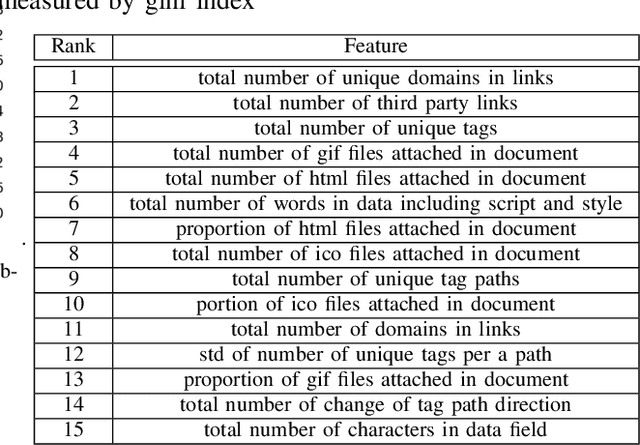
Recent advances in learning Deep Neural Network (DNN) architectures have received a great deal of attention due to their ability to outperform state-of-the-art classifiers across a wide range of applications, with little or no feature engineering. In this paper, we broadly study the applicability of deep learning to website fingerprinting. We show that unsupervised DNNs can be used to extract low-dimensional feature vectors that improve the performance of state-of-the-art website fingerprinting attacks. When used as classifiers, we show that they can match or exceed performance of existing attacks across a range of application scenarios, including fingerprinting Tor website traces, fingerprinting search engine queries over Tor, defeating fingerprinting defenses, and fingerprinting TLS-encrypted websites. Finally, we show that DNNs can be used to predict the fingerprintability of a website based on its contents, achieving 99% accuracy on a data set of 4500 website downloads.