 Add to Chrome
 Add to Firefox
 Add to Edge
Interaction-Centered Intelligence: Toward Interaction as the Primary Unit of Analysis in Co-Creative AI and Human-AI Systems
May 30, 2026
Traditional artificial intelligence has largely conceptualized intelligence as isolated computation occurring within bounded agents. Across classical AI, machine learning, and many generative systems, the dominant unit of analysis remains the individual model or autonomous system evaluated through outputs, benchmarks, prediction accuracy, or optimization performance. While these approaches have produced major advances, they often under-theorize the role of interaction in the emergence of intelligence, creativity, meaning, and adaptive behavior. This paper proposes interaction as the primary unit of analysis for co-creative AI and interaction-centered intelligence more broadly. Drawing from distributed cognition, embodied cognition, enaction, participatory sense-making, human-computer interaction, and computational creativity, the paper traces a historical progression toward increasingly relational accounts of intelligence. Building upon prior work in Creative Sense-Making, quantified co-creation, and co-creative systems such as the Drawing Apprentice and AI Drawing Partner, it argues that intelligence emerges through evolving interaction dynamics among agents, environments, and socio-technical systems rather than solely through internal computation. The paper introduces Interaction-Centered Intelligence as a framework for understanding human-AI co-creation, collaborative emergence, adaptive participation, and interactional dynamics. Rather than evaluating intelligence solely through generated outputs, the framework emphasizes interaction trajectories, coordination patterns, participatory engagement, adaptive regulation, and interactional drift unfolding through time. Implications for explainable co-creative AI, hybrid intelligence, enactive AI, and future human-AI systems are discussed.

Deep Learning in a Computational Model for Conceptual Shifts in a Co-Creative Design System
Jun 24, 2019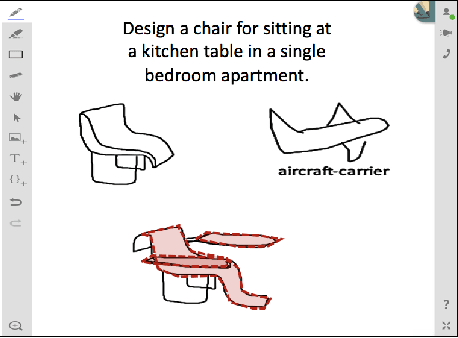
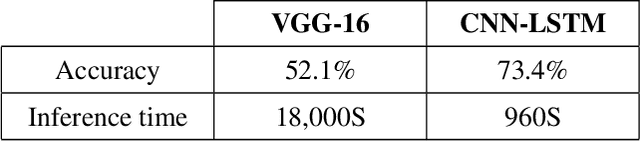
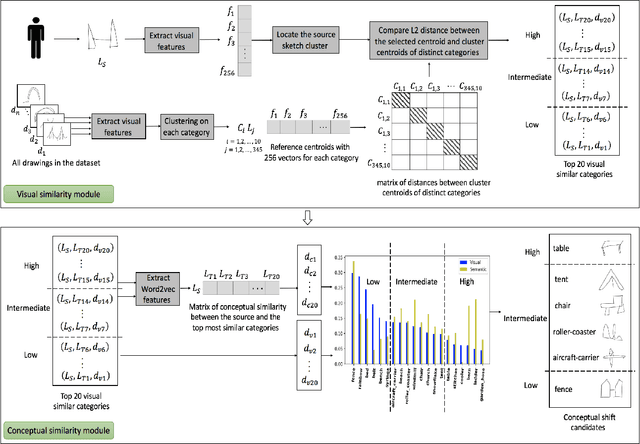
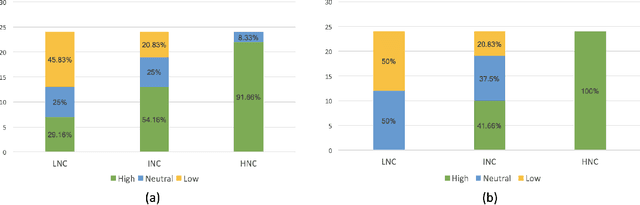
This paper presents a computational model for conceptual shifts, based on a novelty metric applied to a vector representation generated through deep learning. This model is integrated into a co-creative design system, which enables a partnership between an AI agent and a human designer interacting through a sketching canvas. The AI agent responds to the human designer's sketch with a new sketch that is a conceptual shift: intentionally varying the visual and conceptual similarity with increasingly more novelty. The paper presents the results of a user study showing that increasing novelty in the AI contribution is associated with higher creative outcomes, whereas low novelty leads to less creative outcomes.
Evaluating Creativity in Computational Co-Creative Systems
Jul 25, 2018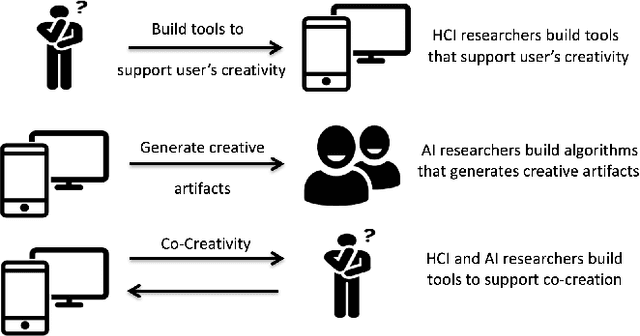
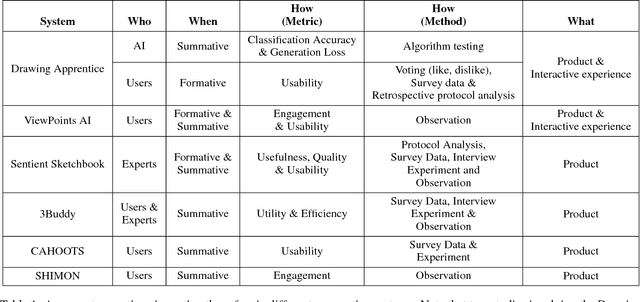
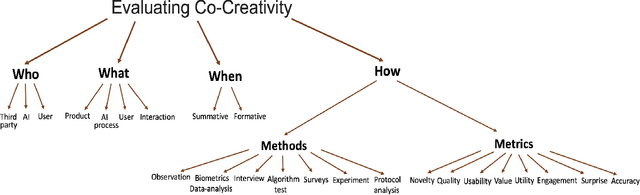
This paper provides a framework for evaluating creativity in co-creative systems: those that involve computer programs collaborating with human users on creative tasks. We situate co-creative systems within a broader context of computational creativity and explain the unique qualities of these systems. We present four main questions that can guide evaluation in co-creative systems: Who is evaluating the creativity, what is being evaluated, when does evaluation occur and how the evaluation is performed. These questions provide a framework for comparing how existing co-creative systems evaluate creativity, and we apply them to examples of co-creative systems in art, humor, games and robotics. We conclude that existing co-creative systems tend to focus on evaluating the user experience. Adopting evaluation methods from autonomous creative systems may lead to co-creative systems that are self-aware and intentional.
Deep Learning for Identifying Potential Conceptual Shifts for Co-creative Drawing
Jan 02, 2018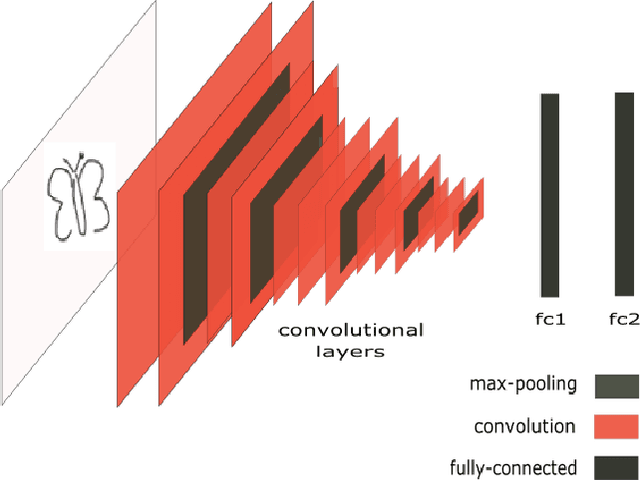
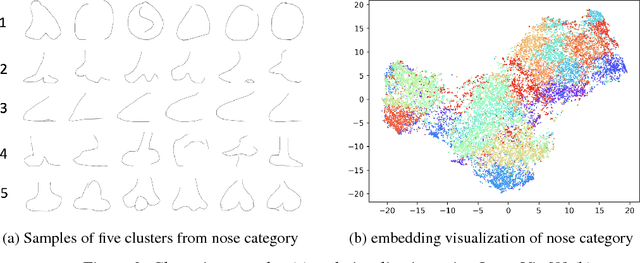
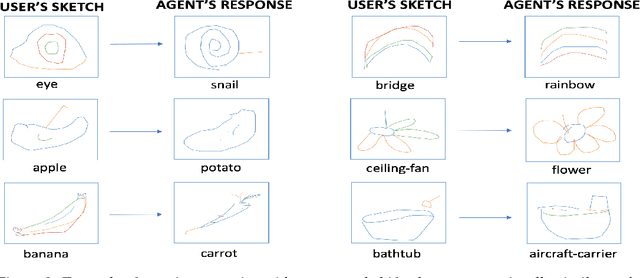
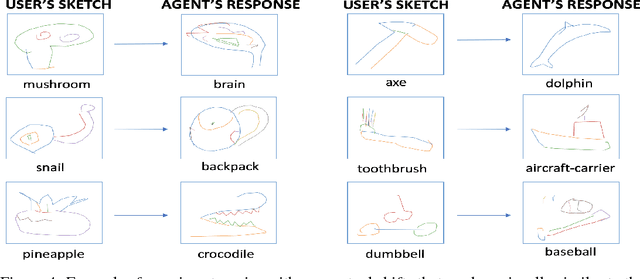
We present a system for identifying conceptual shifts between visual categories, which will form the basis for a co-creative drawing system to help users draw more creative sketches. The system recognizes human sketches and matches them to structurally similar sketches from categories to which they do not belong. This would allow a co-creative drawing system to produce an ambiguous sketch that blends features from both categories.