 Add to Chrome
 Add to Firefox
 Add to Edge
Vehicle Routing Problems via Quantum Graph Attention Network Deep Reinforcement Learning
Nov 19, 2025
The vehicle routing problem (VRP) is a fundamental NP-hard task in intelligent transportation systems with broad applications in logistics and distribution. Deep reinforcement learning (DRL) with Graph Neural Networks (GNNs) has shown promise, yet classical models rely on large multi-layer perceptrons (MLPs) that are parameter-heavy and memory-bound. We propose a Quantum Graph Attention Network (Q-GAT) within a DRL framework, where parameterized quantum circuits (PQCs) replace conventional MLPs at critical readout stages. The hybrid model maintains the expressive capacity of graph attention encoders while reducing trainable parameters by more than 50%. Using proximal policy optimization (PPO) with greedy and stochastic decoding, experiments on VRP benchmarks show that Q-GAT achieves faster convergence and reduces routing cost by about 5% compared with classical GAT baselines. These results demonstrate the potential of PQC-enhanced GNNs as compact and effective solvers for large-scale routing and logistics optimization.

Quantum Annealing-Based Sum Rate Maximization for Multi-UAV-Aided Wireless Networks
Feb 25, 2025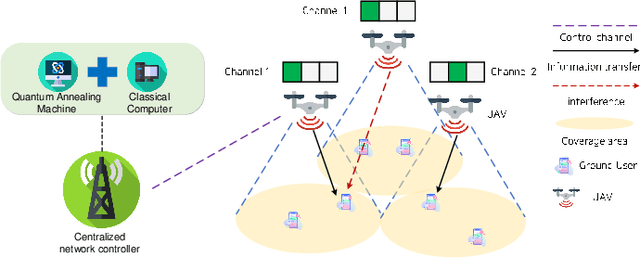
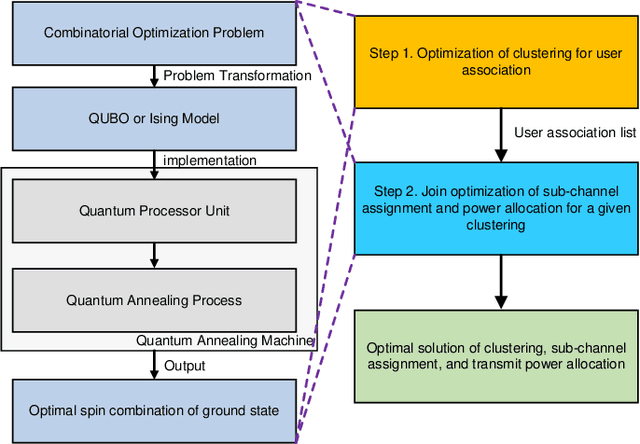
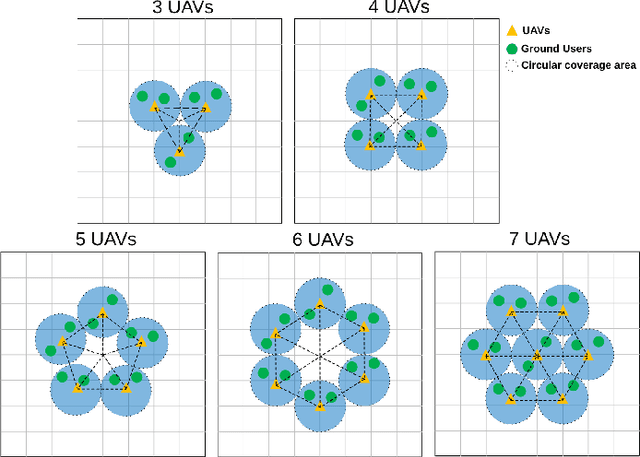
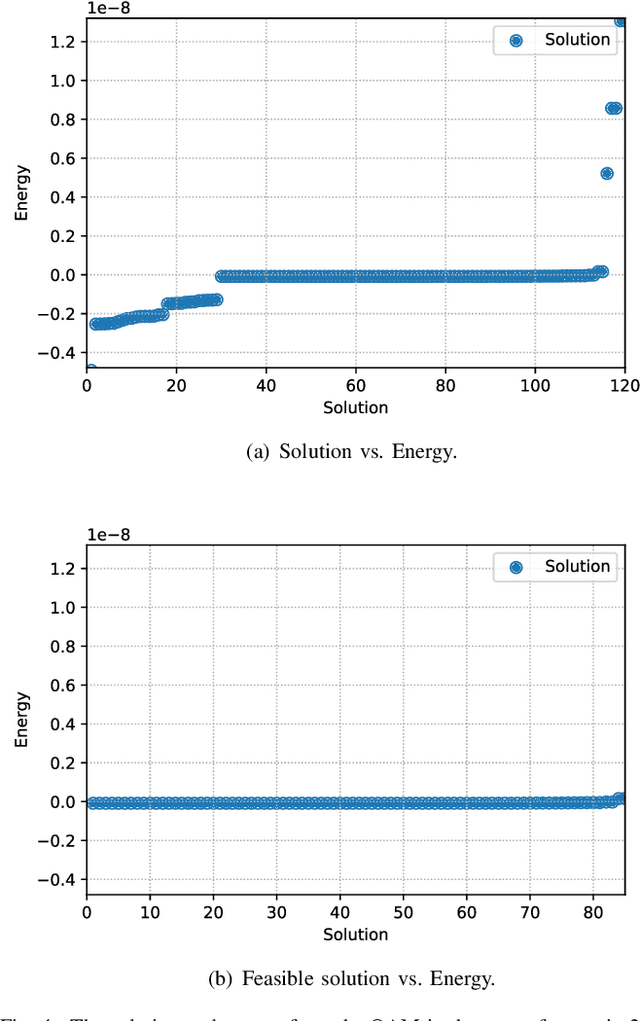
In wireless communication networks, it is difficult to solve many NP-hard problems owing to computational complexity and high cost. Recently, quantum annealing (QA) based on quantum physics was introduced as a key enabler for solving optimization problems quickly. However, only some studies consider quantum-based approaches in wireless communications. Therefore, we investigate the performance of a QA solution to an optimization problem in wireless networks. Specifically, we aim to maximize the sum rate by jointly optimizing clustering, sub-channel assignment, and power allocation in a multi-unmanned aerial vehicle-aided wireless network. We formulate the sum rate maximization problem as a combinatorial optimization problem. Then, we divide it into two sub-problems: 1) a QA-based clustering and 2) sub-channel assignment and power allocation for a given clustering configuration. Subsequently, we obtain an optimized solution for the joint optimization problem by solving these two sub-problems. For the first sub-problem, we convert the problem into a simplified quadratic unconstrained binary optimization (QUBO) model. As for the second sub-problem, we introduce a novel QA algorithm with optimal scaling parameters to address it. Simulation results demonstrate the effectiveness of the proposed algorithm in terms of the sum rate and running time.