 Add to Chrome
 Add to Firefox
 Add to Edge
From Prompts to Context: An Ontology-Driven Framework for Human-Generative AI Collaboration
May 28, 2026
Collaborations with Generative AI often begin with a short prompt and end with an opaque output, leaving implicit who was involved, what task was being pursued, which resources were used, and which constraints should have shaped the process. This limited contextual explicitness hinders trust, traceability, and accountability, particularly when Generative AI is embedded in information-intensive workflows such as search, querying, and profile management. This paper introduces From Prompts to Context, an ontology-driven framework for representing Human-Generative AI collaboration. Its core component, the Contextual Collaboration AI Ontology (CCAI), models key elements of collaboration - including tasks, agent roles, resources, and constraints - as a shared machine-interpretable vocabulary. By combining populated CCAI instances with SPARQL-based context retrieval in operational workflows, the framework turns otherwise ephemeral prompt-response interactions into structured and queryable collaboration traces linking prompts, outputs, and their surrounding context. The approach is illustrated through a case study involving a software development team building a competency-based education feature for viewing and updating learner competency profiles. The case study shows how the framework can support the representation and documentation of collaboration episodes across requirements analysis, design, implementation, and testing. Within this setting, the results indicate that explicit collaboration modelling helps make task context more explicit, improves the traceability of AI-generated contributions, and supports more transparent and accountable Human-Generative AI practices. We conclude by outlining design principles for future Human-Generative AI systems that emphasise not only output quality, but also the explicit representation of the collaborative context in which outputs are produced.

From Learning Resources to Competencies: LLM-Based Tagging with Evidence and Graph Constraints
May 27, 2026Linking learning resources to a structured competency framework is key to enabling competency-based search and curriculum analytics in Learning Management Systems (LMS). However, manual tagging is labor-intensive, and fully automatic methods often lack transparency. In this paper, we present an end-to-end alignment pipeline that uses a large language model (LLM) as a constrained, evidence-producing tagger. LMS resources -both instructional content and assessments -are first segmented into meaningful pedagogical fragments. For each fragment, a small set of candidate competencies is retrieved from structured competency profiles enriched with graph-based context. The LLM then selects the most relevant competencies from this set and provides supporting evidence spans from the fragment text. These predictions are refined using the structure of the competency graph and aggregated at the resource level. We evaluate our approach on a dataset built from the Computer Science department's competency referential at the Université de Technologie de Compiègne (UTC), covering 22 competencies across multiple course materials. Our LLM+BM25+Graph (LBG) pipeline achieves strong results, with a micro-F1 of 0.57 and macro-F1 of 0.50 at the fragment level, 0.51 macro-F1 at the resource level, and an MRR of 0.82outperforming zero-shot and few-shot LLM variants, retrieval/similarity baselines, and supervised classifiers -while also producing more mechanically traceable evidence spans to support human auditing and educational analysis.
When Can We Trust Early Warnings? Leakage-Excluded Early Outcome Prediction from LMS Interaction Logs
May 25, 2026Early-warning models built from Learning Management System (LMS) logs aim to predict end-of-course outcomes early enough to enable timely learner support. However, reported "early" performance is often inflated by temporal leakage. This occurs when the pipeline uses information that would not yet be available at the time of prediction. We formalize cutoff-based early outcome prediction under a temporal availability constraint and introduce LEAP (Leakage-Excluded Early-Availability Protocol), which enforces cutoff-first truncation prior to joins and aggregation and audits feature provenance to prevent post-cutoff evidence from entering the benchmark. We instantiate LEAP on the public Open University Learning Analytics Dataset (OULAD) as a multi-step protocol for leakage-controlled evaluation across weekly cutoffs. Using several standard learning methods, we evaluate performance using ROC-AUC, PR-AUC, Brier score, and F1@0.5. Results show improving performance as the observation window expands, with a marked gain around week~3; Random Forest performs best at the earliest cutoffs, while Gradient Boosting dominates thereafter. Leakage ablations further show that temporal violations, especially through assessment information, can inflate apparent "early" performance.
From Individual to Group: Developing a Context-Aware Multi-Criteria Group Recommender System
Mar 27, 2025Group decision-making is becoming increasingly common in areas such as education, dining, travel, and finance, where collaborative choices must balance diverse individual preferences. While conventional recommender systems are effective in personalization, they fall short in group settings due to their inability to manage conflicting preferences, contextual factors, and multiple evaluation criteria. This study presents the development of a Context-Aware Multi-Criteria Group Recommender System (CA-MCGRS) designed to address these challenges by integrating contextual factors and multiple criteria to enhance recommendation accuracy. By leveraging a Multi-Head Attention mechanism, our model dynamically weighs the importance of different features. Experiments conducted on an educational dataset with varied ratings and contextual variables demonstrate that CA-MCGRS consistently outperforms other approaches across four scenarios. Our findings underscore the importance of incorporating context and multi-criteria evaluations to improve group recommendations, offering valuable insights for developing more effective group recommender systems.
Extraction multi-étiquettes de relations en utilisant des couches de Transformer
Feb 21, 2025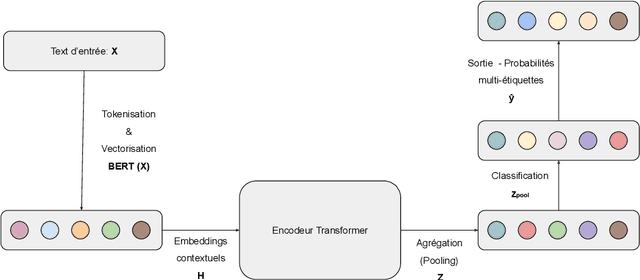
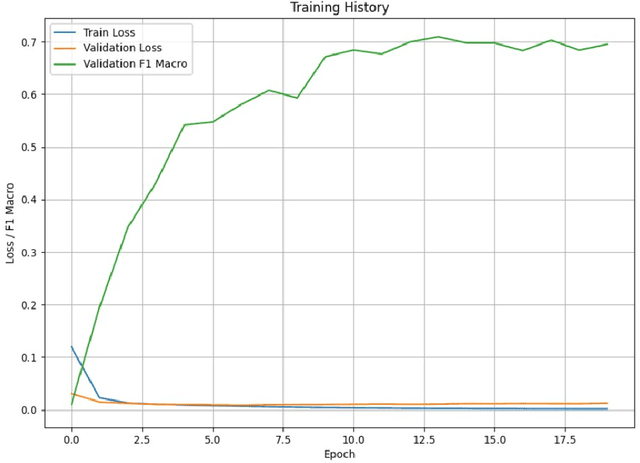
In this article, we present the BTransformer18 model, a deep learning architecture designed for multi-label relation extraction in French texts. Our approach combines the contextual representation capabilities of pre-trained language models from the BERT family - such as BERT, RoBERTa, and their French counterparts CamemBERT and FlauBERT - with the power of Transformer encoders to capture long-term dependencies between tokens. Experiments conducted on the dataset from the TextMine'25 challenge show that our model achieves superior performance, particularly when using CamemBERT-Large, with a macro F1 score of 0.654, surpassing the results obtained with FlauBERT-Large. These results demonstrate the effectiveness of our approach for the automatic extraction of complex relations in intelligence reports.
Exploring Weighted Property Approaches for RDF Graph Similarity Measure
Apr 29, 2024Measuring similarity between RDF graphs is essential for various applications, including knowledge discovery, semantic web analysis, and recommender systems. However, traditional similarity measures often treat all properties equally, potentially overlooking the varying importance of different properties in different contexts. Consequently, exploring weighted property approaches for RDF graph similarity measure presents an intriguing avenue for investigation. Therefore, in this paper, we propose a weighted property approach for RDF graph similarity measure to address this limitation. Our approach incorporates the relative importance of properties into the similarity calculation, enabling a more nuanced and context-aware measures of similarity. We evaluate our approach through a comprehensive experimental study on an RDF graph dataset in the vehicle domain. Our results demonstrate that the proposed approach achieves promising accuracy and effectively reflects the perceived similarity between RDF graphs.
Combining Embedding-Based and Semantic-Based Models for Post-hoc Explanations in Recommender Systems
Jan 09, 2024In today's data-rich environment, recommender systems play a crucial role in decision support systems. They provide to users personalized recommendations and explanations about these recommendations. Embedding-based models, despite their widespread use, often suffer from a lack of interpretability, which can undermine trust and user engagement. This paper presents an approach that combines embedding-based and semantic-based models to generate post-hoc explanations in recommender systems, leveraging ontology-based knowledge graphs to improve interpretability and explainability. By organizing data within a structured framework, ontologies enable the modeling of intricate relationships between entities, which is essential for generating explanations. By combining embedding-based and semantic based models for post-hoc explanations in recommender systems, the framework we defined aims at producing meaningful and easy-to-understand explanations, enhancing user trust and satisfaction, and potentially promoting the adoption of recommender systems across the e-commerce sector.
Recognizing Similar Crises through the Application of Ontology-based Knowledge Mining
Jan 08, 2024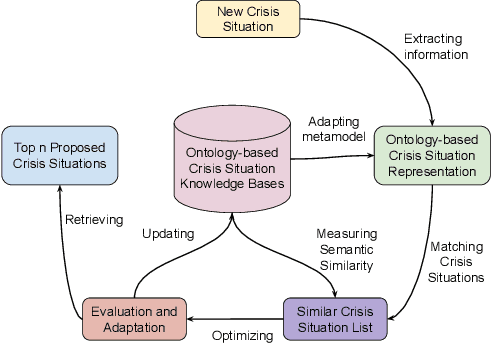
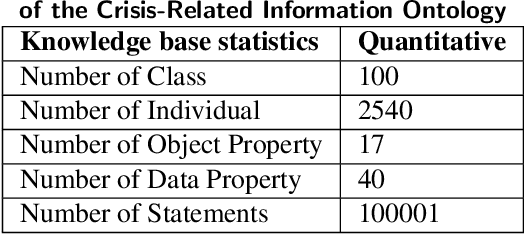
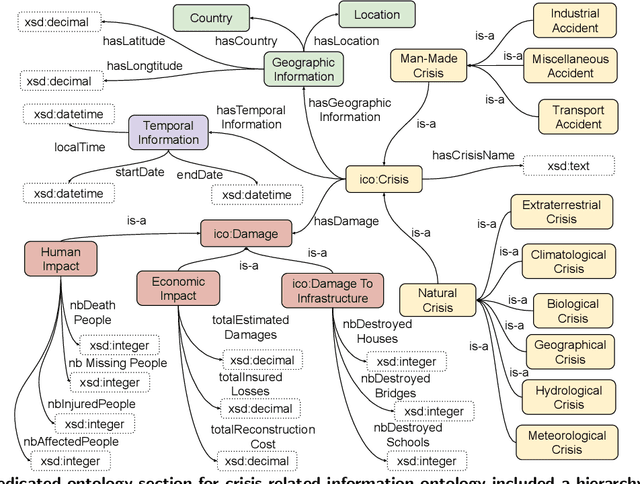
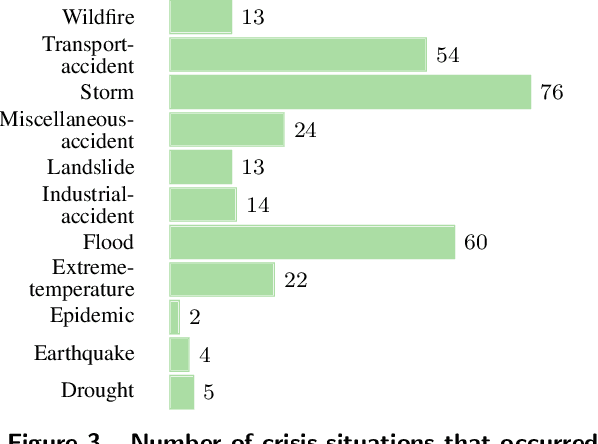
Recognizing and learning from similar crisis situations is crucial for the development of effective response strategies. This study addresses the challenge of identifying similarities within a wide range of crisis-related information. To overcome this challenge, we employed an ontology-based crisis situation knowledge base enriched with crisis-related information. Additionally, we implemented a semantic similarity measure to assess the degree of similarity between crisis situations. Our investigation specifically focuses on recognizing similar crises through the application of ontology-based knowledge mining. Through our experiments, we demonstrate the accuracy and efficiency of our approach to recognizing similar crises. These findings highlight the potential of ontology-based knowledge mining for enhancing crisis recognition processes and improving overall crisis management strategies.
CORec-Cri: How collaborative and social technologies can help to contextualize crises?
Oct 03, 2023Crisis situations can present complex and multifaceted challenges, often requiring the involvement of multiple organizations and stakeholders with varying areas of expertise, responsibilities, and resources. Acquiring accurate and timely information about impacted areas is crucial to effectively respond to these crises. In this paper, we investigate how collaborative and social technologies help to contextualize crises, including identifying impacted areas and real-time needs. To this end, we define CORec-Cri (Contextulized Ontology-based Recommender system for crisis management) based on existing work. Our motivation for this approach is two-fold: first, effective collaboration among stakeholders is essential for efficient and coordinated crisis response; second, social computing facilitates interaction, information flow, and collaboration among stakeholders. We detail the key components of our system design, highlighting its potential to support decision-making, resource allocation, and communication among stakeholders. Finally, we provide examples of how our system can be applied to contextualize crises to improve crisis management.
Designing a User Contextual Profile Ontology: A Focus on the Vehicle Sales Domain
Aug 11, 2023In the digital age, it is crucial to understand and tailor experiences for users interacting with systems and applications. This requires the creation of user contextual profiles that combine user profiles with contextual information. However, there is a lack of research on the integration of contextual information with different user profiles. This study aims to address this gap by designing a user contextual profile ontology that considers both user profiles and contextual information on each profile. Specifically, we present a design and development of the user contextual profile ontology with a focus on the vehicle sales domain. Our designed ontology serves as a structural foundation for standardizing the representation of user profiles and contextual information, enhancing the system's ability to capture user preferences and contextual information of the user accurately. Moreover, we illustrate a case study using the User Contextual Profile Ontology in generating personalized recommendations for vehicle sales domain.