 Add to Chrome
 Add to Firefox
 Add to Edge
Monolingual versus Multilingual BERTology for Vietnamese Extractive Multi-Document Summarization
Aug 31, 2021
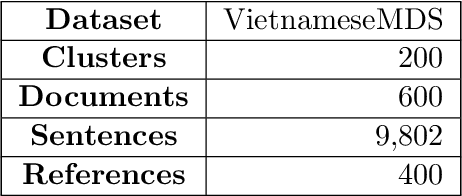
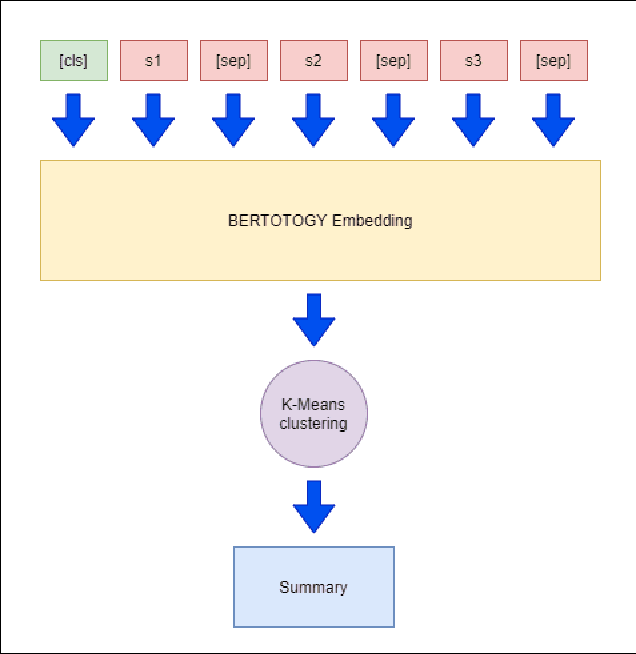
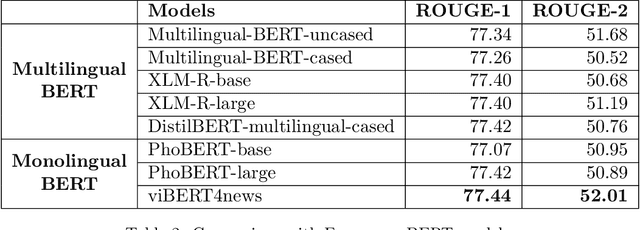
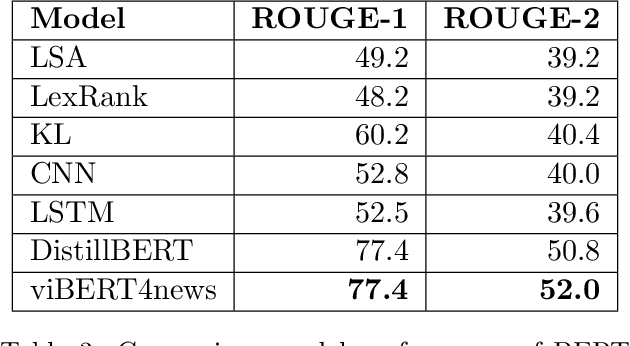
Recent researches have demonstrated that BERT shows potential in a wide range of natural language processing tasks. It is adopted as an encoder for many state-of-the-art automatic summarizing systems, which achieve excellent performance. However, so far, there is not much work done for Vietnamese. In this paper, we showcase how BERT can be implemented for extractive text summarization in Vietnamese. We introduce a novel comparison between different multilingual and monolingual BERT models. The experiment results indicate that monolingual models produce promising results compared to other multilingual models and previous text summarizing models for Vietnamese.

Sentence Extraction-Based Machine Reading Comprehension for Vietnamese
Jun 11, 2021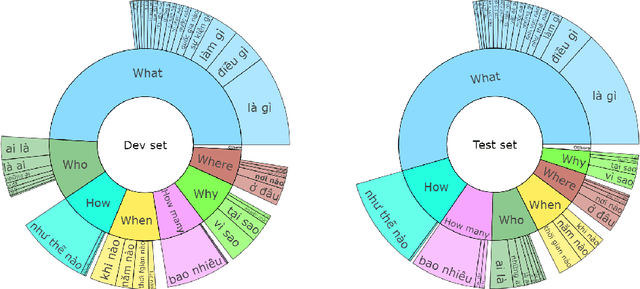
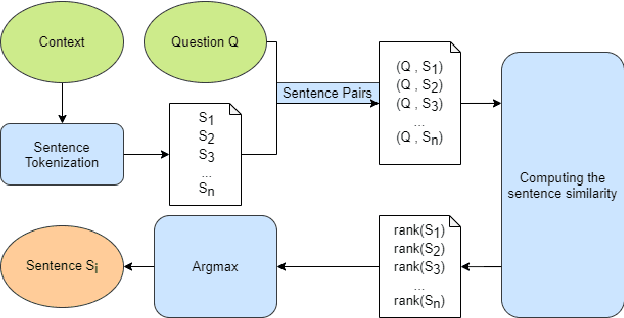
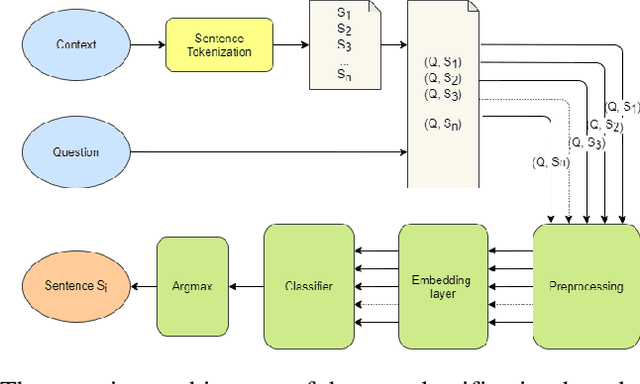
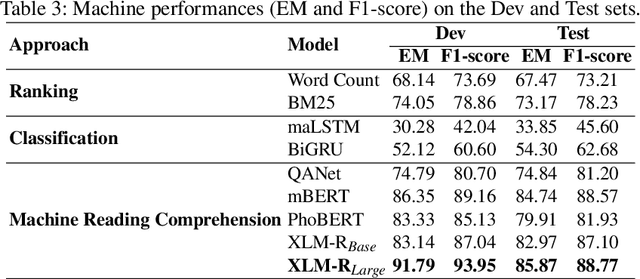
The development of natural language processing (NLP) in general and machine reading comprehension in particular has attracted the great attention of the research community. In recent years, there are a few datasets for machine reading comprehension tasks in Vietnamese with large sizes, such as UIT-ViQuAD and UIT-ViNewsQA. However, the datasets are not diverse in answers to serve the research. In this paper, we introduce UIT-ViWikiQA, the first dataset for evaluating sentence extraction-based machine reading comprehension in the Vietnamese language. The UIT-ViWikiQA dataset is converted from the UIT-ViQuAD dataset, consisting of comprises 23.074 question-answers based on 5.109 passages of 174 Wikipedia Vietnamese articles. We propose a conversion algorithm to create the dataset for sentence extraction-based machine reading comprehension and three types of approaches for sentence extraction-based machine reading comprehension in Vietnamese. Our experiments show that the best machine model is XLM-R_Large, which achieves an exact match (EM) of 85.97% and an F1-score of 88.77% on our dataset. Besides, we analyze experimental results in terms of the question type in Vietnamese and the effect of context on the performance of the MRC models, thereby showing the challenges from the UIT-ViWikiQA dataset that we propose to the language processing community.
Conversational Machine Reading Comprehension for Vietnamese Healthcare Texts
May 21, 2021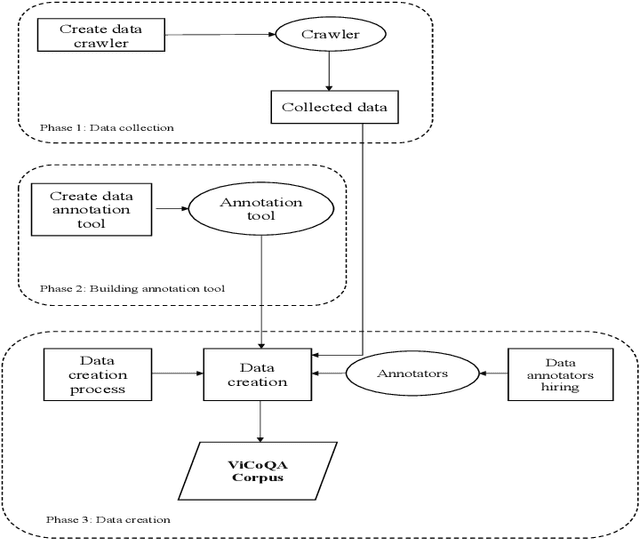
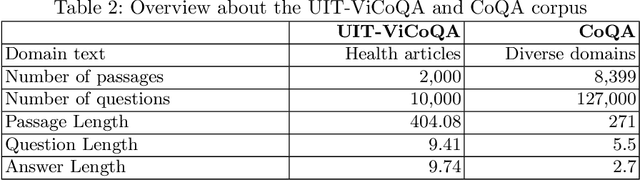
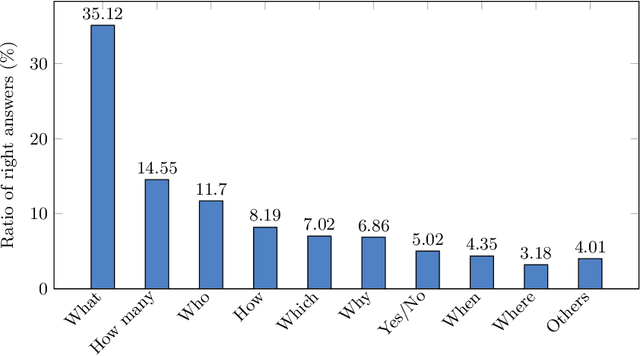
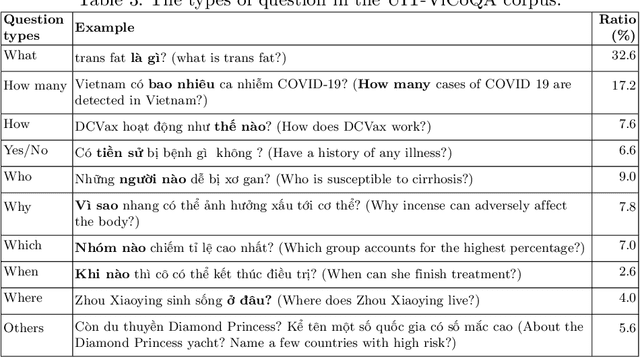
Machine reading comprehension (MRC) is a sub-field in natural language processing that aims to help computers understand unstructured texts and then answer questions related to them. In practice, conversation is an essential way to communicate and transfer information. To help machines understand conversation texts, we present UIT-ViCoQA - a new corpus for conversational machine reading comprehension in the Vietnamese language. This corpus consists of 10,000 questions with answers to over 2,000 conversations about health news articles. Then, we evaluate several baseline approaches for conversational machine comprehension on the UIT-ViCoQA corpus. The best model obtains an F1 score of 45.27%, which is 30.91 points behind human performance (76.18%), indicating that there is ample room for improvement.
UIT-ISE-NLP at SemEval-2021 Task 5: Toxic Spans Detection with BiLSTM-CRF and Toxic Bert Comment Classification
May 15, 2021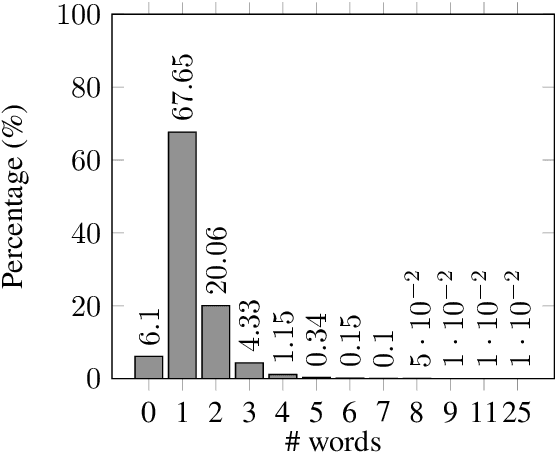
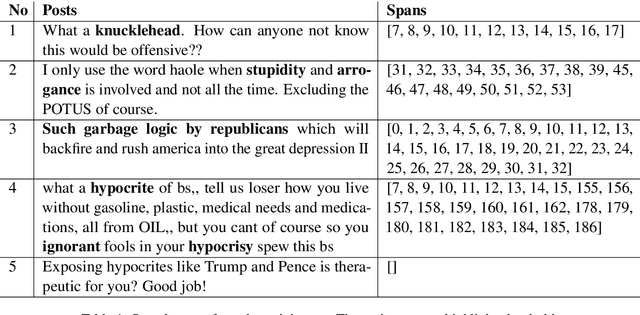
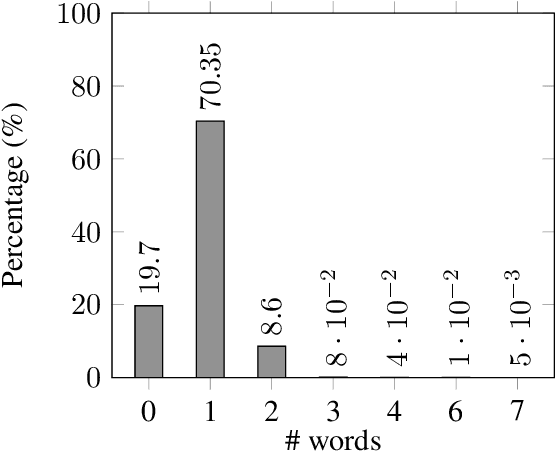
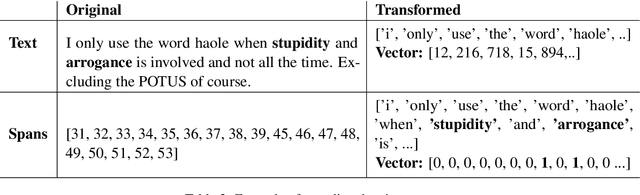
We present our works on SemEval-2021 Task 5 about Toxic Spans Detection. This task aims to build a model for identifying toxic words in whole posts. We use the BiLSTM-CRF model combining with Toxic Bert Classification to train the detection model for identifying toxic words in posts. Our model achieves 62.23% by F1-score on the Toxic Spans Detection task.
Vietnamese Open-domain Complaint Detection in E-Commerce Websites
May 10, 2021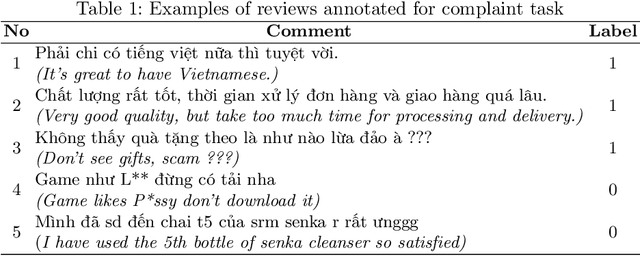
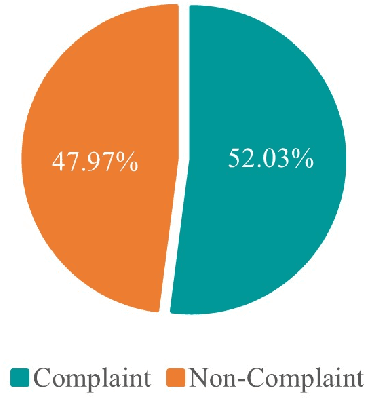
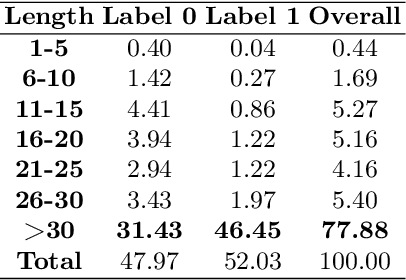
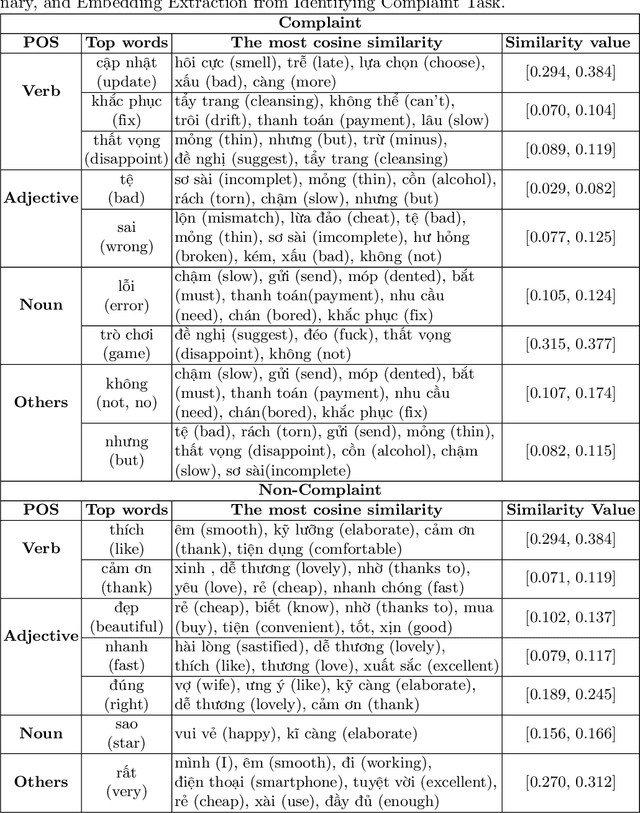
Customer product reviews play a role in improving the quality of products and services for business organizations or their brands. Complaining is an attitude that expresses dissatisfaction with an event or a product not meeting customer expectations. In this paper, we build a Open-domain Complaint Detection dataset (UIT-ViOCD), including 5,485 human-annotated reviews on four categories about product reviews on e-commerce sites. After the data collection phase, we proceed to the annotation task and achieve the inter-annotator agreement Am of 87%. Then, we present an extensive methodology for the research purposes and achieve 92.16% by F1-score for identifying complaints. With the results, in the future, we aim to build a system for open-domain complaint detection in E-commerce websites.
A Large-scale Dataset for Hate Speech Detection on Vietnamese Social Media Texts
Apr 05, 2021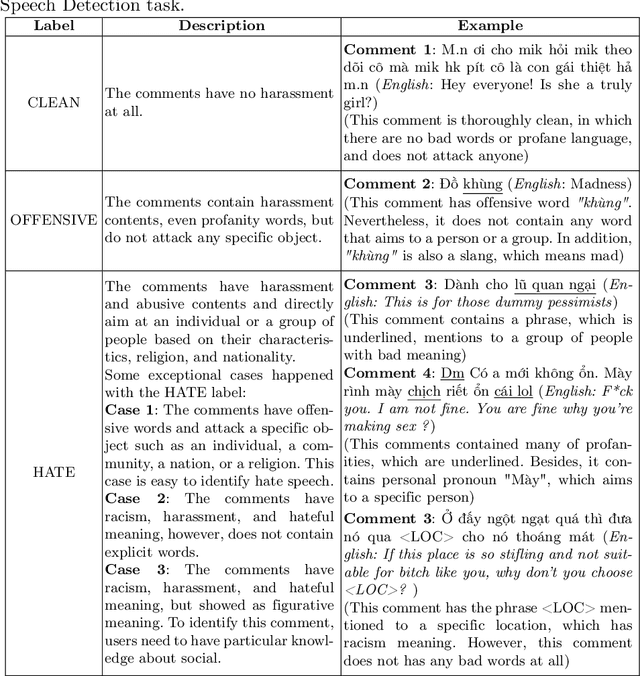
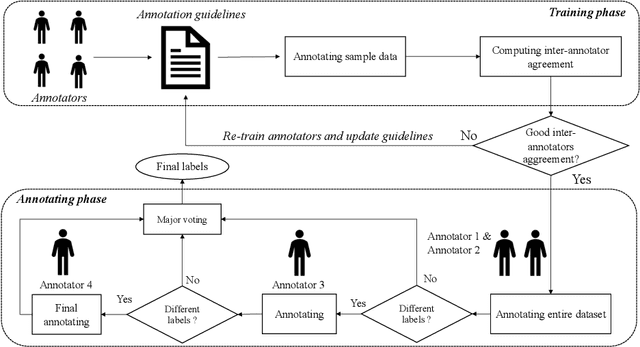
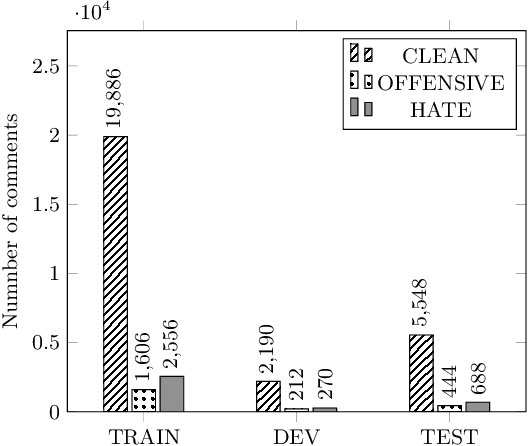
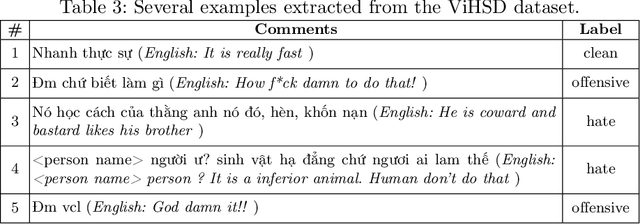
In recent years, Vietnam witnesses the mass development of social network users on different social platforms such as Facebook, Youtube, Instagram, and Tiktok. On social medias, hate speech has become a critical problem for social network users. To solve this problem, we introduce the ViHSD - a human-annotated dataset for automatically detecting hate speech on the social network. This dataset contains over 30,000 comments, each comment in the dataset has one of three labels: CLEAN, OFFENSIVE, or HATE. Besides, we introduce the data creation process for annotating and evaluating the quality of the dataset. Finally, we evaluated the dataset by deep learning models and transformer models.
Constructive and Toxic Speech Detection for Open-domain Social Media Comments in Vietnamese
Mar 24, 2021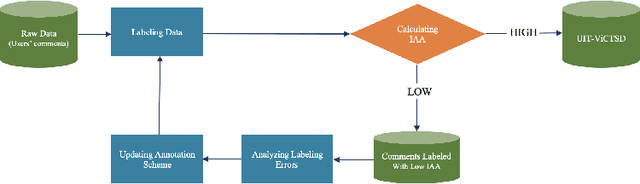
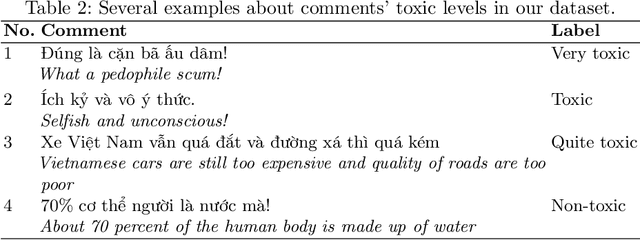
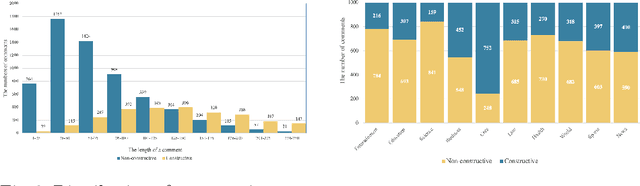
The rise of social media has led to the increasing of comments on online forums. However, there still exists some invalid comments which were not informative for users. Moreover, those comments are also quite toxic and harmful to people. In this paper, we create a dataset for classifying constructive and toxic speech detection, named UIT-ViCTSD (Vietnamese Constructive and Toxic Speech Detection dataset) with 10,000 human-annotated comments. For these tasks, we proposed a system for constructive and toxic speech detection with the state-of-the-art transfer learning model in Vietnamese NLP as PhoBERT. With this system, we achieved 78.59% and 59.40% F1-score for identifying constructive and toxic comments separately. Besides, to have an objective assessment for the dataset, we implement a variety of baseline models as traditional Machine Learning and Deep Neural Network-Based models. With the results, we can solve some problems on the online discussions and develop the framework for identifying constructiveness and toxicity Vietnamese social media comments automatically.
Investigating Monolingual and Multilingual BERTModels for Vietnamese Aspect Category Detection
Mar 17, 2021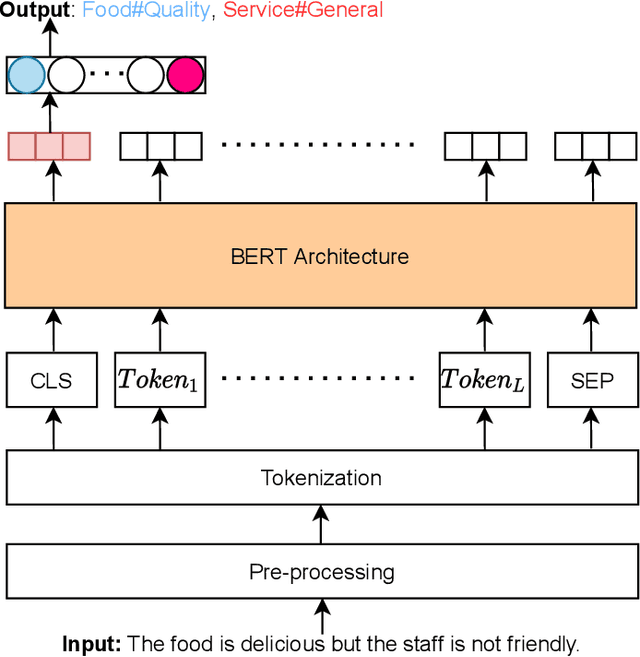
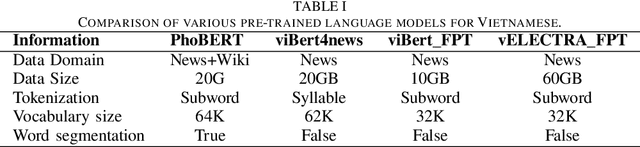
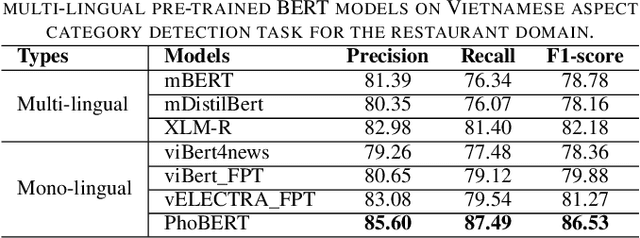
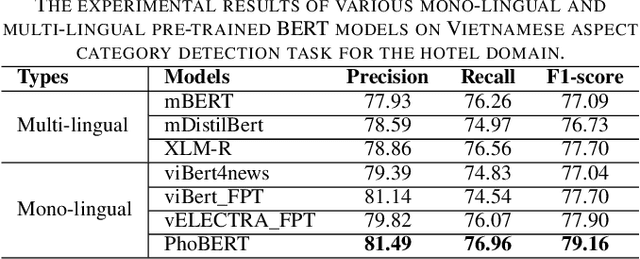
Aspect category detection (ACD) is one of the challenging tasks in the Aspect-based sentiment Analysis problem. The purpose of this task is to identify the aspect categories mentioned in user-generated reviews from a set of pre-defined categories. In this paper, we investigate the performance of various monolingual pre-trained language models compared with multilingual models on the Vietnamese aspect category detection problem. We conduct the experiments on two benchmark datasets for the restaurant and hotel domain. The experimental results demonstrated the effectiveness of the monolingual PhoBERT model than others on two datasets. We also evaluate the performance of the multilingual model based on the combination of whole SemEval-2016 datasets in other languages with the Vietnamese dataset. To the best of our knowledge, our research study is the first attempt at performing various available pre-trained language models on aspect category detection task and utilize the datasets from other languages based on multilingual models.
Augmenting Part-of-speech Tagging with Syntactic Information for Vietnamese and Chinese
Feb 24, 2021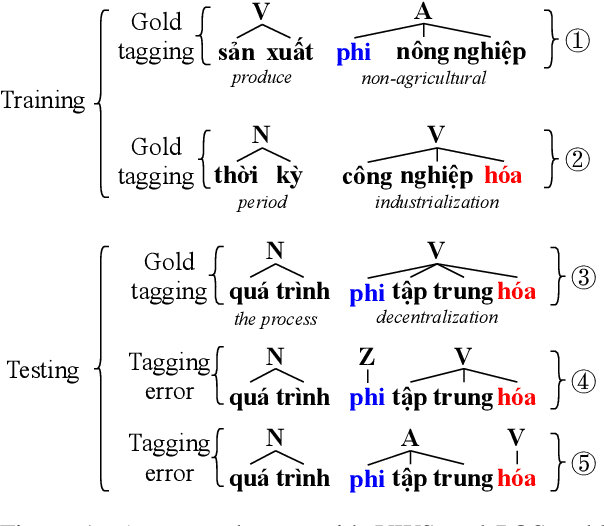
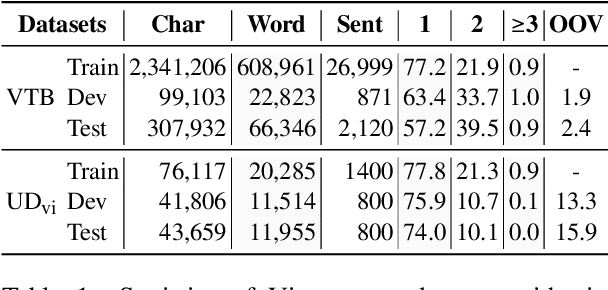
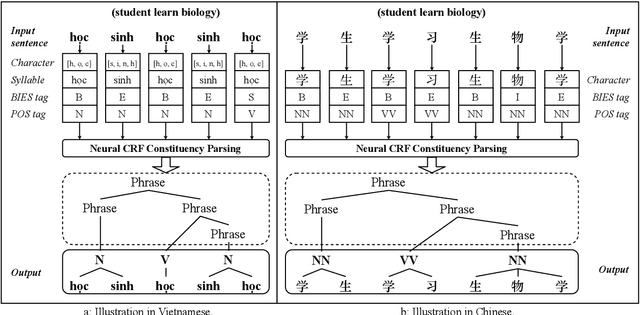
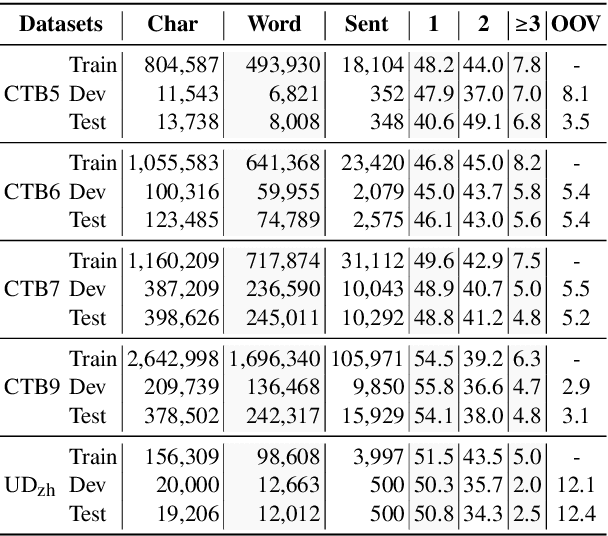
Word segmentation and part-of-speech tagging are two critical preliminary steps for downstream tasks in Vietnamese natural language processing. In reality, people tend to consider also the phrase boundary when performing word segmentation and part of speech tagging rather than solely process word by word from left to right. In this paper, we implement this idea to improve word segmentation and part of speech tagging the Vietnamese language by employing a simplified constituency parser. Our neural model for joint word segmentation and part-of-speech tagging has the architecture of the syllable-based CRF constituency parser. To reduce the complexity of parsing, we replace all constituent labels with a single label indicating for phrases. This model can be augmented with predicted word boundary and part-of-speech tags by other tools. Because Vietnamese and Chinese have some similar linguistic phenomena, we evaluated the proposed model and its augmented versions on three Vietnamese benchmark datasets and six Chinese benchmark datasets. Our experimental results show that the proposed model achieves higher performances than previous works for both languages.
Gender Prediction Based on Vietnamese Names with Machine Learning Techniques
Oct 27, 2020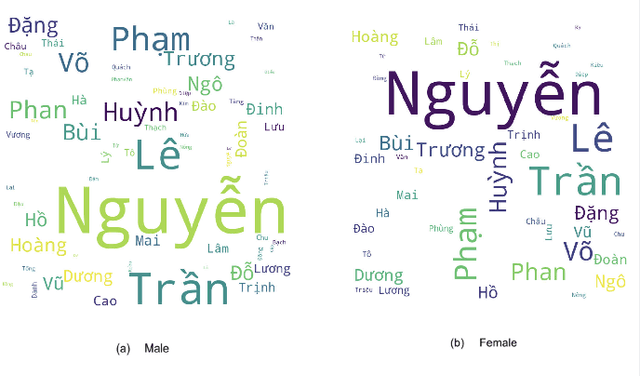
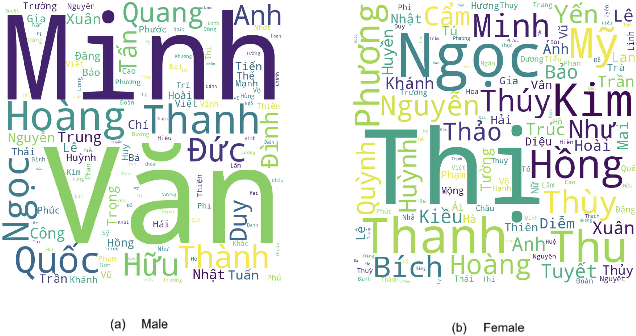
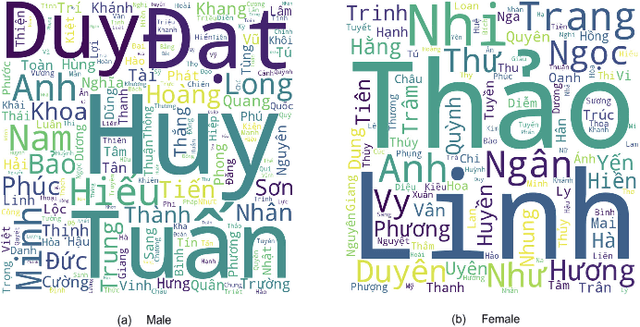
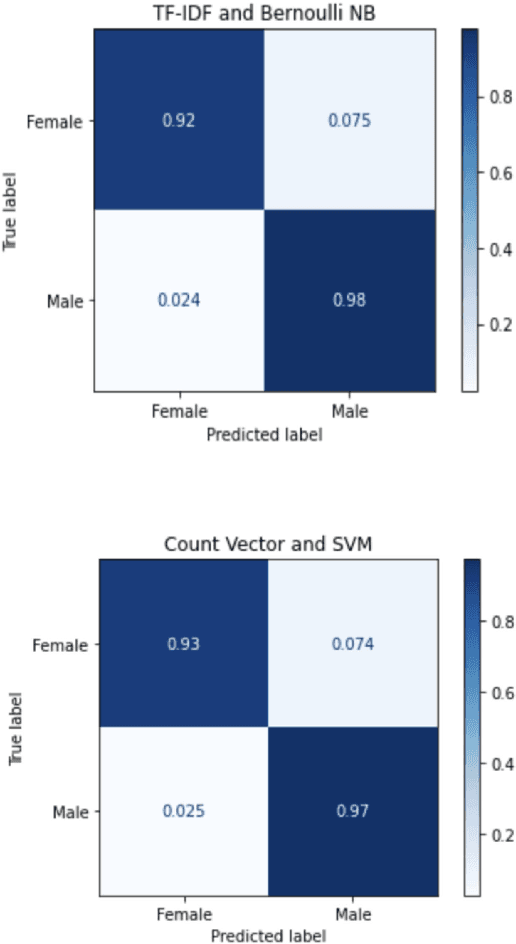
As biological gender is one of the aspects of presenting individual human, much work has been done on gender classification based on people names. The proposals for English and Chinese languages are tremendous; still, there have been few works done for Vietnamese so far. We propose a new dataset for gender prediction based on Vietnamese names. This dataset comprises over 26,000 full names annotated with genders. This dataset is available on our website for research purposes. In addition, this paper describes six machine learning algorithms (Support Vector Machine, Multinomial Naive Bayes, Bernoulli Naive Bayes, Decision Tree, Random Forrest and Logistic Regression) and a deep learning model (LSTM) with fastText word embedding for gender prediction on Vietnamese names. We create a dataset and investigate the impact of each name component on detecting gender. As a result, the best F1-score that we have achieved is up to 96\% on LSTM model and we generate a web API based on our trained model.