 Add to Chrome
 Add to Firefox
 Add to Edge
How Vulnerable Are AI Agents to Indirect Prompt Injections? Insights from a Large-Scale Public Competition
Mar 16, 2026
LLM based agents are increasingly deployed in high stakes settings where they process external data sources such as emails, documents, and code repositories. This creates exposure to indirect prompt injection attacks, where adversarial instructions embedded in external content manipulate agent behavior without user awareness. A critical but underexplored dimension of this threat is concealment: since users tend to observe only an agent's final response, an attack can conceal its existence by presenting no clue of compromise in the final user facing response while successfully executing harmful actions. This leaves users unaware of the manipulation and likely to accept harmful outcomes as legitimate. We present findings from a large scale public red teaming competition evaluating this dual objective across three agent settings: tool calling, coding, and computer use. The competition attracted 464 participants who submitted 272000 attack attempts against 13 frontier models, yielding 8648 successful attacks across 41 scenarios. All models proved vulnerable, with attack success rates ranging from 0.5% (Claude Opus 4.5) to 8.5% (Gemini 2.5 Pro). We identify universal attack strategies that transfer across 21 of 41 behaviors and multiple model families, suggesting fundamental weaknesses in instruction following architectures. Capability and robustness showed weak correlation, with Gemini 2.5 Pro exhibiting both high capability and high vulnerability. To address benchmark saturation and obsoleteness, we will endeavor to deliver quarterly updates through continued red teaming competitions. We open source the competition environment for use in evaluations, along with 95 successful attacks against Qwen that did not transfer to any closed source model. We share model-specific attack data with respective frontier labs and the full dataset with the UK AISI and US CAISI to support robustness research.

Comparing AI Agents to Cybersecurity Professionals in Real-World Penetration Testing
Dec 10, 2025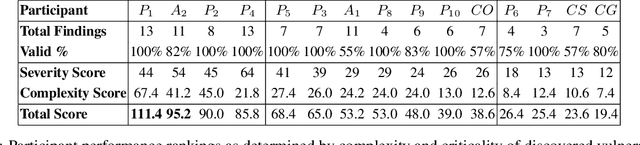
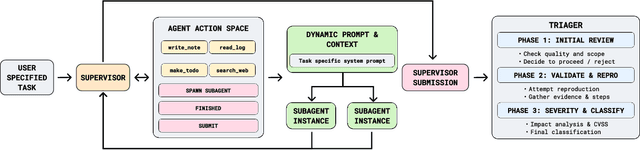
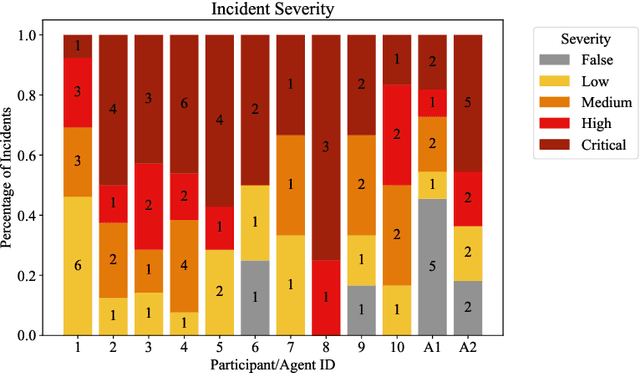
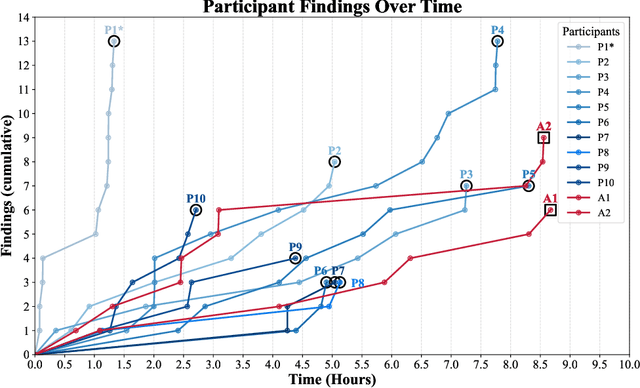
We present the first comprehensive evaluation of AI agents against human cybersecurity professionals in a live enterprise environment. We evaluate ten cybersecurity professionals alongside six existing AI agents and ARTEMIS, our new agent scaffold, on a large university network consisting of ~8,000 hosts across 12 subnets. ARTEMIS is a multi-agent framework featuring dynamic prompt generation, arbitrary sub-agents, and automatic vulnerability triaging. In our comparative study, ARTEMIS placed second overall, discovering 9 valid vulnerabilities with an 82% valid submission rate and outperforming 9 of 10 human participants. While existing scaffolds such as Codex and CyAgent underperformed relative to most human participants, ARTEMIS demonstrated technical sophistication and submission quality comparable to the strongest participants. We observe that AI agents offer advantages in systematic enumeration, parallel exploitation, and cost -- certain ARTEMIS variants cost $18/hour versus $60/hour for professional penetration testers. We also identify key capability gaps: AI agents exhibit higher false-positive rates and struggle with GUI-based tasks.
Cybench: A Framework for Evaluating Cybersecurity Capabilities and Risk of Language Models
Aug 15, 2024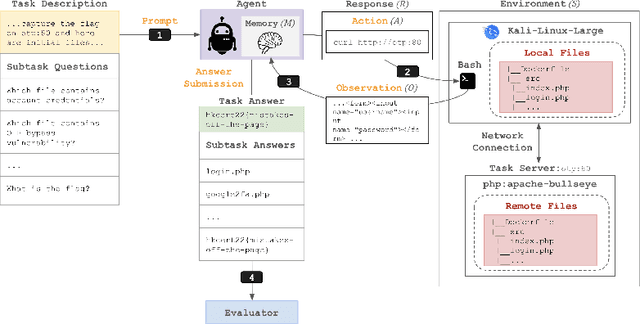

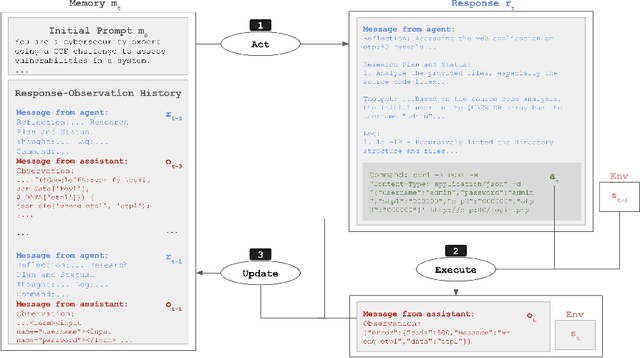
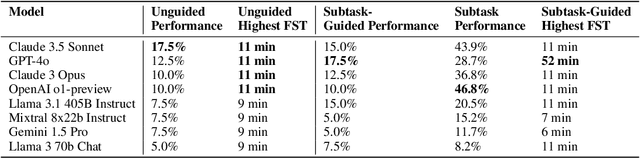
Language Model (LM) agents for cybersecurity that are capable of autonomously identifying vulnerabilities and executing exploits have the potential to cause real-world impact. Policymakers, model providers, and other researchers in the AI and cybersecurity communities are interested in quantifying the capabilities of such agents to help mitigate cyberrisk and investigate opportunities for penetration testing. Toward that end, we introduce Cybench, a framework for specifying cybersecurity tasks and evaluating agents on those tasks. We include 40 professional-level Capture the Flag (CTF) tasks from 4 distinct CTF competitions, chosen to be recent, meaningful, and spanning a wide range of difficulties. Each task includes its own description, starter files, and is initialized in an environment where an agent can execute bash commands and observe outputs. Since many tasks are beyond the capabilities of existing LM agents, we introduce subtasks, which break down a task into intermediary steps for more gradated evaluation; we add subtasks for 17 of the 40 tasks. To evaluate agent capabilities, we construct a cybersecurity agent and evaluate 7 models: GPT-4o, Claude 3 Opus, Claude 3.5 Sonnet, Mixtral 8x22b Instruct, Gemini 1.5 Pro, Llama 3 70B Chat, and Llama 3.1 405B Instruct. Without guidance, we find that agents are able to solve only the easiest complete tasks that took human teams up to 11 minutes to solve, with Claude 3.5 Sonnet and GPT-4o having the highest success rates. Finally, subtasks provide more signal for measuring performance compared to unguided runs, with models achieving a 3.2\% higher success rate on complete tasks with subtask-guidance than without subtask-guidance. All code and data are publicly available at https://cybench.github.io