 Add to Chrome
 Add to Firefox
 Add to Edge
Perceived Importance of Cognitive Skills Among Computing Students in the Era of AI
Apr 12, 2026
The availability and increasing integration of generative AI tools have transformed computing education. While AI in education presents opportunities, it also raises new concerns about how these powerful know-it-all AI tools, which are becoming widespread, impact cognitive skill development among students. Cognitive skills are essential for academic success and professional competence. It relates to the ability to understand, analyze, evaluate, synthesize information and more. The extensive use of these AI tools can aid in cognitive offloading, freeing up cognitive resources to be used in other tasks and activities. However, cognitive offloading may inadvertently lead to diminishing cognitive involvement in learning and related activities when using AI tools. Understanding cognitive skills' impact in the era of AI is essential to align curricular design with evolving workforce demands and changing work environment and processes. To address this concern and to develop an understanding of how the importance of cognitive skills changes with increasing integration of AI, we conducted a researcher-monitored and regulated quantitative survey of undergraduate computing students. We examined students' perceptions of cognitive skills across three temporal frames: prior to widespread AI adoption (past), current informal and formal use of AI in learning contexts (present), and future with even more AI integration in professional environments (future). In the study, students rated the importance of 11 cognitive skills. Our analysis reveals that students expect all 11 cognitive skills to be of diminishing importance in the future, when AI use and integration increases. Our findings highlight the need for educational interventions that explicitly reinforce cognitive skill development within learning environments that are now often relying on AI.

Trust and Reliance on AI in Education: AI Literacy and Need for Cognition as Moderators
Apr 01, 2026As generative AI systems are integrated into educational settings, students often encounter AI-generated output while working through learning tasks, either by requesting help or through integrated tools. Trust in AI can influence how students interpret and use that output, including whether they evaluate it critically or exhibit overreliance. We investigate how students' trust relates to their appropriate reliance on an AI assistant during programming problem-solving tasks, and whether this relationship differs by learner characteristics. With 432 undergraduate participants, students' completed Python output-prediction problems while receiving recommendations and explanations from an AI chatbot, including accurate and intentionally misleading suggestions. We operationalize reliance behaviorally as the extent to which students' responses reflected appropriate use of the AI assistant's suggestions, accepting them when they were correct and rejecting them when they were incorrect. Pre- and post-task surveys assessed trust in the assistant, AI literacy, need for cognition, programming self-efficacy, and programming literacy. Results showed a non-linear relationship in which higher trust was associated with lower appropriate reliance, suggesting weaker discrimination between correct and incorrect recommendations. This relationship was significantly moderated by students' AI literacy and need for cognition. These findings highlight the need for future work on instructional and system supports that encourage more reflective evaluation of AI assistance during problem-solving.
Brain Tumor Detection and Classification with Feed Forward Back-Prop Neural Network
May 31, 2017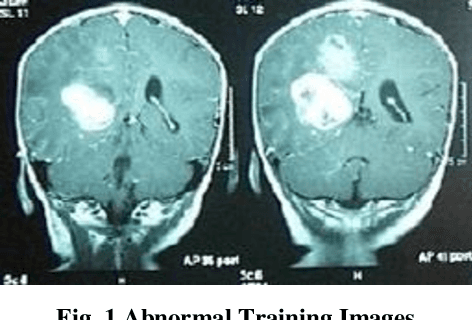
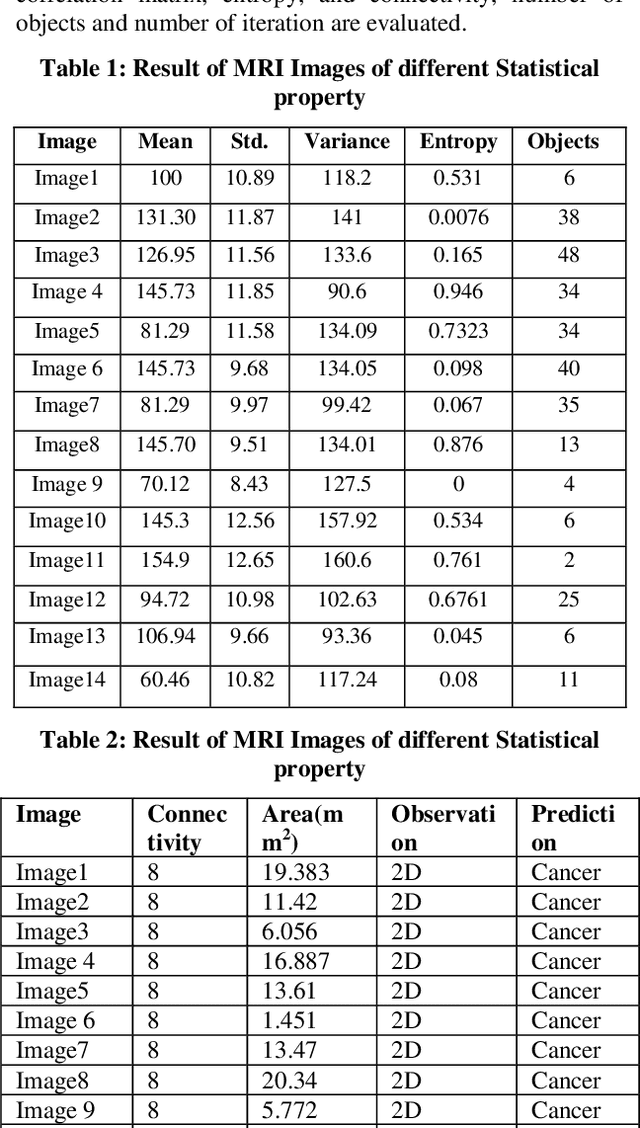
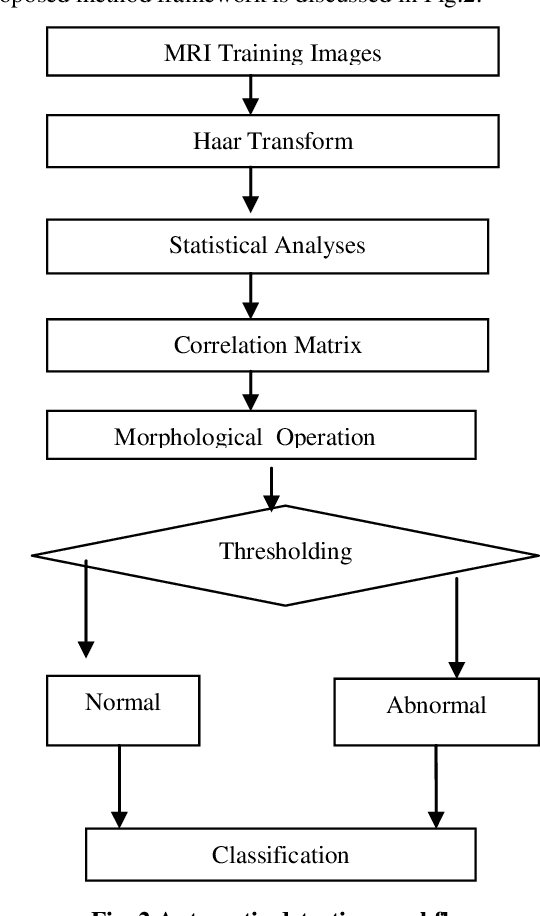
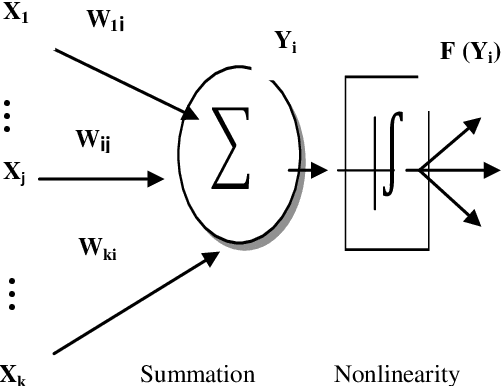
Brain is an organ that controls activities of all the parts of the body. Recognition of automated brain tumor in Magnetic resonance imaging (MRI) is a difficult task due to complexity of size and location variability. This automatic method detects all the type of cancer present in the body. Previous methods for tumor are time consuming and less accurate. In the present work, statistical analysis morphological and thresholding techniques are used to process the images obtained by MRI. Feed-forward back-prop neural network is used to classify the performance of tumors part of the image. This method results high accuracy and less iterations detection which further reduces the consumption time.