 Add to Chrome
 Add to Firefox
 Add to Edge
LLM Router: Prefill is All You Need
Mar 21, 2026
LLMs often share comparable benchmark accuracies, but their complementary performance across task subsets suggests that an Oracle router--a theoretical selector with perfect foresight--can significantly surpass standalone model accuracy by navigating model-specific strengths. While current routers rely on fragile semantic signals, we propose using internal prefill activations via Encoder-Target Decoupling--a functional separation between the model providing the predictive signal (the Encoder) and the model whose performance is being estimated (the Target). This allows optimized heterogeneous pairing between unique encoders and target models. We utilize Fisher Separability (J) and Effective Dimensionality (d_eff) as mathematical probes to isolate optimal layer-wise signals, providing the predictive foundation for our SharedTrunkNet architecture. SharedTrunkNet captures up to 45.58% of the accuracy gap between the strongest standalone model and the Oracle while achieving 74.31% cost savings relative to the highest-cost model.

Accelerating the Generation of Molecular Conformations with Progressive Distillation of Equivariant Latent Diffusion Models
Apr 21, 2024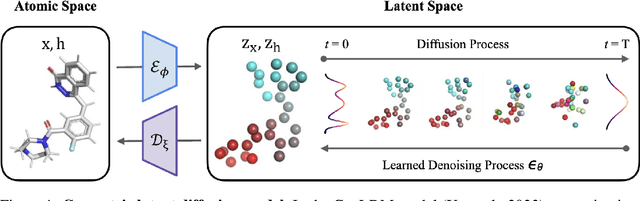
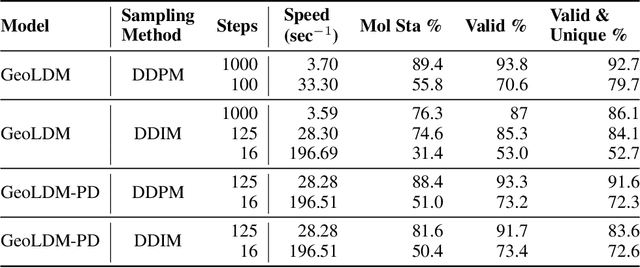
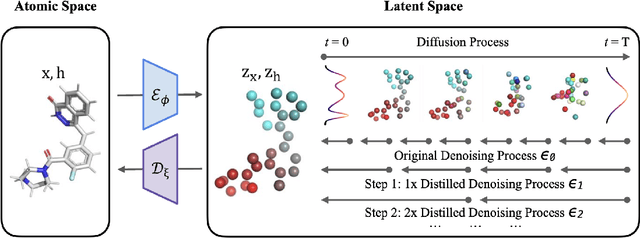
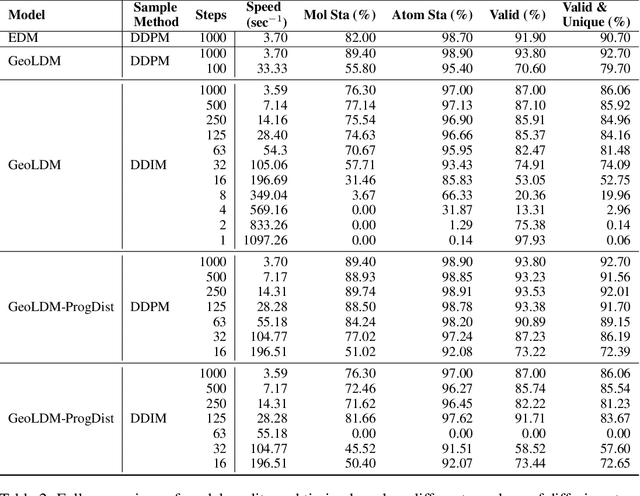
Recent advances in fast sampling methods for diffusion models have demonstrated significant potential to accelerate generation on image modalities. We apply these methods to 3-dimensional molecular conformations by building on the recently introduced GeoLDM equivariant latent diffusion model (Xu et al., 2023). We evaluate trade-offs between speed gains and quality loss, as measured by molecular conformation structural stability. We introduce Equivariant Latent Progressive Distillation, a fast sampling algorithm that preserves geometric equivariance and accelerates generation from latent diffusion models. Our experiments demonstrate up to 7.5x gains in sampling speed with limited degradation in molecular stability. These results suggest this accelerated sampling method has strong potential for high-throughput in silico molecular conformations screening in computational biochemistry, drug discovery, and life sciences applications.