 Add to Chrome
 Add to Firefox
 Add to Edge
SCALP: Semi-Supervised Statistical Shape Modeling from Imperfect 3D Photogrammetry via Landmark-Anchored Spectral Warp
Jul 31, 2026
Correspondence-based statistical shape modeling (SSM) is vital for population-level morphometric analysis, but conventional pipelines assume clean, fully registered surfaces. Real-world clinical photogrammetry scans are often noisy, partial, and cluttered, hindering the adoption of radiation-free surface imaging as a safe alternative to computed tomography (CT) for infant craniosynostosis. We present SCALP (Semi-supervised Correspondence via lAndmark Localization and sPectral warping), a two-stage framework that constructs consistent shape models directly from raw, imperfect surface scans. First, a semi-supervised Point Transformer leverages a small expert-annotated dataset alongside a large unlabeled cohort to accurately localize craniofacial landmarks with minimal annotation overhead. Second, these landmarks anchor a Laplace--Beltrami spectral deformation of an anatomical template, generating dense correspondences while naturally isolating the cranium from peripheral scanning clutter without manual preprocessing. Experiments on infant photogrammetry scans demonstrate that SCALP consistently outperforms state-of-the-art unsupervised point-cloud approaches, offering a clinically practical pathway toward objective, radiation-free head shape analysis.

Spatiotemporal Cardiac Statistical Shape Modeling: A Data-Driven Approach
Sep 06, 2022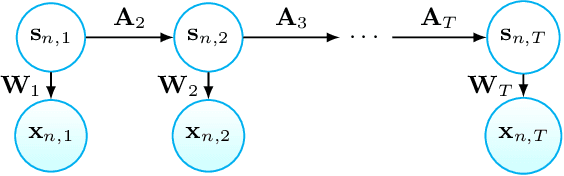

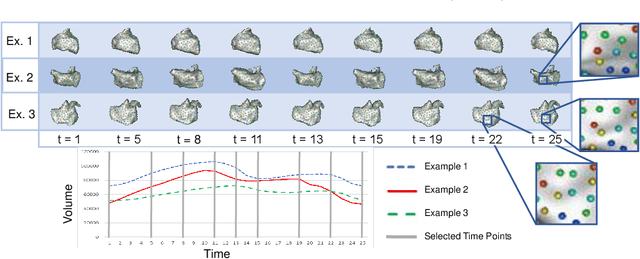
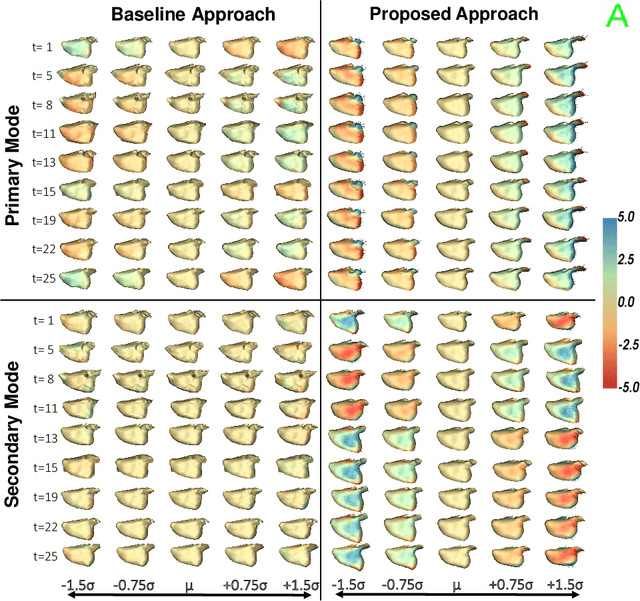
Clinical investigations of anatomy's structural changes over time could greatly benefit from population-level quantification of shape, or spatiotemporal statistic shape modeling (SSM). Such a tool enables characterizing patient organ cycles or disease progression in relation to a cohort of interest. Constructing shape models requires establishing a quantitative shape representation (e.g., corresponding landmarks). Particle-based shape modeling (PSM) is a data-driven SSM approach that captures population-level shape variations by optimizing landmark placement. However, it assumes cross-sectional study designs and hence has limited statistical power in representing shape changes over time. Existing methods for modeling spatiotemporal or longitudinal shape changes require predefined shape atlases and pre-built shape models that are typically constructed cross-sectionally. This paper proposes a data-driven approach inspired by the PSM method to learn population-level spatiotemporal shape changes directly from shape data. We introduce a novel SSM optimization scheme that produces landmarks that are in correspondence both across the population (inter-subject) and across time-series (intra-subject). We apply the proposed method to 4D cardiac data from atrial-fibrillation patients and demonstrate its efficacy in representing the dynamic change of the left atrium. Furthermore, we show that our method outperforms an image-based approach for spatiotemporal SSM with respect to a generative time-series model, the Linear Dynamical System (LDS). LDS fit using a spatiotemporal shape model optimized via our approach provides better generalization and specificity, indicating it accurately captures the underlying time-dependency.