 Add to Chrome
 Add to Firefox
 Add to Edge
Nyxus: A Next Generation Image Feature Extraction Library for the Big Data and AI Era
Mar 12, 2026
Modern imaging instruments can produce terabytes to petabytes of data for a single experiment. The biggest barrier to processing big image datasets has been computational, where image analysis algorithms often lack the efficiency needed to process such large datasets or make tradeoffs in robustness and accuracy. Deep learning algorithms have vastly improved the accuracy of the first step in an analysis workflow (region segmentation), but the expansion of domain specific feature extraction libraries across scientific disciplines has made it difficult to compare the performance and accuracy of extracted features. To address these needs, we developed a novel feature extraction library called Nyxus. Nyxus is designed from the ground up for scalable out-of-core feature extraction for 2D and 3D image data and rigorously tested against established standards. The comprehensive feature set of Nyxus covers multiple biomedical domains including radiomics and cellular analysis, and is designed for computational scalability across CPUs and GPUs. Nyxus has been packaged to be accessible to users of various skill sets and needs: as a Python package for code developers, a command line tool, as a Napari plugin for low to no-code users or users that want to visualize results, and as an Open Container Initiative (OCI) compliant container that can be used in cloud or super-computing workflows aimed at processing large data sets. Further, Nyxus enables a new methodological approach to feature extraction allowing for programmatic tuning of many features sets for optimal computational efficiency or coverage for use in novel machine learning and deep learning applications.

Assessing Intelligence in Artificial Neural Networks
Jun 03, 2020
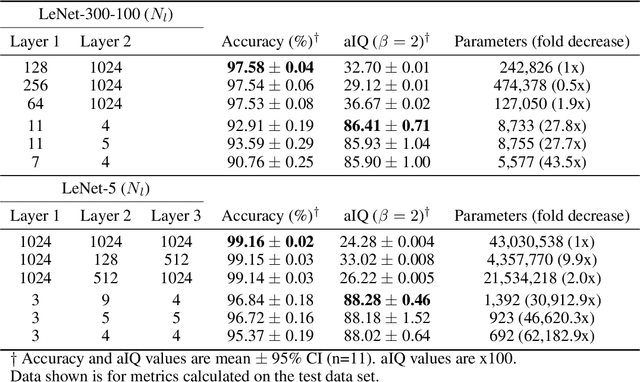

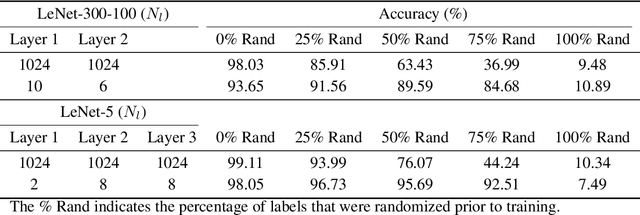
The purpose of this work was to develop of metrics to assess network architectures that balance neural network size and task performance. To this end, the concept of neural efficiency is introduced to measure neural layer utilization, and a second metric called artificial intelligence quotient (aIQ) was created to balance neural network performance and neural network efficiency. To study aIQ and neural efficiency, two simple neural networks were trained on MNIST: a fully connected network (LeNet-300-100) and a convolutional neural network (LeNet-5). The LeNet-5 network with the highest aIQ was 2.32% less accurate but contained 30,912 times fewer parameters than the highest accuracy network. Both batch normalization and dropout layers were found to increase neural efficiency. Finally, high aIQ networks are shown to be memorization and overtraining resistant, capable of learning proper digit classification with an accuracy of 92.51% even when 75% of the class labels are randomized. These results demonstrate the utility of aIQ and neural efficiency as metrics for balancing network performance and size.