 Add to Chrome
 Add to Firefox
 Add to Edge
Imputation-free transformer learning enables robust Alzheimer's disease prediction and calibrated uncertainty quantification across heterogeneous clinical cohorts
Jul 14, 2026
Accurate diagnostic classification and disease-severity prediction for Alzheimer's disease are hampered by the incompleteness and heterogeneity of real-world clinical data. Left unaddressed, these barriers prevent reliable disease modelling and hinder effective clinical evaluation. Conventional imputation strategies introduce systematic bias, distort inter-feature relationships, and yield overconfident predictions, limitations especially consequential in diagnostic settings. Here, we propose NITROGEN, an imputation-free transformer that jointly models within-patient feature dependencies and between-patient relational structure through masked and intersample attention, enabling robust multimodal learning directly from partially observed records. We trained NITROGEN on ADNI (N=7858 scans), and evaluated it on two independent cohorts: OASIS-3 (N=2675 scans) and AIBL (N=1286 scans). Across cohorts and diagnostic and cognitive score prediction tasks, NITROGEN showed robust calibration and uncertainty quantification advantages over tree-based ensemble methods, while maintaining competitive discriminative performance. Cross-cohort and cross-method analyses identified cortical thickness in the temporal pole, age, and APOE genotype as important, though not individually sufficient, features for AD classification. We further introduced a modality-aware uncertainty adjustment that augments predictive uncertainty proportionally to the importance of absent modalities, enabling calibrated confidence when diagnostic information is unavailable. Together, our results show that imputation-free attention learning preserved meaningful discrimination under cohort shift, revealing expected degradation on more distributionally different cohorts, and demonstrate that evaluating models along calibration, interpretability, and cross-cohort reliability, not accuracy alone, is essential for clinical deployment.

Explainable Graph-theoretical Machine Learning: with Application to Alzheimer's Disease Prediction
Mar 20, 2025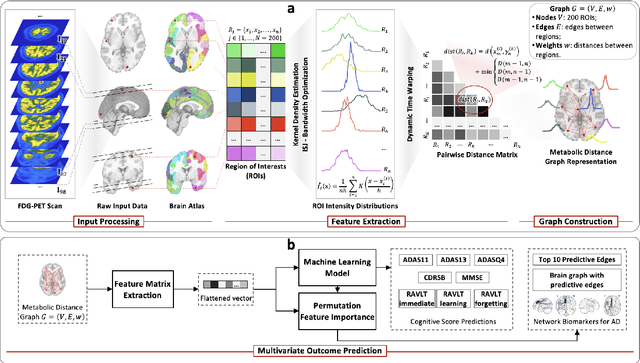
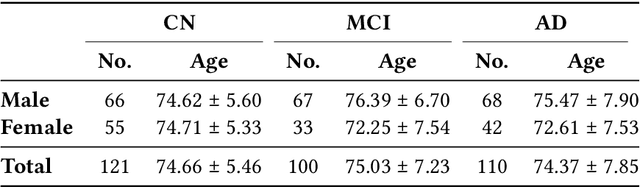
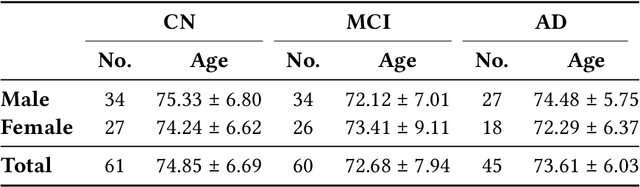
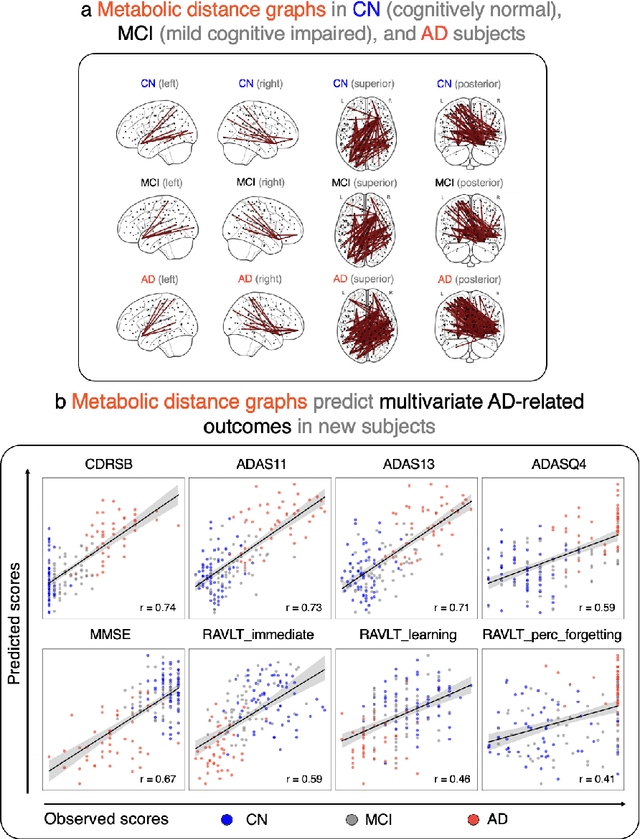
Alzheimer's disease (AD) affects 50 million people worldwide and is projected to overwhelm 152 million by 2050. AD is characterized by cognitive decline due partly to disruptions in metabolic brain connectivity. Thus, early and accurate detection of metabolic brain network impairments is crucial for AD management. Chief to identifying such impairments is FDG-PET data. Despite advancements, most graph-based studies using FDG-PET data rely on group-level analysis or thresholding. Yet, group-level analysis can veil individual differences and thresholding may overlook weaker but biologically critical brain connections. Additionally, machine learning-based AD prediction largely focuses on univariate outcomes, such as disease status. Here, we introduce explainable graph-theoretical machine learning (XGML), a framework employing kernel density estimation and dynamic time warping to construct individual metabolic brain graphs that capture the distance between pair-wise brain regions and identify subgraphs most predictive of multivariate AD-related outcomes. Using FDG-PET data from the Alzheimer's Disease Neuroimaging Initiative, XGML builds metabolic brain graphs and uncovers subgraphs predictive of eight AD-related cognitive scores in new subjects. XGML shows robust performance, particularly for predicting scores measuring learning, memory, language, praxis, and orientation, such as CDRSB ($r = 0.74$), ADAS11 ($r = 0.73$), and ADAS13 ($r = 0.71$). Moreover, XGML unveils key edges jointly but differentially predictive of several AD-related outcomes; they may serve as potential network biomarkers for assessing overall cognitive decline. Together, we show the promise of graph-theoretical machine learning in biomarker discovery and disease prediction and its potential to improve our understanding of network neural mechanisms underlying AD.