 Add to Chrome
 Add to Firefox
 Add to Edge
Tacit Knowledge Management with Generative AI: Proposal of the GenAI SECI Model
Mar 23, 2026
The emergence of generative AI is bringing about a significant transformation in knowledge management. Generative AI has the potential to address the limitations of conventional knowledge management systems, and it is increasingly being deployed in real-world settings with promising results. Related research is also expanding rapidly. However, much of this work focuses on research and practice related to the management of explicit knowledge. While fragmentary efforts have been made regarding the management of tacit knowledge using generative AI, the modeling and systematization that handle both tacit and explicit knowledge in an integrated manner remain insufficient. In this paper, we propose the "GenAI SECI" model as an updated version of the knowledge creation process (SECI) model, redesigned to leverage the capabilities of generative AI. A defining feature of the "GenAI SECI" model is the introduction of "Digital Fragmented Knowledge", a new concept that integrates explicit and tacit knowledge within cyberspace. Furthermore, a concrete system architecture for the proposed model is presented, along with a comparison with prior research models that share a similar problem awareness and objectives.

Digital Business Model Analysis Using a Large Language Model
Jun 09, 2024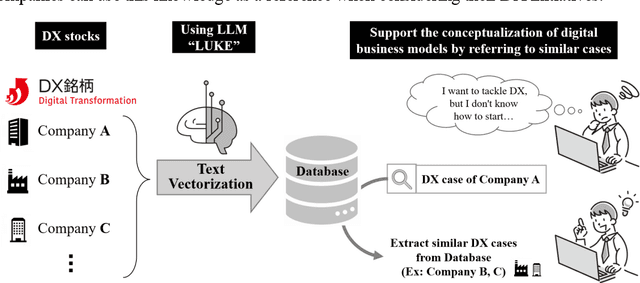

Digital transformation (DX) has recently become a pressing issue for many companies as the latest digital technologies, such as artificial intelligence and the Internet of Things, can be easily utilized. However, devising new business models is not easy for compa-nies, though they can improve their operations through digital technologies. Thus, business model design support methods are needed by people who lack digital tech-nology expertise. In contrast, large language models (LLMs) represented by ChatGPT and natural language processing utilizing LLMs have been developed revolutionarily. A business model design support system that utilizes these technologies has great potential. However, research on this area is scant. Accordingly, this study proposes an LLM-based method for comparing and analyzing similar companies from different business do-mains as a first step toward business model design support utilizing LLMs. This method can support idea generation in digital business model design.