 Add to Chrome
 Add to Firefox
 Add to Edge
Poisson-Gamma Modeling of Inter-Relational Dependencies in Dynamic Knowledge Graphs
Jul 03, 2026
Dynamic knowledge graphs are ubiquitous in today's AI applications, as we represent molecular structures, social relationships, and language information using these graph models. As knowledge graphs evolve over time and are often noisy and incomplete, modeling their temporal and relational dependencies becomes crucial for downstream tasks. To address these challenges, this paper proposes PGRE (Poisson-Gamma Relational Evolution), a probabilistic model for modeling inter-relational dependencies in dynamic knowledge graphs. PGRE represents multi-relational temporal links via a Poisson-Bernoulli formulation. It introduces Gamma-distributed latent variables to capture entity-factor associations and cross-relation dependencies mediated by shared latent communities. A Gamma Markov process further models the temporal evolution of these latent variables, enabling principled characterization of relational dynamics. Experiments on benchmark datasets show that PGRE achieves competitive performance in link prediction, particularly in sparse settings, while revealing meaningful relational evolution patterns in dynamic knowledge graphs.

Offline Inverse Constrained Reinforcement Learning for Safe-Critical Decision Making in Healthcare
Oct 10, 2024
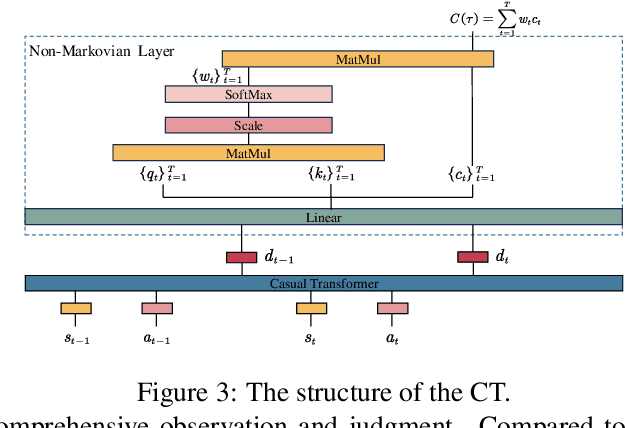


Reinforcement Learning (RL) applied in healthcare can lead to unsafe medical decisions and treatment, such as excessive dosages or abrupt changes, often due to agents overlooking common-sense constraints. Consequently, Constrained Reinforcement Learning (CRL) is a natural choice for safe decisions. However, specifying the exact cost function is inherently difficult in healthcare. Recent Inverse Constrained Reinforcement Learning (ICRL) is a promising approach that infers constraints from expert demonstrations. ICRL algorithms model Markovian decisions in an interactive environment. These settings do not align with the practical requirement of a decision-making system in healthcare, where decisions rely on historical treatment recorded in an offline dataset. To tackle these issues, we propose the Constraint Transformer (CT). Specifically, 1) we utilize a causal attention mechanism to incorporate historical decisions and observations into the constraint modeling, while employing a Non-Markovian layer for weighted constraints to capture critical states. 2) A generative world model is used to perform exploratory data augmentation, enabling offline RL methods to simulate unsafe decision sequences. In multiple medical scenarios, empirical results demonstrate that CT can capture unsafe states and achieve strategies that approximate lower mortality rates, reducing the occurrence probability of unsafe behaviors.