 Add to Chrome
 Add to Firefox
 Add to Edge
PEDESTRIANQA: A Benchmark for Vision-Language Models on Pedestrian Intention and Trajectory Prediction
May 23, 2026
Pedestrian intention and trajectory prediction are critical for the safe deployment of autonomous driving systems, directly influencing navigation decisions in complex traffic environments. Recent advances in large vision-language models offer a powerful new paradigm for these tasks by combining high-capacity visual understanding with flexible natural language reasoning. In this work, we introduce PedestrianQA, a large-scale video-based dataset that formulates pedestrian intention and trajectory prediction as question-answering tasks augmented with structured rationales. PedestrianQA expresses richly annotated pedestrian sequences, in natural language, enabling VLMs to learn from visual dynamics, contextual cues, and interactions among traffic agents while generating concise explanations of their predictions without needing specialized architectures tailored for each task. Empirical evaluations across PIE, JAAD, TITAN, and IDD-PeD show that finetuning state-of-the-art VLMs on PedestrianQA significantly improves intention classification, trajectory forecasting accuracy, and the quality of explanatory rationales, demonstrating the strong potential of VLMs as a unified and explainable framework for safety-critical pedestrian behavior modeling.

Invisible Traces: Using Hybrid Fingerprinting to identify underlying LLMs in GenAI Apps
Jan 30, 2025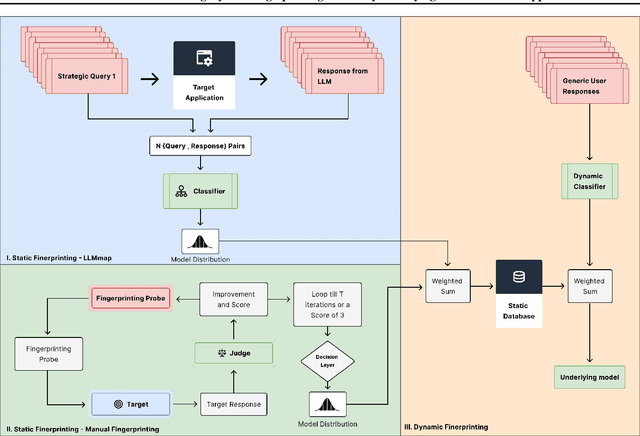



Fingerprinting refers to the process of identifying underlying Machine Learning (ML) models of AI Systemts, such as Large Language Models (LLMs), by analyzing their unique characteristics or patterns, much like a human fingerprint. The fingerprinting of Large Language Models (LLMs) has become essential for ensuring the security and transparency of AI-integrated applications. While existing methods primarily rely on access to direct interactions with the application to infer model identity, they often fail in real-world scenarios involving multi-agent systems, frequent model updates, and restricted access to model internals. In this paper, we introduce a novel fingerprinting framework designed to address these challenges by integrating static and dynamic fingerprinting techniques. Our approach identifies architectural features and behavioral traits, enabling accurate and robust fingerprinting of LLMs in dynamic environments. We also highlight new threat scenarios where traditional fingerprinting methods are ineffective, bridging the gap between theoretical techniques and practical application. To validate our framework, we present an extensive evaluation setup that simulates real-world conditions and demonstrate the effectiveness of our methods in identifying and monitoring LLMs in Gen-AI applications. Our results highlight the framework's adaptability to diverse and evolving deployment contexts.