 Add to Chrome
 Add to Firefox
 Add to Edge
Long-Term Sequential Decision Making under Risk
Jul 22, 2026
We study finite-horizon MDP planning under \emph{root-based} (resolute) risk objectives that apply a rank-dependent functional to the distribution of total returns. Such objectives are non-linear in the return distribution and generally break Bellman optimality, so direct optimization by scenario-tree enumeration is intractable. We propose \textbf{ERQDP}, an enumeration-free and sampling-free method that solves a rank--quantile surrogate via exact DP (Dynamic Programming), evaluates candidate policies exactly by DP over return Probability Mass Functions (PMFs) on a discretized return grid (with an explicit rounding bound), and refines the surrogate in an anytime loop that reports an explicit upper--lower gap (certificate) for the target objective up to discretization budgets. Across tested benchmarks, ERQDP returns certified solutions or explicit residual gaps, enables fast risk-parameter sweeps with substantial runtime gains, and supports both risk-averse and risk-seeking behaviors.

Bayesian preference elicitation for multiobjective combinatorial optimization
Jul 29, 2020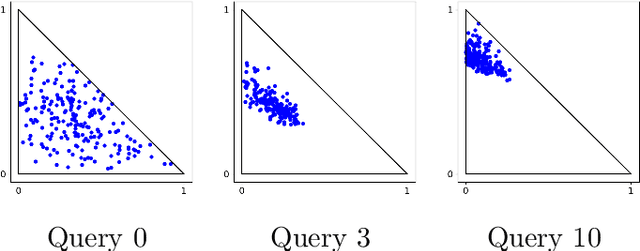
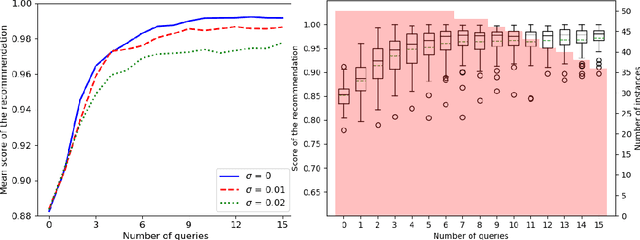
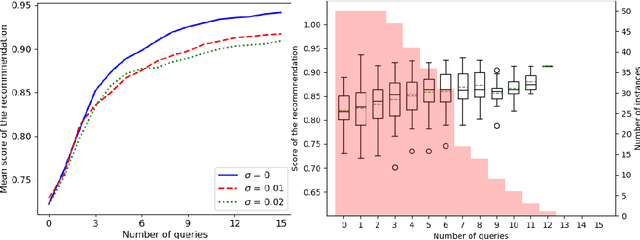
We introduce a new incremental preference elicitation procedure able to deal with noisy responses of a Decision Maker (DM). The originality of the contribution is to propose a Bayesian approach for determining a preferred solution in a multiobjective decision problem involving a combinatorial set of alternatives. We assume that the preferences of the DM are represented by an aggregation function whose parameters are unknown and that the uncertainty about them is represented by a density function on the parameter space. Pairwise comparison queries are used to reduce this uncertainty (by Bayesian revision). The query selection strategy is based on the solution of a mixed integer linear program with a combinatorial set of variables and constraints, which requires to use columns and constraints generation methods. Numerical tests are provided to show the practicability of the approach.