 Add to Chrome
 Add to Firefox
 Add to Edge
Cluster Frequency Conformal Prediction for Local Coverage
May 24, 2026
Conformal prediction provides distribution-free coverage guarantees, but in many-class classification it may still under-cover specific classes or subpopulations, preventing safe deployment in high-stakes applications. We propose Cluster Frequency Conformal Prediction (CFCP), a plug-in framework that adapts conformal prediction to local structure in a learned representation space. CFCP clusters learned embeddings, estimates cluster-level label-frequency distributions from calibration data, and for each test point constructs a sample-specific probability vector by softly mixing nearby cluster distributions regularized with global-prior and reliability-aware shrinkage. This vector is then conformalized using standard set constructors. In the disjoint-split regime, CFCP inherits standard finite-sample marginal validity. Under additional assumptions, CFCP further admits a local-validity interpretation. Since representation clusters aggregate locally similar samples, their empirical class frequencies provide a stable estimate of local label ambiguity. Across image and text benchmarks, CFCP achieves the best class coverage in 15/16 dataset/score-family comparisons and a competitive prediction set size efficiency, with several settings substantially more efficient. Overall, our results show that cluster-frequency information provides an effective localized signal for improving classwise reliability in many-class conformal prediction.

Trajectory-Based Difficulty Scoring for Reliable Learning on Tabular Data
May 23, 2026Gradient-boosted trees achieve strong performance on tabular data, yet often leave a long tail of poorly predicted instances. We introduce a Trajectory-based Difficulty Score (TDS), an instance-level difficulty estimator for boosted ensembles derived from per-tree cumulative prediction trajectories. For each instance, we compute interpretable trajectory descriptors (e.g., variance, oscillation peaks, sign switches, and tail stability) and train a lightweight regression model to predict held-out loss. An empirical CDF calibrates the resulting signal into a score in $[0,1]$ that supports ranking hard cases. Across diverse tabular benchmarks and ensemble sizes, TDS exhibits strong rank correlation with error and outperforms established instance-hardness and uncertainty baselines on classification, while remaining competitive on regression. We then show how a single difficulty signal improves multiple data mining workflows: difficulty-driven active learning for label-efficient training, difficulty-thresholded selective prediction for improved risk-coverage trade-offs, and TDS-stratified (Mondrian) conformal prediction for more uniform conditional coverage. Finally, clustering high-TDS instances using SHAP attributions reveals coherent failure modes characterized by compact feature-value ranges, supporting error analysis and targeted data acquisition.
Calibration and Discrimination Optimization Using Clusters of Learned Representation
Oct 22, 2025Machine learning models are essential for decision-making and risk assessment, requiring highly reliable predictions in terms of both discrimination and calibration. While calibration often receives less attention, it is crucial for critical decisions, such as those in clinical predictions. We introduce a novel calibration pipeline that leverages an ensemble of calibration functions trained on clusters of learned representations of the input samples to enhance overall calibration. This approach not only improves the calibration score of various methods from 82.28% up to 100% but also introduces a unique matching metric that ensures model selection optimizes both discrimination and calibration. Our generic scheme adapts to any underlying representation, clustering, calibration methods and metric, offering flexibility and superior performance across commonly used calibration methods.
CUPCase: Clinically Uncommon Patient Cases and Diagnoses Dataset
Mar 08, 2025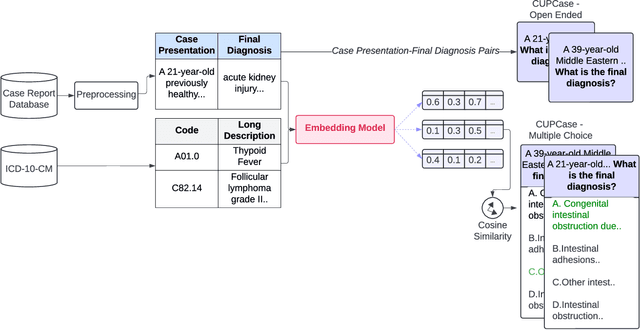
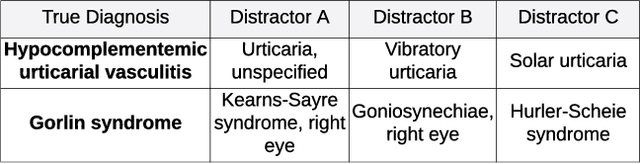
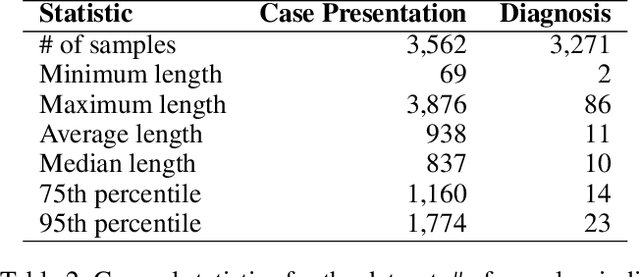
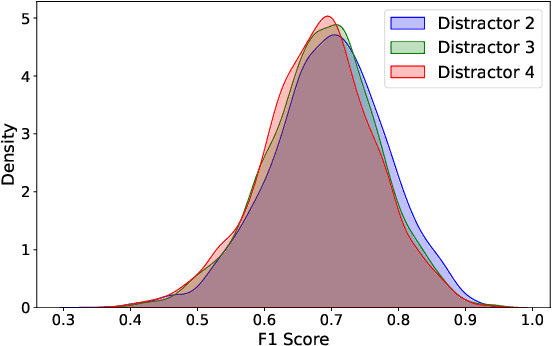
Medical benchmark datasets significantly contribute to developing Large Language Models (LLMs) for medical knowledge extraction, diagnosis, summarization, and other uses. Yet, current benchmarks are mainly derived from exam questions given to medical students or cases described in the medical literature, lacking the complexity of real-world patient cases that deviate from classic textbook abstractions. These include rare diseases, uncommon presentations of common diseases, and unexpected treatment responses. Here, we construct Clinically Uncommon Patient Cases and Diagnosis Dataset (CUPCase) based on 3,562 real-world case reports from BMC, including diagnoses in open-ended textual format and as multiple-choice options with distractors. Using this dataset, we evaluate the ability of state-of-the-art LLMs, including both general-purpose and Clinical LLMs, to identify and correctly diagnose a patient case, and test models' performance when only partial information about cases is available. Our findings show that general-purpose GPT-4o attains the best performance in both the multiple-choice task (average accuracy of 87.9%) and the open-ended task (BERTScore F1 of 0.764), outperforming several LLMs with a focus on the medical domain such as Meditron-70B and MedLM-Large. Moreover, GPT-4o was able to maintain 87% and 88% of its performance with only the first 20% of tokens of the case presentation in multiple-choice and free text, respectively, highlighting the potential of LLMs to aid in early diagnosis in real-world cases. CUPCase expands our ability to evaluate LLMs for clinical decision support in an open and reproducible manner.
MedConceptsQA: Open Source Medical Concepts QA Benchmark
May 14, 2024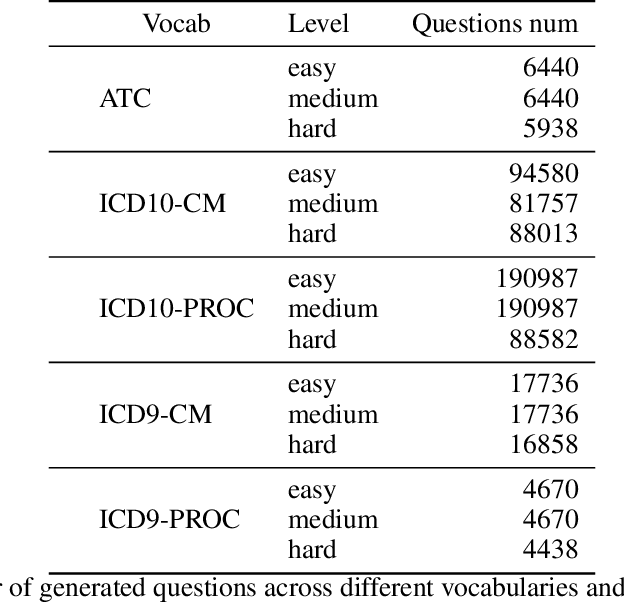
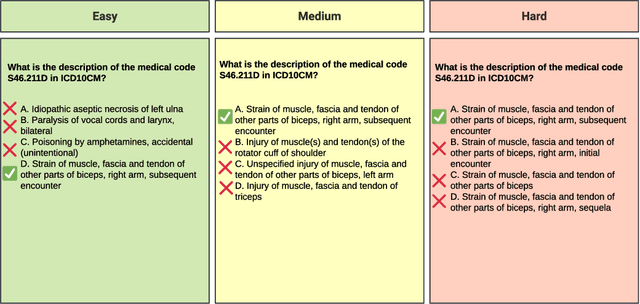
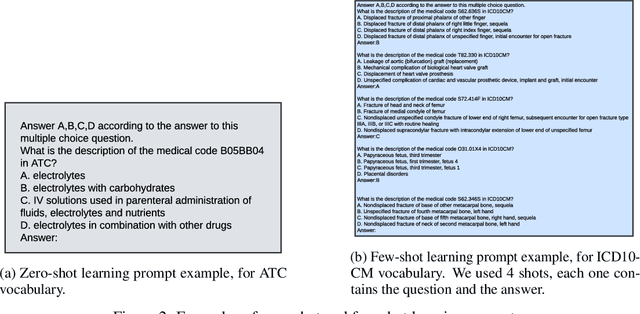
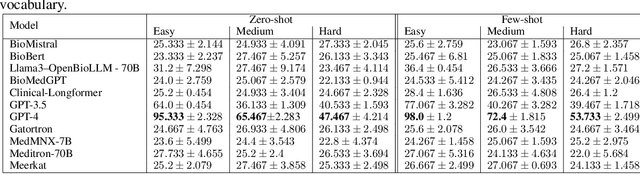
We present MedConceptsQA, a dedicated open source benchmark for medical concepts question answering. The benchmark comprises of questions of various medical concepts across different vocabularies: diagnoses, procedures, and drugs. The questions are categorized into three levels of difficulty: easy, medium, and hard. We conducted evaluations of the benchmark using various Large Language Models. Our findings show that pre-trained clinical Large Language Models achieved accuracy levels close to random guessing on this benchmark, despite being pre-trained on medical data. However, GPT-4 achieves an absolute average improvement of nearly 27%-37% (27% for zero-shot learning and 37% for few-shot learning) when compared to clinical Large Language Models. Our benchmark serves as a valuable resource for evaluating the understanding and reasoning of medical concepts by Large Language Models. Our benchmark is available at https://huggingface.co/datasets/ofir408/MedConceptsQA
DSF-GAN: DownStream Feedback Generative Adversarial Network
Mar 27, 2024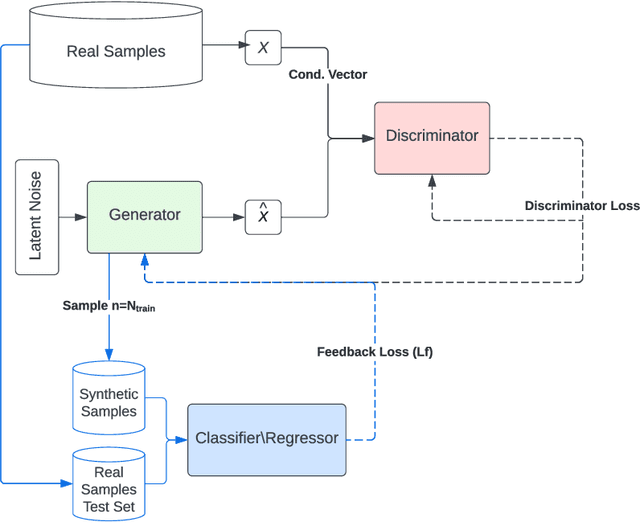
Utility and privacy are two crucial measurements of the quality of synthetic tabular data. While significant advancements have been made in privacy measures, generating synthetic samples with high utility remains challenging. To enhance the utility of synthetic samples, we propose a novel architecture called the DownStream Feedback Generative Adversarial Network (DSF-GAN). This approach incorporates feedback from a downstream prediction model during training to augment the generator's loss function with valuable information. Thus, DSF-GAN utilizes a downstream prediction task to enhance the utility of synthetic samples. To evaluate our method, we tested it using two popular datasets. Our experiments demonstrate improved model performance when training on synthetic samples generated by DSF-GAN, compared to those generated by the same GAN architecture without feedback. The evaluation was conducted on the same validation set comprising real samples. All code and datasets used in this research will be made openly available for ease of reproduction.
CPLLM: Clinical Prediction with Large Language Models
Sep 20, 2023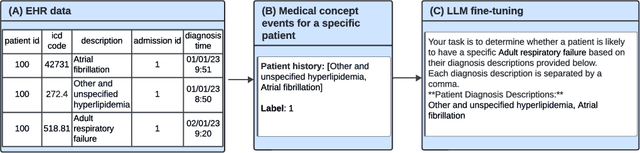
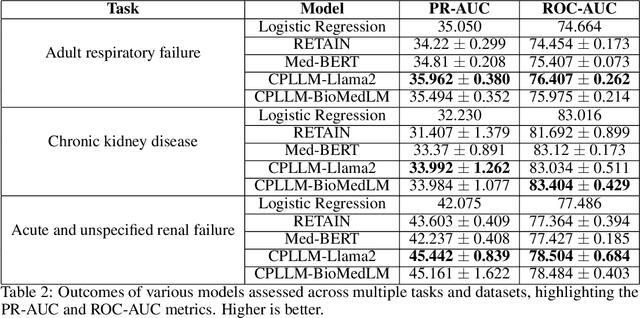
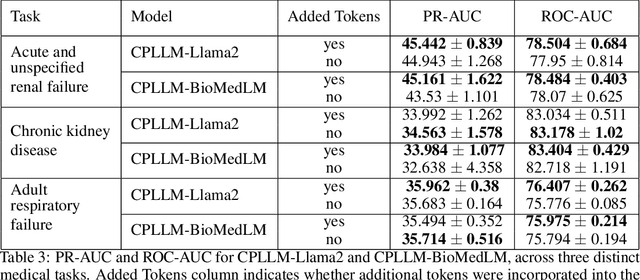
We present Clinical Prediction with Large Language Models (CPLLM), a method that involves fine-tuning a pre-trained Large Language Model (LLM) for clinical disease prediction. We utilized quantization and fine-tuned the LLM using prompts, with the task of predicting whether patients will be diagnosed with a target disease during their next visit or in the subsequent diagnosis, leveraging their historical diagnosis records. We compared our results versus various baselines, including Logistic Regression, RETAIN, and Med-BERT, which is the current state-of-the-art model for disease prediction using structured EHR data. Our experiments have shown that CPLLM surpasses all the tested models in terms of both PR-AUC and ROC-AUC metrics, displaying noteworthy enhancements compared to the baseline models.
Ensemble Synthetic EHR Generation for Increasing Subpopulation Model's Performance
May 25, 2023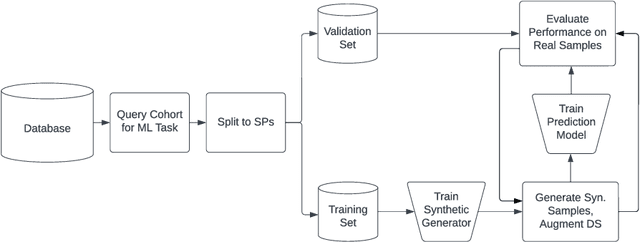
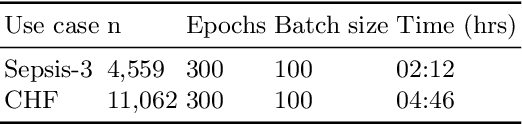
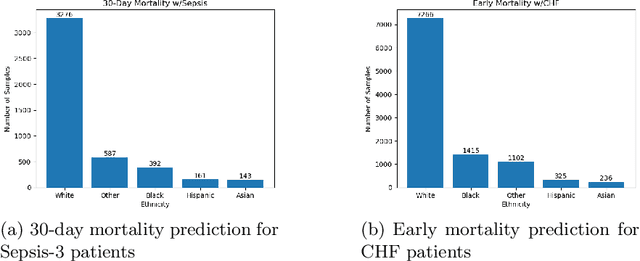
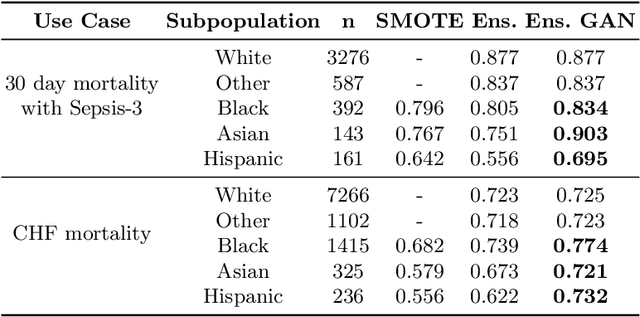
Electronic health records (EHR) often contain different rates of representation of certain subpopulations (SP). Factors like patient demographics, clinical condition prevalence, and medical center type contribute to this underrepresentation. Consequently, when training machine learning models on such datasets, the models struggle to generalize well and perform poorly on underrepresented SPs. To address this issue, we propose a novel ensemble framework that utilizes generative models. Specifically, we train a GAN-based synthetic data generator for each SP and incorporate synthetic samples into each SP training set. Ultimately, we train SP-specific prediction models. To properly evaluate this method, we design an evaluation pipeline with 2 real-world use case datasets, queried from the MIMIC database. Our approach shows increased model performance over underrepresented SPs. Our code and models are given as supplementary and will be made available on a public repository.
Federated Learning of Medical Concepts Embedding using BEHRT
May 22, 2023
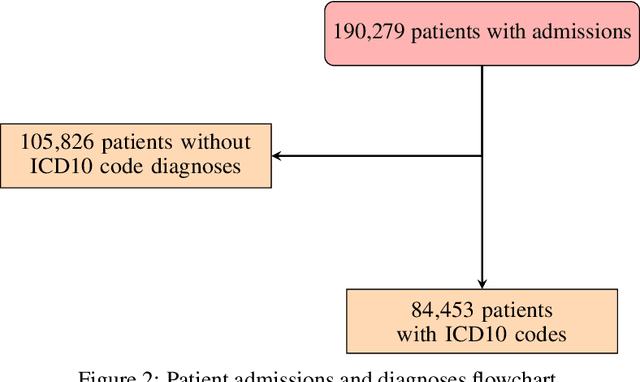
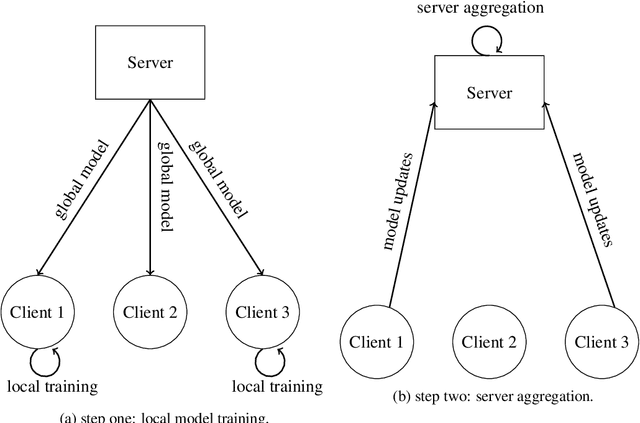
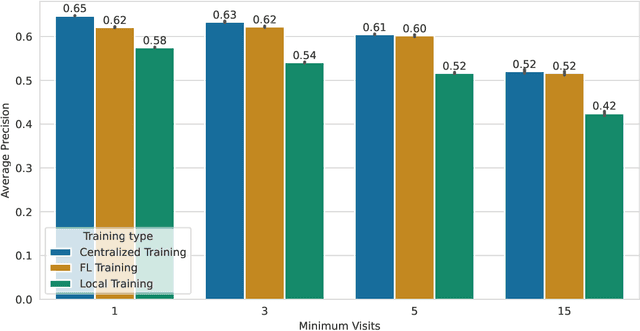
Electronic Health Records (EHR) data contains medical records such as diagnoses, medications, procedures, and treatments of patients. This data is often considered sensitive medical information. Therefore, the EHR data from the medical centers often cannot be shared, making it difficult to create prediction models using multi-center EHR data, which is essential for such models' robustness and generalizability. Federated Learning (FL) is an algorithmic approach that allows learning a shared model using data in multiple locations without the need to store all data in a central place. An example of a prediction model's task is to predict future diseases. More specifically, the model needs to predict patient's next visit diagnoses, based on current and previous clinical data. Such a prediction model can support care providers in making clinical decisions and even provide preventive treatment. We propose a federated learning approach for learning medical concepts embedding. This pre-trained model can be used for fine-tuning for specific downstream tasks. Our approach is based on an embedding model like BEHRT, a deep neural sequence transduction model for EHR. We train using federated learning, both the Masked Language Modeling (MLM) and the next visit downstream model. We demonstrate our approach on the MIMIC-IV dataset. We compare the performance of a model trained with FL against a model trained on centralized data. We find that our federated learning approach reaches very close to the performance of a centralized model, and it outperforms local models in terms of average precision. We also show that pre-trained MLM improves the model's average precision performance in the next visit prediction task, compared to an MLM model without pre-training. Our code is available at https://github.com/nadavlab/FederatedBEHRT.