 Add to Chrome
 Add to Firefox
 Add to Edge
IndicEval: A Bilingual Indian Educational Evaluation Framework for Large Language Models
Feb 18, 2026
The rapid advancement of large language models (LLMs) necessitates evaluation frameworks that reflect real-world academic rigor and multilingual complexity. This paper introduces IndicEval, a scalable benchmarking platform designed to assess LLM performance using authentic high-stakes examination questions from UPSC, JEE, and NEET across STEM and humanities domains in both English and Hindi. Unlike synthetic benchmarks, IndicEval grounds evaluation in real examination standards, enabling realistic measurement of reasoning, domain knowledge, and bilingual adaptability. The framework automates assessment using Zero-Shot, Few-Shot, and Chain-of-Thought (CoT) prompting strategies and supports modular integration of new models and languages. Experiments conducted on Gemini 2.0 Flash, GPT-4, Claude, and LLaMA 3-70B reveal three major findings. First, CoT prompting consistently improves reasoning accuracy, with substantial gains across subjects and languages. Second, significant cross-model performance disparities persist, particularly in high-complexity examinations. Third, multilingual degradation remains a critical challenge, with marked accuracy drops in Hindi compared to English, especially under Zero-Shot conditions. These results highlight persistent gaps in bilingual reasoning and domain transfer. Overall, IndicEval provides a practice-oriented, extensible foundation for rigorous, equitable evaluation of LLMs in multilingual educational settings and offers actionable insights for improving reasoning robustness and language adaptability.

Improving LLM Reliability through Hybrid Abstention and Adaptive Detection
Feb 17, 2026Large Language Models (LLMs) deployed in production environments face a fundamental safety-utility trade-off either a strict filtering mechanisms prevent harmful outputs but often block benign queries or a relaxed controls risk unsafe content generation. Conventional guardrails based on static rules or fixed confidence thresholds are typically context-insensitive and computationally expensive, resulting in high latency and degraded user experience. To address these limitations, we introduce an adaptive abstention system that dynamically adjusts safety thresholds based on real-time contextual signals such as domain and user history. The proposed framework integrates a multi-dimensional detection architecture composed of five parallel detectors, combined through a hierarchical cascade mechanism to optimize both speed and precision. The cascade design reduces unnecessary computation by progressively filtering queries, achieving substantial latency improvements compared to non-cascaded models and external guardrail systems. Extensive evaluation on mixed and domain-specific workloads demonstrates significant reductions in false positives, particularly in sensitive domains such as medical advice and creative writing. The system maintains high safety precision and near-perfect recall under strict operating modes. Overall, our context-aware abstention framework effectively balances safety and utility while preserving performance, offering a scalable solution for reliable LLM deployment.
Explainability-Inspired Layer-Wise Pruning of Deep Neural Networks for Efficient Object Detection
Feb 15, 2026Deep neural networks (DNNs) have achieved remarkable success in object detection tasks, but their increasing complexity poses significant challenges for deployment on resource-constrained platforms. While model compression techniques such as pruning have emerged as essential tools, traditional magnitude-based pruning methods do not necessarily align with the true functional contribution of network components to task-specific performance. In this work, we present an explainability-inspired, layer-wise pruning framework tailored for efficient object detection. Our approach leverages a SHAP-inspired gradient--activation attribution to estimate layer importance, providing a data-driven proxy for functional contribution rather than relying solely on static weight magnitudes. We conduct comprehensive experiments across diverse object detection architectures, including ResNet-50, MobileNetV2, ShuffleNetV2, Faster R-CNN, RetinaNet, and YOLOv8, evaluating performance on the Microsoft COCO 2017 validation set. The results show that the proposed attribution-inspired pruning consistently identifies different layers as least important compared to L1-norm-based methods, leading to improved accuracy--efficiency trade-offs. Notably, for ShuffleNetV2, our method yields a 10\% empirical increase in inference speed, whereas L1-pruning degrades performance by 13.7\%. For RetinaNet, the proposed approach preserves the baseline mAP (0.151) with negligible impact on inference speed, while L1-pruning incurs a 1.3\% mAP drop for a 6.2\% speed increase. These findings highlight the importance of data-driven layer importance assessment and demonstrate that explainability-inspired compression offers a principled direction for deploying deep neural networks on edge and resource-constrained platforms while preserving both performance and interpretability.
ABHINAW: A method for Automatic Evaluation of Typography within AI-Generated Images
Sep 18, 2024
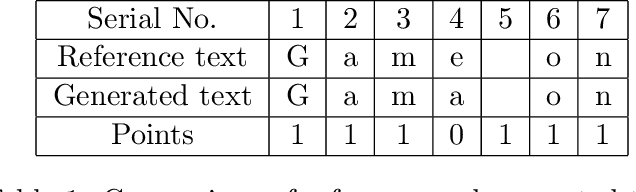


In the fast-evolving field of Generative AI, platforms like MidJourney, DALL-E, and Stable Diffusion have transformed Text-to-Image (T2I) Generation. However, despite their impressive ability to create high-quality images, they often struggle to generate accurate text within these images. Theoretically, if we could achieve accurate text generation in AI images in a ``zero-shot'' manner, it would not only make AI-generated images more meaningful but also democratize the graphic design industry. The first step towards this goal is to create a robust scoring matrix for evaluating text accuracy in AI-generated images. Although there are existing bench-marking methods like CLIP SCORE and T2I-CompBench++, there's still a gap in systematically evaluating text and typography in AI-generated images, especially with diffusion-based methods. In this paper, we introduce a novel evaluation matrix designed explicitly for quantifying the performance of text and typography generation within AI-generated images. We have used letter by letter matching strategy to compute the exact matching scores from the reference text to the AI generated text. Our novel approach to calculate the score takes care of multiple redundancies such as repetition of words, case sensitivity, mixing of words, irregular incorporation of letters etc. Moreover, we have developed a Novel method named as brevity adjustment to handle excess text. In addition we have also done a quantitative analysis of frequent errors arise due to frequently used words and less frequently used words. Project page is available at: https://github.com/Abhinaw3906/ABHINAW-MATRIX.