 Add to Chrome
 Add to Firefox
 Add to Edge
Directional Textual Inversion for Personalized Text-to-Image Generation
Dec 15, 2025
Textual Inversion (TI) is an efficient approach to text-to-image personalization but often fails on complex prompts. We trace these failures to embedding norm inflation: learned tokens drift to out-of-distribution magnitudes, degrading prompt conditioning in pre-norm Transformers. Empirically, we show semantics are primarily encoded by direction in CLIP token space, while inflated norms harm contextualization; theoretically, we analyze how large magnitudes attenuate positional information and hinder residual updates in pre-norm blocks. We propose Directional Textual Inversion (DTI), which fixes the embedding magnitude to an in-distribution scale and optimizes only direction on the unit hypersphere via Riemannian SGD. We cast direction learning as MAP with a von Mises-Fisher prior, yielding a constant-direction prior gradient that is simple and efficient to incorporate. Across personalization tasks, DTI improves text fidelity over TI and TI-variants while maintaining subject similarity. Crucially, DTI's hyperspherical parameterization enables smooth, semantically coherent interpolation between learned concepts (slerp), a capability that is absent in standard TI. Our findings suggest that direction-only optimization is a robust and scalable path for prompt-faithful personalization.

DGQ: Distribution-Aware Group Quantization for Text-to-Image Diffusion Models
Jan 08, 2025Despite the widespread use of text-to-image diffusion models across various tasks, their computational and memory demands limit practical applications. To mitigate this issue, quantization of diffusion models has been explored. It reduces memory usage and computational costs by compressing weights and activations into lower-bit formats. However, existing methods often struggle to preserve both image quality and text-image alignment, particularly in lower-bit($<$ 8bits) quantization. In this paper, we analyze the challenges associated with quantizing text-to-image diffusion models from a distributional perspective. Our analysis reveals that activation outliers play a crucial role in determining image quality. Additionally, we identify distinctive patterns in cross-attention scores, which significantly affects text-image alignment. To address these challenges, we propose Distribution-aware Group Quantization (DGQ), a method that identifies and adaptively handles pixel-wise and channel-wise outliers to preserve image quality. Furthermore, DGQ applies prompt-specific logarithmic quantization scales to maintain text-image alignment. Our method demonstrates remarkable performance on datasets such as MS-COCO and PartiPrompts. We are the first to successfully achieve low-bit quantization of text-to-image diffusion models without requiring additional fine-tuning of weight quantization parameters.
TextBoost: Towards One-Shot Personalization of Text-to-Image Models via Fine-tuning Text Encoder
Sep 12, 2024


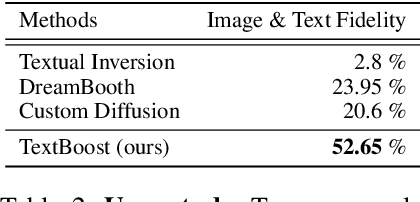
Recent breakthroughs in text-to-image models have opened up promising research avenues in personalized image generation, enabling users to create diverse images of a specific subject using natural language prompts. However, existing methods often suffer from performance degradation when given only a single reference image. They tend to overfit the input, producing highly similar outputs regardless of the text prompt. This paper addresses the challenge of one-shot personalization by mitigating overfitting, enabling the creation of controllable images through text prompts. Specifically, we propose a selective fine-tuning strategy that focuses on the text encoder. Furthermore, we introduce three key techniques to enhance personalization performance: (1) augmentation tokens to encourage feature disentanglement and alleviate overfitting, (2) a knowledge-preservation loss to reduce language drift and promote generalizability across diverse prompts, and (3) SNR-weighted sampling for efficient training. Extensive experiments demonstrate that our approach efficiently generates high-quality, diverse images using only a single reference image while significantly reducing memory and storage requirements.