 Add to Chrome
 Add to Firefox
 Add to Edge
AlignTune: Modular Toolkit for Post-Training Alignment of Large Language Models
Feb 11, 2026
Post-training alignment is central to deploying large language models (LLMs), yet practical workflows remain split across backend-specific tools and ad-hoc glue code, making experiments hard to reproduce. We identify backend interference, reward fragmentation, and irreproducible pipelines as key obstacles in alignment research. We introduce AlignTune, a modular toolkit exposing a unified interface for supervised fine-tuning (SFT) and RLHF-style optimization with interchangeable TRL and Unsloth backends. AlignTune standardizes configuration, provides an extensible reward layer (rule-based and learned), and integrates evaluation over standard benchmarks and custom tasks. By isolating backend-specific logic behind a single factory boundary, AlignTune enables controlled comparisons and reproducible alignment experiments.

Beyond Uniform Credit: Causal Credit Assignment for Policy Optimization
Feb 10, 2026Policy gradient methods for language model reasoning, such as GRPO and DAPO, assign uniform credit to all generated tokens - the filler phrase "Let me think" receives the same gradient update as the critical calculation "23 + 45 = 68." We propose counterfactual importance weighting: mask reasoning spans, measure the drop in answer probability, and upweight tokens accordingly during policy gradient updates. Our method requires no auxiliary models or external annotation, instead importance is estimated directly from the policy model's own probability shifts. Experiments on GSM8K across three models spanning the Qwen and Llama families demonstrate consistent improvements over uniform baselines and faster convergence to equivalent accuracy. Inverting the importance signal hurts performance, confirming we capture genuine causal structure rather than noise. Analysis shows the method correctly prioritizes calculation steps over scaffolding text. We view these findings as establishing counterfactual importance weighting as a foundation for further research rather than a complete solution.
Beyond KL Divergence: Policy Optimization with Flexible Bregman Divergences for LLM Reasoning
Feb 04, 2026Policy optimization methods like Group Relative Policy Optimization (GRPO) and its variants have achieved strong results on mathematical reasoning and code generation tasks. Despite extensive exploration of reward processing strategies and training dynamics, all existing group-based methods exclusively use KL divergence for policy regularization, leaving the choice of divergence function unexplored. We introduce Group-Based Mirror Policy Optimization (GBMPO), a framework that extends group-based policy optimization to flexible Bregman divergences, including hand-designed alternatives (L2 in probability space) and learned neural mirror maps. On GSM8K mathematical reasoning, hand-designed ProbL2-GRPO achieves 86.7% accuracy, improving +5.5 points over the Dr. GRPO baseline. On MBPP code generation, neural mirror maps reach 60.1-60.8% pass@1, with random initialization already capturing most of the benefit. While evolutionary strategies meta-learning provides marginal accuracy improvements, its primary value lies in variance reduction ($\pm$0.2 versus $\pm$0.6) and efficiency gains (15% shorter responses on MBPP), suggesting that random initialization of neural mirror maps is sufficient for most practical applications. These results establish divergence choice as a critical, previously unexplored design dimension in group-based policy optimization for LLM reasoning.
Benchmarking Multimodal Models for Ukrainian Language Understanding Across Academic and Cultural Domains
Nov 22, 2024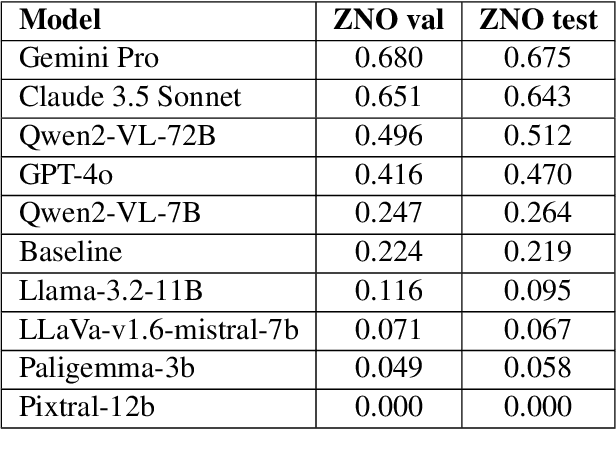
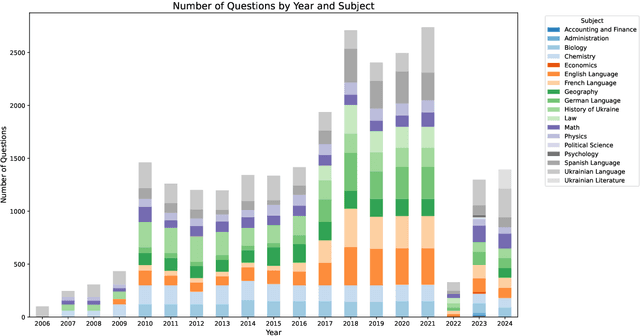
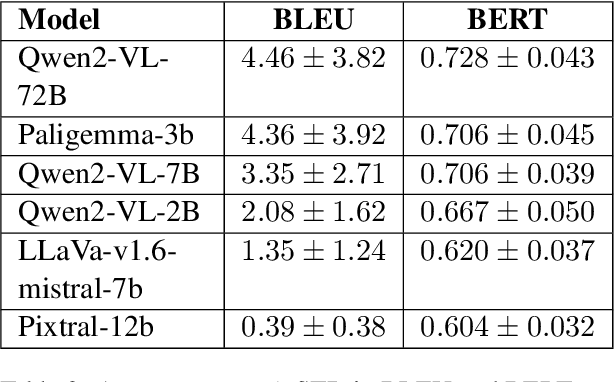
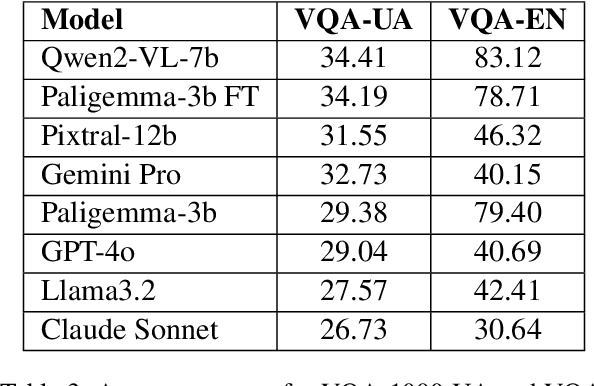
While the evaluation of multimodal English-centric models is an active area of research with numerous benchmarks, there is a profound lack of benchmarks or evaluation suites for low- and mid-resource languages. We introduce ZNO-Vision, a comprehensive multimodal Ukrainian-centric benchmark derived from standardized university entrance examination (ZNO). The benchmark consists of over 4,300 expert-crafted questions spanning 12 academic disciplines, including mathematics, physics, chemistry, and humanities. We evaluated the performance of both open-source models and API providers, finding that only a handful of models performed above baseline. Alongside the new benchmark, we performed the first evaluation study of multimodal text generation for the Ukrainian language: we measured caption generation quality on the Multi30K-UK dataset, translated the VQA benchmark into Ukrainian, and measured performance degradation relative to original English versions. Lastly, we tested a few models from a cultural perspective on knowledge of national cuisine. We believe our work will advance multimodal generation capabilities for the Ukrainian language and our approach could be useful for other low-resource languages.
From English-Centric to Effective Bilingual: LLMs with Custom Tokenizers for Underrepresented Languages
Oct 24, 2024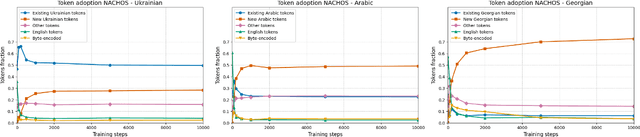

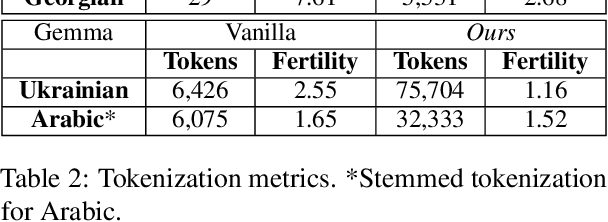
In this paper, we propose a model-agnostic cost-effective approach to developing bilingual base large language models (LLMs) to support English and any target language. The method includes vocabulary expansion, initialization of new embeddings, model training and evaluation. We performed our experiments with three languages, each using a non-Latin script - Ukrainian, Arabic, and Georgian. Our approach demonstrates improved language performance while reducing computational costs. It mitigates the disproportionate penalization of underrepresented languages, promoting fairness and minimizing adverse phenomena such as code-switching and broken grammar. Additionally, we introduce new metrics to evaluate language quality, revealing that vocabulary size significantly impacts the quality of generated text.
From Bytes to Borsch: Fine-Tuning Gemma and Mistral for the Ukrainian Language Representation
Apr 14, 2024In the rapidly advancing field of AI and NLP, generative large language models (LLMs) stand at the forefront of innovation, showcasing unparalleled abilities in text understanding and generation. However, the limited representation of low-resource languages like Ukrainian poses a notable challenge, restricting the reach and relevance of this technology. Our paper addresses this by fine-tuning the open-source Gemma and Mistral LLMs with Ukrainian datasets, aiming to improve their linguistic proficiency and benchmarking them against other existing models capable of processing Ukrainian language. This endeavor not only aims to mitigate language bias in technology but also promotes inclusivity in the digital realm. Our transparent and reproducible approach encourages further NLP research and development. Additionally, we present the Ukrainian Knowledge and Instruction Dataset (UKID) to aid future efforts in language model fine-tuning. Our research not only advances the field of NLP but also highlights the importance of linguistic diversity in AI, which is crucial for cultural preservation, education, and expanding AI's global utility. Ultimately, we advocate for a future where technology is inclusive, enabling AI to communicate effectively across all languages, especially those currently underrepresented.