 Add to Chrome
 Add to Firefox
 Add to Edge
Graph Neural Network-based Algorithm Selection for the Traveling Salesman Problem: A Systematic Study of Cost and Rank Losses under Distinct Budget Regimes
Jul 21, 2026
Automated Algorithm Selection (AS) aims to improve problem-solving performance by selecting, for each problem instance, the most suitable algorithm from a predefined portfolio. This is particularly relevant to the Traveling Salesman Problem (TSP), where solver performance is strongly instance-dependent. We introduce GNNAS-TSP, a Graph Neural Network (GNN)-based AS framework that learns TSP instance representations directly from raw graph data, avoiding manual feature engineering. GNNAS-TSP formulates AS as a joint cost-prediction and ranking task. We evaluate cost-based (mean squared error (MSE), mean absolute error (MAE), and Huber), rank-based (RankNet, ListNet, and LambdaRank), and hybrid learning objectives for a portfolio comprising Chained Lin-Kernighan, Edge Assembly Crossover, Lin-Kernighan-Helsgaun, Multiagent Optimization System, and Concorde. Experiments use fixed computational budgets of 10 and 60 seconds. On the held-out test set, the selected configurations improve on the Single Best Solver (SBS) in normalized solution cost at both budgets. For the 10s budget, AS achieves substantial and statistically significant cost improvement over SBS. Overall, the results suggest that GNNAS-TSP is a useful meta-solving strategy when exploitable variation exists across solver performance.

Beyond Numerical Features: CNN-Driven Algorithm Selection via Contour Plots for Continuous Black-Box Optimization
May 20, 2026The present paper introduces a new representation-driven approach to per-instance algorithm selection, applied to black-box optimization, for automatically choosing the most promising solver from a fixed portfolio. Prior work in continuous optimization largely relies on numerical descriptors, including Exploratory Landscape Analysis features and learned embeddings such as Deep-ELA. This work studies a complementary representation: contour-map visualizations of probed landscapes. A CNN regressor takes multiple instance-specific contour views (stacked or encoded per view and aggregated) and predicts per-solver performance, enabling selection by the predicted best value. On the standard BBOB 2009 single-objective protocol, the resulting selectors significantly outperform the single best solver (SBS) and are competitive with feature-based baselines. A subsequent bi-objective evaluation under the DeepELA setting further indicates that the same image-based principle can be competitive when using windowed contour views. Overall, the results suggest that simple vision models can exploit spatial structure in probed landscapes for algorithm selection without handcrafted ELA features.
GeoPAS: Geometric Probing for Algorithm Selection in Continuous Black-Box Optimisation
Apr 14, 2026Automated algorithm selection in continuous black-box optimisation typically relies on fixed landscape descriptors computed under a limited probing budget, yet such descriptors can degrade under problem-split or cross-benchmark evaluation. We propose GeoPAS, a geometric probing approach that represents a problem instance by multiple coarse two-dimensional slices sampled across locations, orientations, and logarithmic scales. A shared validity-aware convolutional encoder maps each slice to an embedding, conditions it on slice-scale and amplitude statistics, and aggregates the resulting features permutation-invariantly for risk-aware solver selection via log-scale performance prediction with an explicit penalty on tail failures. On COCO/BBOB with a 12-solver portfolio in dimensions 2--10, GeoPAS improves over the single best solver under leave-instance-out, grouped random, and leave-problem-out evaluation. These results suggest that multi-scale geometric slices provide a useful transferable static signal for algorithm selection, although a small number of heavy-tail regimes remain and continue to dominate the mean. Our code is available at https://github.com/BradWangW/GeoPAS.
GNNAS-Dock: Budget Aware Algorithm Selection with Graph Neural Networks for Molecular Docking
Nov 19, 2024Molecular docking is a major element in drug discovery and design. It enables the prediction of ligand-protein interactions by simulating the binding of small molecules to proteins. Despite the availability of numerous docking algorithms, there is no single algorithm consistently outperforms the others across a diverse set of docking scenarios. This paper introduces GNNAS-Dock, a novel Graph Neural Network (GNN)-based automated algorithm selection system for molecular docking in blind docking situations. GNNs are accommodated to process the complex structural data of both ligands and proteins. They benefit from the inherent graph-like properties to predict the performance of various docking algorithms under different conditions. The present study pursues two main objectives: 1) predict the performance of each candidate docking algorithm, in terms of Root Mean Square Deviation (RMSD), thereby identifying the most accurate method for specific scenarios; and 2) choose the best computationally efficient docking algorithm for each docking case, aiming to reduce the time required for docking while maintaining high accuracy. We validate our approach on PDBBind 2020 refined set, which contains about 5,300 pairs of protein-ligand complexes.
A case study of algorithm selection for the traveling thief problem
Sep 02, 2016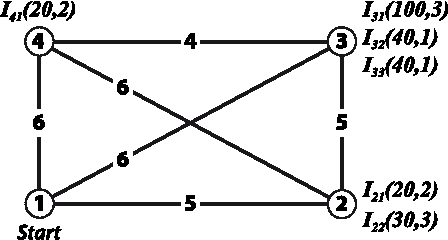
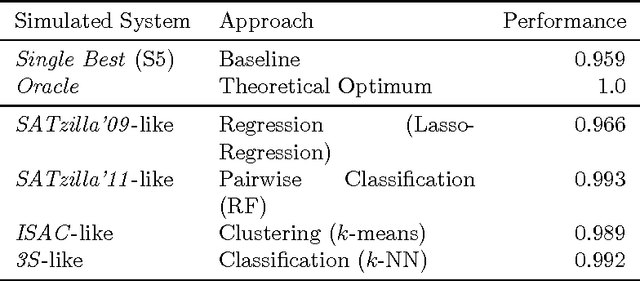
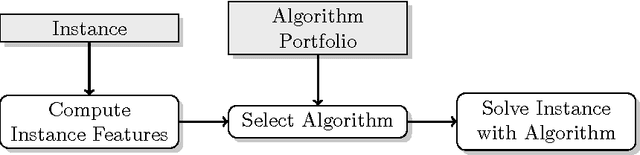
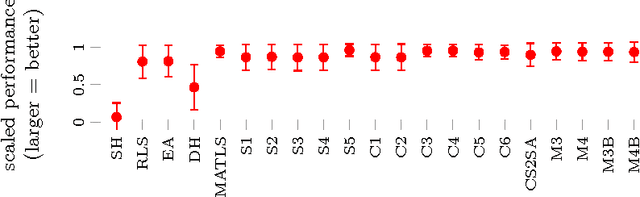
Many real-world problems are composed of several interacting components. In order to facilitate research on such interactions, the Traveling Thief Problem (TTP) was created in 2013 as the combination of two well-understood combinatorial optimization problems. With this article, we contribute in four ways. First, we create a comprehensive dataset that comprises the performance data of 21 TTP algorithms on the full original set of 9720 TTP instances. Second, we define 55 characteristics for all TPP instances that can be used to select the best algorithm on a per-instance basis. Third, we use these algorithms and features to construct the first algorithm portfolios for TTP, clearly outperforming the single best algorithm. Finally, we study which algorithms contribute most to this portfolio.