 Add to Chrome
 Add to Firefox
 Add to Edge
SEDULity: A Proof-of-Learning Framework for Distributed and Secure Blockchains with Efficient Useful Work
Dec 15, 2025
The security and decentralization of Proof-of-Work (PoW) have been well-tested in existing blockchain systems. However, its tremendous energy waste has raised concerns about sustainability. Proof-of-Useful-Work (PoUW) aims to redirect the meaningless computation to meaningful tasks such as solving machine learning (ML) problems, giving rise to the branch of Proof-of-Learning (PoL). While previous studies have proposed various PoLs, they all, to some degree, suffer from security, decentralization, or efficiency issues. In this paper, we propose a PoL framework that trains ML models efficiently while maintaining blockchain security in a fully distributed manner. We name the framework SEDULity, which stands for a Secure, Efficient, Distributed, and Useful Learning-based blockchain system. Specifically, we encode the template block into the training process and design a useful function that is difficult to solve but relatively easy to verify, as a substitute for the PoW puzzle. We show that our framework is distributed, secure, and efficiently trains ML models. We further demonstrate that the proposed PoL framework can be extended to other types of useful work and design an incentive mechanism to incentivize task verification. We show theoretically that a rational miner is incentivized to train fully honestly with well-designed system parameters. Finally, we present simulation results to demonstrate the performance of our framework and validate our analysis.

Dynamical Dorfman Testing with Quarantine
Jan 18, 2022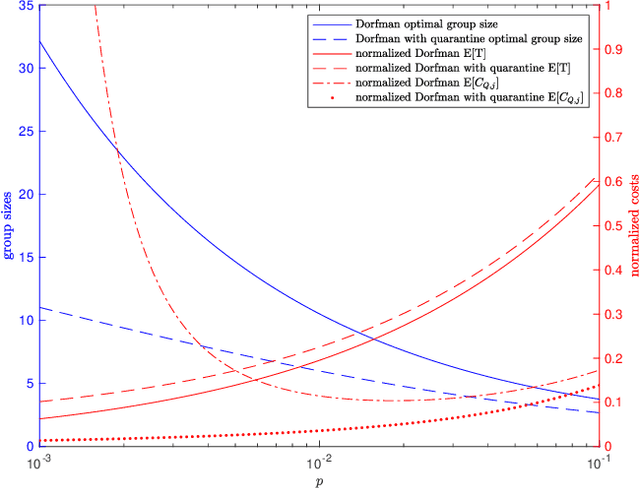
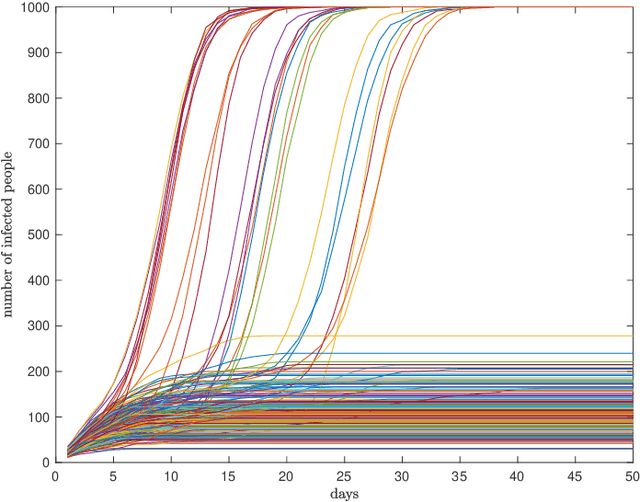
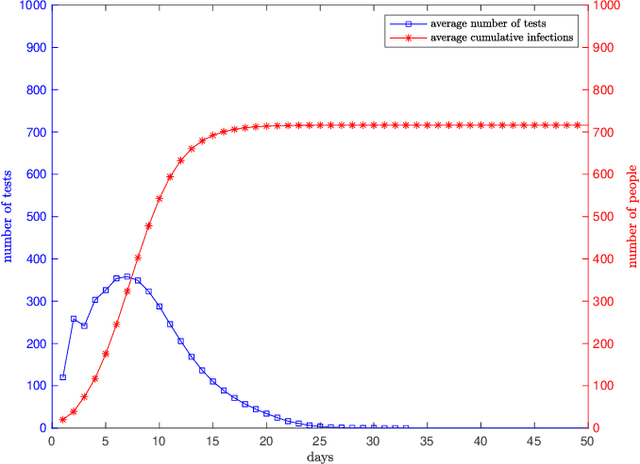
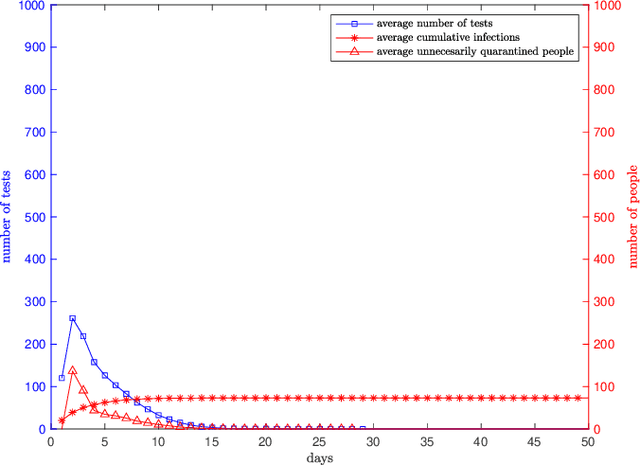
We consider dynamical group testing problem with a community structure. With a discrete-time SIR (susceptible, infectious, recovered) model, we use Dorfman's two-step group testing approach to identify infections, and step in whenever necessary to inhibit infection spread via quarantines. We analyze the trade-off between quarantine and test costs as well as disease spread. For the special dynamical i.i.d. model, we show that the optimal first stage Dorfman group size differs in dynamic and static cases. We compare the performance of the proposed dynamic two-stage Dorfman testing with state-of-the-art non-adaptive group testing method in dynamic settings.
Group Testing with Non-identical Infection Probabilities
Aug 27, 2021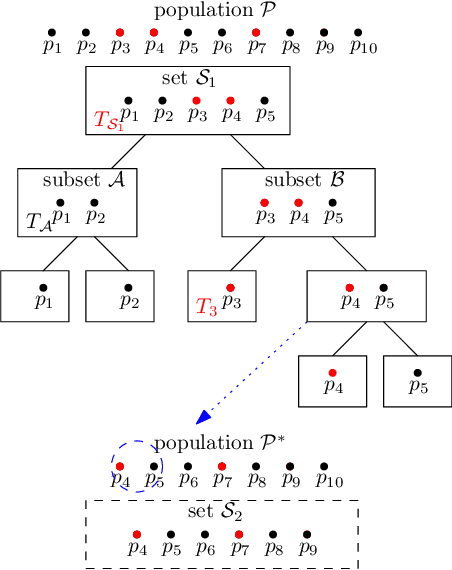
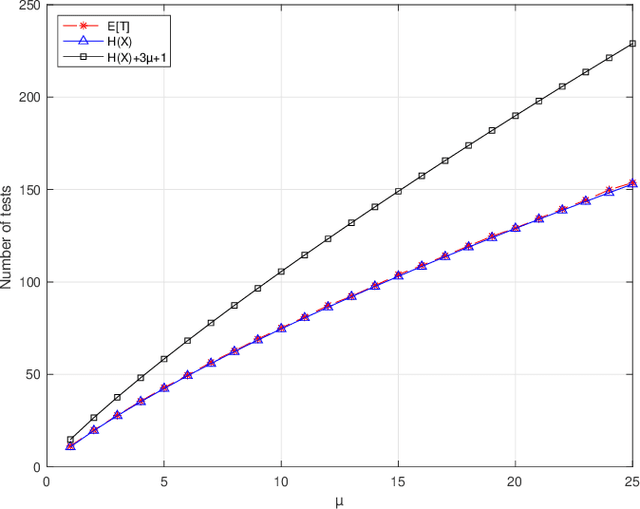
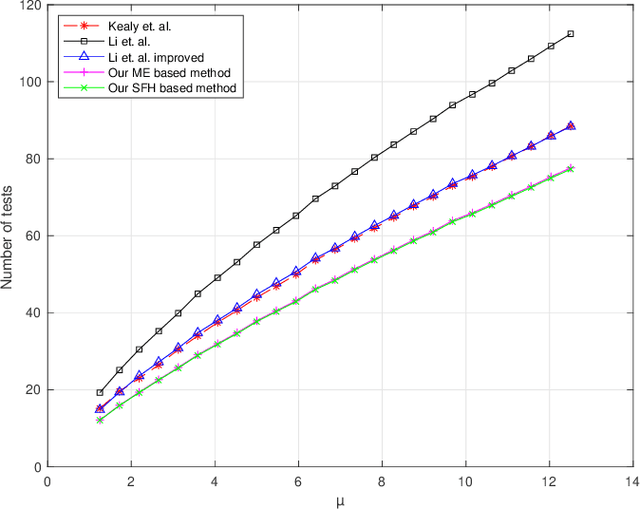
We consider a zero-error probabilistic group testing problem where individuals are defective independently but not with identical probabilities. We propose a greedy set formation method to build sets of individuals to be tested together. We develop an adaptive group testing algorithm that uses the proposed set formation method recursively. We prove novel upper bounds on the number of tests for the proposed algorithm. Via numerical results, we show that our algorithm outperforms the state of the art, and performs close to the entropy lower bound.