 Add to Chrome
 Add to Firefox
 Add to Edge
Enhanced Low-Density Region Exploration in Classifier-Guided Diffusion Models Through Modified Reverse Diffusion Sampling
Jun 11, 2026
Diffusion models have emerged as state-of-the-art generative models for high-fidelity image synthesis, particularly in their classifier-free guided and classifier-guided forms. However, standard classifier guidance concentrates probability mass around high-density class mean, leading to poor coverage of rare samples in the tails of the class-conditional distributions. Recent work on diffusion-based tail sampling mitigates this by training an additional low-density-seeking classifier with a synthetic-vs-real discriminator, at the cost of additional networks and training. In parallel, a number of samplers and distillation techniques accelerate or refine diffusion sampling, but do not explicitly address long-tail coverage. We propose a purely sampling-time, density-aware extension of classifier-guided conditional diffusion model that targets low-density regions without any additional training. We have applied guidance at noisy images not on predicted noise like most diffusion models. Starting from a pretrained conditional diffusion model and classifier on ImageNet, we modify the guided reverse dynamics by steering trajectories toward low-confidence regions via the modified classifier gradient, and at each time step, we also guide the sampling process toward the predicted real image. 1st guidance helps explore low-probability samples, and 2nd guidance helps to generate samples to be close to the real data manifold. The proposed sampler consistently improves ADM model recall at 64x64 resolution while maintaining a comparable FID, and with a 256x256 ADM model, we showed the results visually with different combinations of both guidance. We also showed that standard ADM classifier guidance, combined with predicted real image guidance, helps generate high perceptual quality samples with a 256x256 ADM model on ImageNet.

Optimizing Supply Chain Management using Gravitational Search Algorithm and Multi Agent System
Sep 03, 2012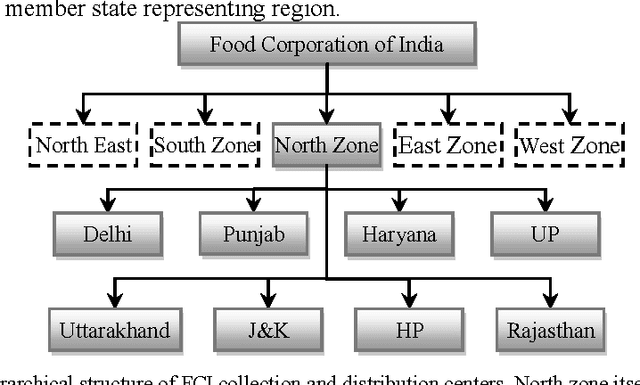
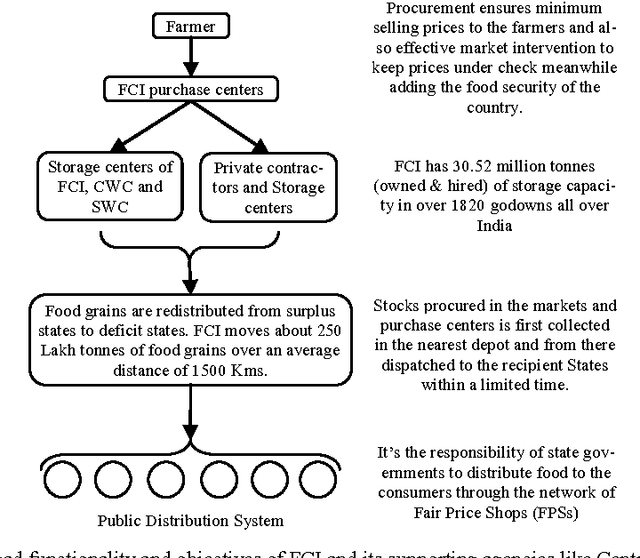
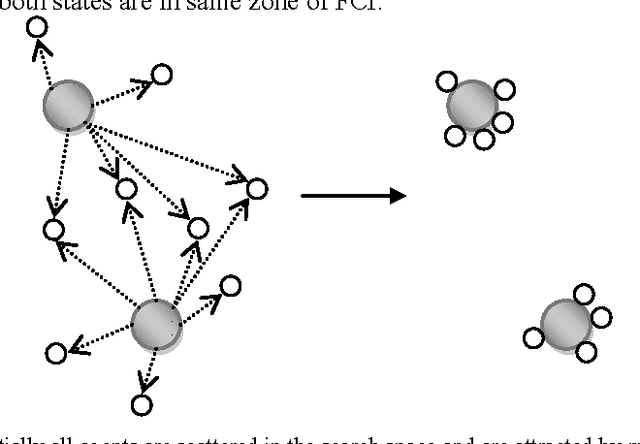
Supply chain management is a very dynamic operation research problem where one has to quickly adapt according to the changes perceived in environment in order to maximize the benefit or minimize the loss. Therefore we require a system which changes as per the changing requirements. Multi agent system technology in recent times has emerged as a possible way of efficient solution implementation for many such complex problems. Our research here focuses on building a Multi Agent System (MAS), which implements a modified version of Gravitational Search swarm intelligence Algorithm (GSA) to find out an optimal strategy in managing the demand supply chain. We target the grains distribution system among various centers of Food Corporation of India (FCI) as application domain. We assume centers with larger stocks as objects of greater mass and vice versa. Applying Newtonian law of gravity as suggested in GSA, larger objects attract objects of smaller mass towards itself, creating a virtual grain supply source. As heavier object sheds its mass by supplying some to the one in demand, it loses its gravitational pull and thus keeps the whole system of supply chain per-fectly in balance. The multi agent system helps in continuous updation of the whole system with the help of autonomous agents which react to the change in environment and act accordingly. This model also reduces the communication bottleneck to greater extents.
* 11 pages, 3 figures, "Published in Conference of Soft Computing and Problem Solving 2011, Springer"