 Add to Chrome
 Add to Firefox
 Add to Edge
TLA$^{+}$-Bench: An Execution-Grounded Benchmark and Dataset for Natural-Language to TLA+ Specification Generation
Jul 26, 2026
Large language models increasingly write TLA$^{+}$ formal specifications from natural-language descriptions, but progress is hard to measure: existing resources grade by resemblance to a reference or by whether the output parses, neither of which shows correctness. We present TLA$^{+}$-Bench, a dataset and benchmark that grades by execution. Every gold specification ships a configuration the TLA$^{+}$ model checker runs over the full reachable state space, deciding exactly whether the specification holds the properties that configuration names. The dataset holds 403 model-checked gold and 897 parse-only silver specifications from 13 public repositories, subsumes prior TLA$^{+}$ generation data, and carries four model-written descriptions in two styles from two providers, with difficulty and category labels. Our main finding is about measurement itself: an exact oracle gives not one correctness number but a range. Varying only the grading choices earlier benchmarks leave unstated, on one fixed set of model outputs, the correct rate moves sixfold, from 10.0\% to 1.7\%; adding the interface-supply choice, where the model is told the configuration's names, widens the range to elevenfold, from 18.7\% to 1.7\%. We call this range the correctness envelope and measure each of its bounds. The findings inside it are stable. Every model writes valid TLA$^{+}$ far more often than correct TLA$^{+}$: the strongest is correct 16\% of the time by default and 26\% when given the interface names, open models at most 1\%, and correctness falls sharply with difficulty.

Identifying Cyberbullying Roles in Social Media
Dec 21, 2024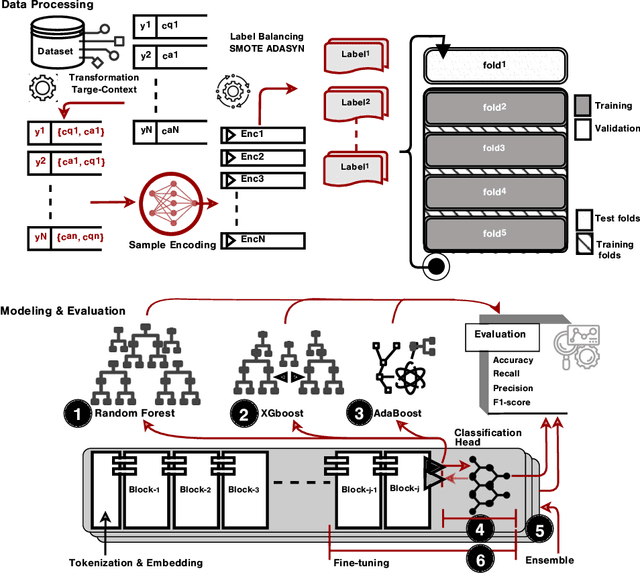
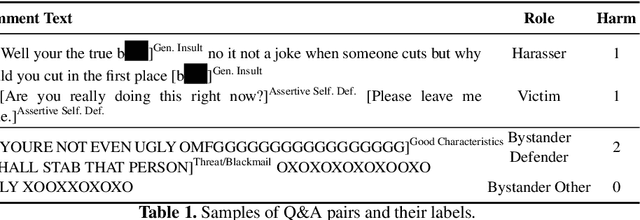
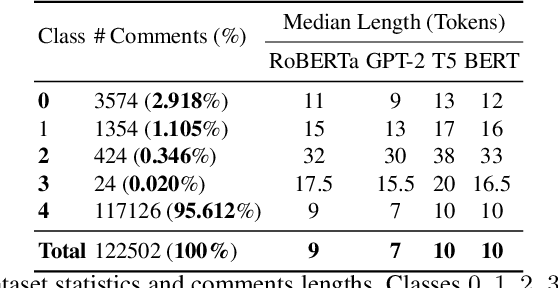
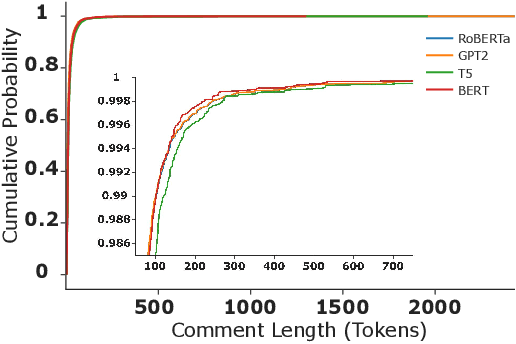
Social media has revolutionized communication, allowing people worldwide to connect and interact instantly. However, it has also led to increases in cyberbullying, which poses a significant threat to children and adolescents globally, affecting their mental health and well-being. It is critical to accurately detect the roles of individuals involved in cyberbullying incidents to effectively address the issue on a large scale. This study explores the use of machine learning models to detect the roles involved in cyberbullying interactions. After examining the AMiCA dataset and addressing class imbalance issues, we evaluate the performance of various models built with four underlying LLMs (i.e., BERT, RoBERTa, T5, and GPT-2) for role detection. Our analysis shows that oversampling techniques help improve model performance. The best model, a fine-tuned RoBERTa using oversampled data, achieved an overall F1 score of 83.5%, increasing to 89.3% after applying a prediction threshold. The top-2 F1 score without thresholding was 95.7%. Our method outperforms previously proposed models. After investigating the per-class model performance and confidence scores, we show that the models perform well in classes with more samples and less contextual confusion (e.g., Bystander Other), but struggle with classes with fewer samples (e.g., Bystander Assistant) and more contextual ambiguity (e.g., Harasser and Victim). This work highlights current strengths and limitations in the development of accurate models with limited data and complex scenarios.