 Add to Chrome
 Add to Firefox
 Add to Edge
Depth-Aware Image and Video Orientation Estimation
Apr 15, 2026
This paper introduces a novel approach for image and video orientation estimation by leveraging depth distribution in natural images. The proposed method estimates the orientation based on the depth distribution across different quadrants of the image, providing a robust framework for orientation estimation suited for applications such as virtual reality (VR), augmented reality (AR), autonomous navigation, and interactive surveillance systems. To further enhance fine-scale perceptual alignment, we incorporate depth gradient consistency (DGC) and horizontal symmetry analysis (HSA), enabling precise orientation correction. This hybrid strategy effectively exploits depth cues to support spatial coherence and perceptual stability in immersive visual content. Qualitative and quantitative evaluations demonstrate the robustness and accuracy of the proposed approach, outperforming existing techniques across diverse scenarios.
* 13 pages, 8 figures

How to deal with glare for improved perception of Autonomous Vehicles
Apr 17, 2024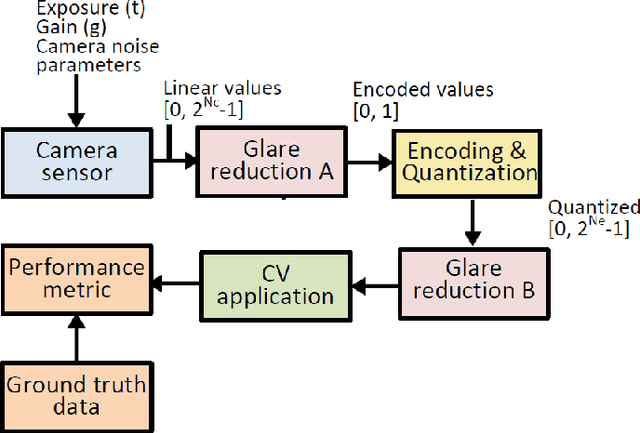
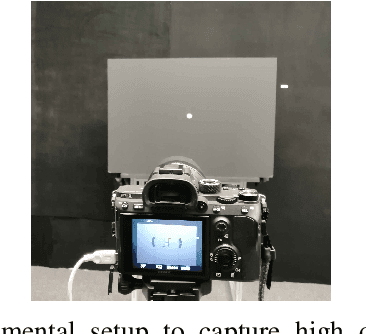
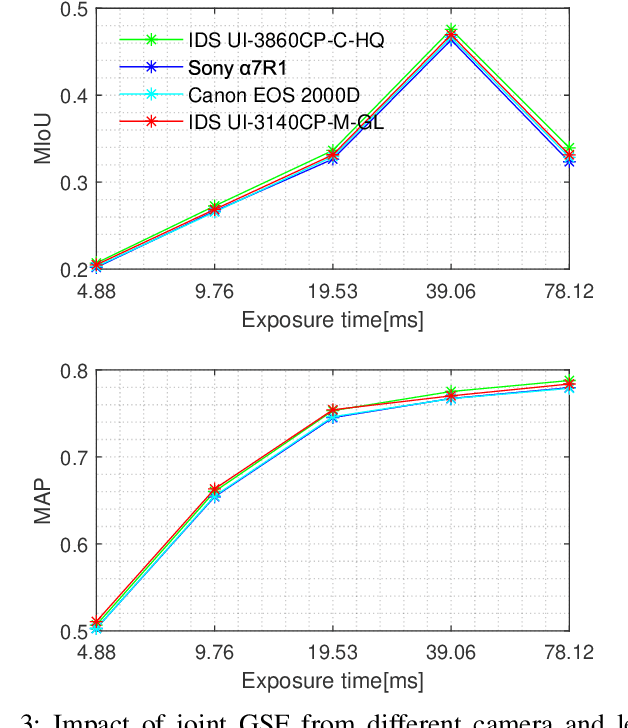
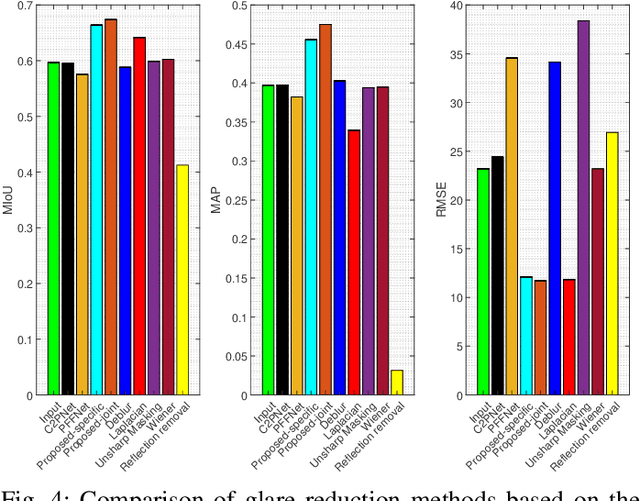
Vision sensors are versatile and can capture a wide range of visual cues, such as color, texture, shape, and depth. This versatility, along with the relatively inexpensive availability of machine vision cameras, played an important role in adopting vision-based environment perception systems in autonomous vehicles (AVs). However, vision-based perception systems can be easily affected by glare in the presence of a bright source of light, such as the sun or the headlights of the oncoming vehicle at night or simply by light reflecting off snow or ice-covered surfaces; scenarios encountered frequently during driving. In this paper, we investigate various glare reduction techniques, including the proposed saturated pixel-aware glare reduction technique for improved performance of the computer vision (CV) tasks employed by the perception layer of AVs. We evaluate these glare reduction methods based on various performance metrics of the CV algorithms used by the perception layer. Specifically, we considered object detection, object recognition, object tracking, depth estimation, and lane detection which are crucial for autonomous driving. The experimental findings validate the efficacy of the proposed glare reduction approach, showcasing enhanced performance across diverse perception tasks and remarkable resilience against varying levels of glare.