 Add to Chrome
 Add to Firefox
 Add to Edge
Leveraging Large Language Models and Survival Analysis for Early Prediction of Chemotherapy Outcomes
Mar 12, 2026
Chemotherapy for cancer treatment is costly and accompanied by severe side effects, highlighting the critical need for early prediction of treatment outcomes to improve patient management and informed decision-making. Predictive models for chemotherapy outcomes using real-world data face challenges, including the absence of explicit phenotypes and treatment outcome labels such as cancer progression and toxicity. This study addresses these challenges by employing Large Language Models (LLMs) and ontology-based techniques for phenotypes and outcome label extraction from patient notes. We focused on one of the most frequently occurring cancers, breast cancer, due to its high prevalence and significant variability in patient response to treatment, making it a critical area for improving predictive modeling. The dataset included features such as vitals, demographics, staging, biomarkers, and performance scales. Drug regimens and their combinations were extracted from the chemotherapy plans in the EMR data and shortlisted based on NCCN guidelines, verified with NIH standards, and analyzed through survival modeling. The proposed approach significantly reduced phenotypes sparsity and improved predictive accuracy. Random Survival Forest was used to predict time-to-failure, achieving a C-index of 73%, and utilized as a classifier at a specific time point to predict treatment outcomes, with accuracy and F1 scores above 70%. The outcome probabilities were validated for reliability by calibration curves. We extended our approach to four other cancer types. This research highlights the potential of early prediction of treatment outcomes using LLM-based clinical data extraction enabling personalized treatment plans with better patient outcomes.

End-to-end Learning for Joint Depth and Image Reconstruction from Diffracted Rotation
Apr 14, 2022


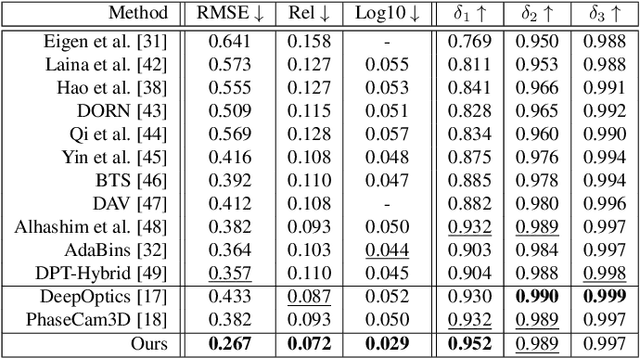
Monocular depth estimation is still an open challenge due to the ill-posed nature of the problem at hand. Deep learning based techniques have been extensively studied and proved capable of producing acceptable depth estimation accuracy even if the lack of meaningful and robust depth cues within single RGB input images severally limits their performance. Coded aperture-based methods using phase and amplitude masks encode strong depth cues within 2D images by means of depth-dependent Point Spread Functions (PSFs) at the price of a reduced image quality. In this paper, we propose a novel end-to-end learning approach for depth from diffracted rotation. A phase mask that produces a Rotating Point Spread Function (RPSF) as a function of defocus is jointly optimized with the weights of a depth estimation neural network. To this aim, we introduce a differentiable physical model of the aperture mask and exploit an accurate simulation of the camera imaging pipeline. Our approach requires a significantly less complex model and less training data, yet it is superior to existing methods in the task of monocular depth estimation on indoor benchmarks. In addition, we address the problem of image degradation by incorporating a non-blind and non-uniform image deblurring module to recover the sharp all-in-focus image from its RPSF-blurred counterpart.