 Add to Chrome
 Add to Firefox
 Add to Edge
Towards Truly Unsupervised Evaluation of Feature Selection
Aug 12, 2026
Feature selection is one of the most important and fundamental tasks in data mining, tackled by a family of methods with an established set of evaluation techniques to measure the quality of a specific method. Most of the methods commonly used for the unsupervised evaluation of feature selection algorithms suffer from critical design flaws which question their unsupervised nature. In this paper, we provide a critical discussion on the established allegedly unsupervised evaluation techniques, and shed light on the reasons why they are not truly unsupervised but, at best, supervised evaluation under an unsupervised downstream task. We also propose a novel, truly unsupervised evaluation framework to measure the quality of the feature selection algorithms without any form of information about the labels. The proposed framework utilizes unsupervised Principal Component Analysis, and optimal transport to measure the quality of the feature selection methods in a truly unsupervised manner.

An Empirical Study of Feature Selection Granularity
Jul 27, 2026Feature selection aims to identify the most informative and relevant features for a given dataset, either in terms of capturing the underlying data structure and distribution better, or with respect to the performance on a downstream task. Existing research in this area has largely focused on developing novel algorithms (in both supervised and unsupervised settings), proposing new evaluation metrics and frameworks, or benchmarking the performance of existing methods. In this work, we examine feature selection through an algorithmic design perspective. Conventional feature selection algorithms typically compute feature importance scores globally across the entire feature set and then select the top-ranked features in a single step. However, this approach raises a critical question: Can the presence of less informative (or noisy) features mask or obscure the true importance of other, more relevant features? In other words, would a recursive strategy, where features are removed one by one while re-evaluating importance at each step, yield different and potentially better results than the standard global ranking approach? To answer this question, we conduct an extensive empirical study using five diverse feature selection algorithms. We implement each algorithm under both the conventional global selection design and the greedy recursive elimination design. We then analyze the impact of this algorithmic choice, both individually for each method and collectively across all methods, on a range of standard feature selection evaluation metrics. The empirical evaluation results show that the greedy approach improves the overall feature selection quality almost consistently, albeit on the expense of higher computational cost, supporting our initial expectation that the curse of dimensionality also obscures the ways of mitigating it.
MARS: Magnitude-Aware Rank Statistics
May 22, 2026Comprehensive evaluation of machine learning models is the key to make sure that they perform as robustly and consistently as desired. In order to summarize the experimental results and pick a winner, Critical Difference (CD) diagrams are used. Standard CD diagrams rely on discrete ranks, discarding the magnitude of performance gaps between models, raising an issue which we call magnitude-blindness. In order to address this issue, we propose Magnitude-Aware Rank Statistics (MARS) that incorporates a relative margin coefficient as a weight for the discrete ranks. This coefficient scales ranks based on the distance between the best and worst performers, with a dynamic projection to handle boundary cases. Followed by the calculation of a CD value, MARS results in a more realistic statistical representation of differences of model performances and more insights on how methods actually perform in vast and extensive experimental settings.
Worse than Random: The Importance of a Baseline for Unsupervised Feature Selection
May 21, 2026Many novel unsupervised feature selection methods are proposed each year, yet their empirical evaluation is limited to supervised and unsupervised evaluation metrics computed on selected datasets, along with comparisons to existing methods. However, in the absence of an established evaluation baseline, it is difficult to determine the value added to the existing literature by each of these methods, and how effective their underlying approaches are. We propose using random feature selection as a baseline for evaluating the unsupervised feature selection methods. We empirically show that many of the state-of-the-art methods in unsupervised feature selection are outperformed by random feature selection in both performance and efficiency. Accordingly, we emphasize on the strict requirement of considering random feature selection as a baseline in the development process of novel unsupervised feature selection methods to ensure a consistent improvement over random feature selection.
FSEVAL: Feature Selection Evaluation Toolbox and Dashboard
Apr 20, 2026Feature selection is a fundamental machine learning and data mining task, involved with discriminating redundant features from informative ones. It is an attempt to address the curse of dimensionality by removing the redundant features, while unlike dimensionality reduction methods, preserving explainability. Feature selection is conducted in both supervised and unsupervised settings, with different evaluation metrics employed to determine which feature selection algorithm is the best. In this paper, we propose FSEVAL, a feature selection evaluation toolbox accompanied with a visualization dashboard, with the goal to make it easy to comprehensively evaluate feature selection algorithms. FSEVAL aims to provide a standardized, unified, evaluation and visualization toolbox to help the researchers working in the field, conduct extensive and comprehensive evaluation of feature selection algorithms with ease.
Metrics for Inter-Dataset Similarity with Example Applications in Synthetic Data and Feature Selection Evaluation -- Extended Version
Jan 16, 2025
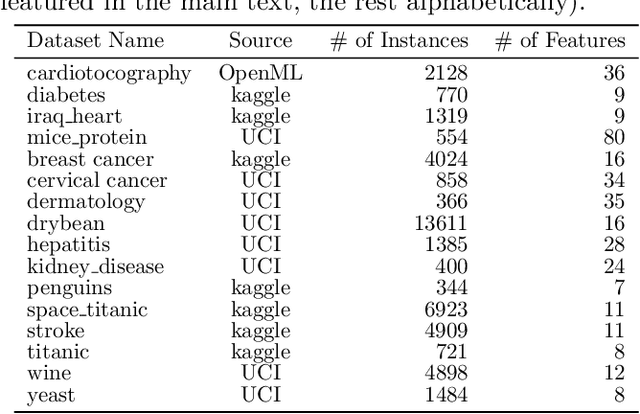

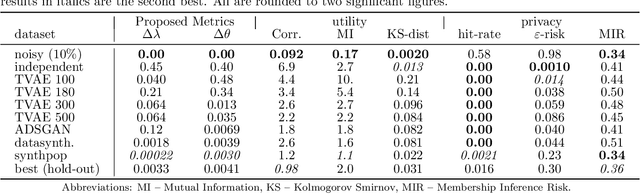
Measuring inter-dataset similarity is an important task in machine learning and data mining with various use cases and applications. Existing methods for measuring inter-dataset similarity are computationally expensive, limited, or sensitive to different entities and non-trivial choices for parameters. They also lack a holistic perspective on the entire dataset. In this paper, we propose two novel metrics for measuring inter-dataset similarity. We discuss the mathematical foundation and the theoretical basis of our proposed metrics. We demonstrate the effectiveness of the proposed metrics by investigating two applications in the evaluation of synthetic data and in the evaluation of feature selection methods. The theoretical and empirical studies conducted in this paper illustrate the effectiveness of the proposed metrics.
FSDEM: Feature Selection Dynamic Evaluation Metric
Aug 26, 2024Expressive evaluation metrics are indispensable for informative experiments in all areas, and while several metrics are established in some areas, in others, such as feature selection, only indirect or otherwise limited evaluation metrics are found. In this paper, we propose a novel evaluation metric to address several problems of its predecessors and allow for flexible and reliable evaluation of feature selection algorithms. The proposed metric is a dynamic metric with two properties that can be used to evaluate both the performance and the stability of a feature selection algorithm. We conduct several empirical experiments to illustrate the use of the proposed metric in the successful evaluation of feature selection algorithms. We also provide a comparison and analysis to show the different aspects involved in the evaluation of the feature selection algorithms. The results indicate that the proposed metric is successful in carrying out the evaluation task for feature selection algorithms. This paper is an extended version of a paper accepted at SISAP 2024.