 Add to Chrome
 Add to Firefox
 Add to Edge
ForCM: Forest Cover Mapping from Multispectral Sentinel-2 Image by Integrating Deep Learning with Object-Based Image Analysis
Dec 29, 2025
This research proposes "ForCM", a novel approach to forest cover mapping that combines Object-Based Image Analysis (OBIA) with Deep Learning (DL) using multispectral Sentinel-2 imagery. The study explores several DL models, including UNet, UNet++, ResUNet, AttentionUNet, and ResNet50-Segnet, applied to high-resolution Sentinel-2 Level 2A satellite images of the Amazon Rainforest. The datasets comprise three collections: two sets of three-band imagery and one set of four-band imagery. After evaluation, the most effective DL models are individually integrated with the OBIA technique to enhance mapping accuracy. The originality of this work lies in evaluating different deep learning models combined with OBIA and comparing them with traditional OBIA methods. The results show that the proposed ForCM method improves forest cover mapping, achieving overall accuracies of 94.54 percent with ResUNet-OBIA and 95.64 percent with AttentionUNet-OBIA, compared to 92.91 percent using traditional OBIA. This research also demonstrates the potential of free and user-friendly tools such as QGIS for accurate mapping within their limitations, supporting global environmental monitoring and conservation efforts.

Hybrid Quantum-Classical Learning for Multiclass Image Classification
Aug 25, 2025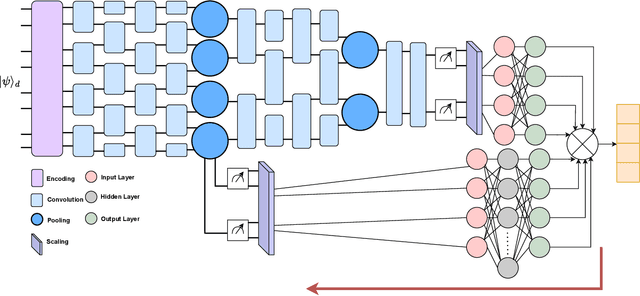
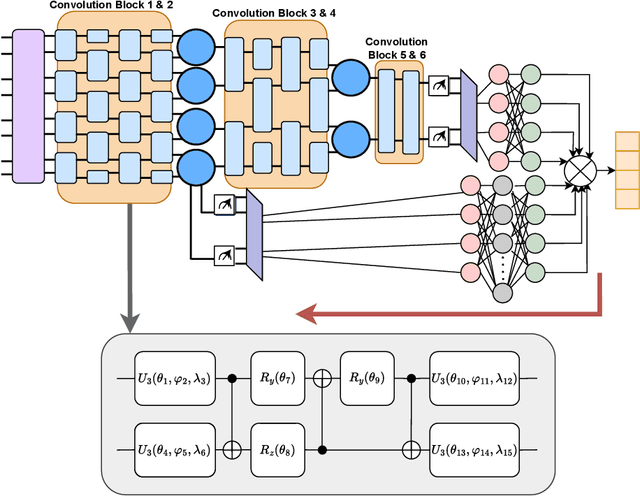
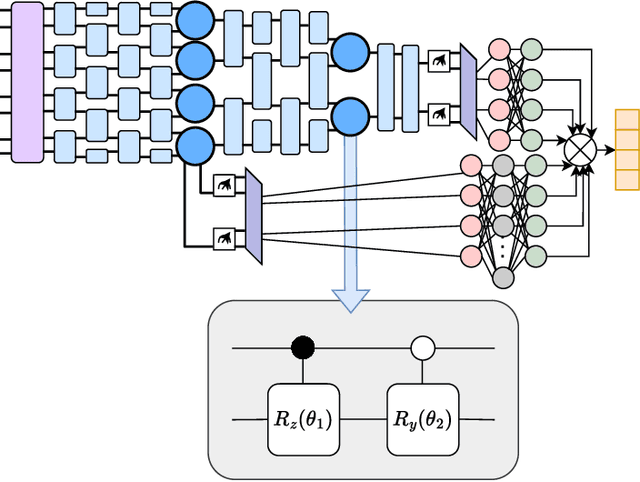
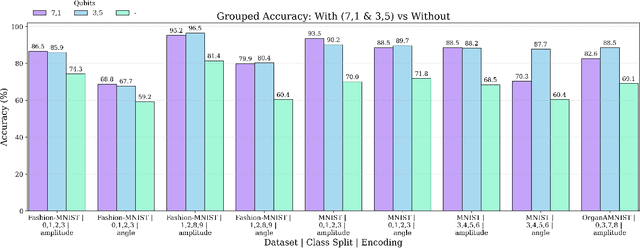
This study explores the challenge of improving multiclass image classification through quantum machine-learning techniques. It explores how the discarded qubit states of Noisy Intermediate-Scale Quantum (NISQ) quantum convolutional neural networks (QCNNs) can be leveraged alongside a classical classifier to improve classification performance. Current QCNNs discard qubit states after pooling; yet, unlike classical pooling, these qubits often remain entangled with the retained ones, meaning valuable correlated information is lost. We experiment with recycling this information and combining it with the conventional measurements from the retained qubits. Accordingly, we propose a hybrid quantum-classical architecture that couples a modified QCNN with fully connected classical layers. Two shallow fully connected (FC) heads separately process measurements from retained and discarded qubits, whose outputs are ensembled before a final classification layer. Joint optimisation with a classical cross-entropy loss allows both quantum and classical parameters to adapt coherently. The method outperforms comparable lightweight models on MNIST, Fashion-MNIST and OrganAMNIST. These results indicate that reusing discarded qubit information is a promising approach for future hybrid quantum-classical models and may extend to tasks beyond image classification.