 Add to Chrome
 Add to Firefox
 Add to Edge
Trustworthy Orchestration Artificial Intelligence by the Ten Criteria with Control-Plane Governance
Dec 11, 2025
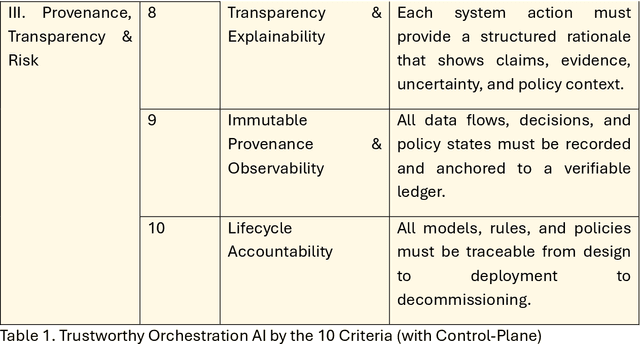
As Artificial Intelligence (AI) systems increasingly assume consequential decision-making roles, a widening gap has emerged between technical capabilities and institutional accountability. Ethical guidance alone is insufficient to counter this challenge; it demands architectures that embed governance into the execution fabric of the ecosystem. This paper presents the Ten Criteria for Trustworthy Orchestration AI, a comprehensive assurance framework that integrates human input, semantic coherence, audit and provenance integrity into a unified Control-Panel architecture. Unlike conventional agentic AI initiatives that primarily focus on AI-to-AI coordination, the proposed framework provides an umbrella of governance to the entire AI components, their consumers and human participants. By taking aspiration from international standards and Australia's National Framework for AI Assurance initiative, this work demonstrates that trustworthiness can be systematically incorporated (by engineering) into AI systems, ensuring the execution fabric remains verifiable, transparent, reproducible and under meaningful human control.

Impact and influence of modern AI in metadata management
Jan 28, 2025Metadata management plays a critical role in data governance, resource discovery, and decision-making in the data-driven era. While traditional metadata approaches have primarily focused on organization, classification, and resource reuse, the integration of modern artificial intelligence (AI) technologies has significantly transformed these processes. This paper investigates both traditional and AI-driven metadata approaches by examining open-source solutions, commercial tools, and research initiatives. A comparative analysis of traditional and AI-driven metadata management methods is provided, highlighting existing challenges and their impact on next-generation datasets. The paper also presents an innovative AI-assisted metadata management framework designed to address these challenges. This framework leverages more advanced modern AI technologies to automate metadata generation, enhance governance, and improve the accessibility and usability of modern datasets. Finally, the paper outlines future directions for research and development, proposing opportunities to further advance metadata management in the context of AI-driven innovation and complex datasets.