 Add to Chrome
 Add to Firefox
 Add to Edge
VisNet: Efficient Person Re-Identification via Alpha-Divergence Loss, Feature Fusion and Dynamic Multi-Task Learning
Jan 01, 2026
Person re-identification (ReID) is an extremely important area in both surveillance and mobile applications, requiring strong accuracy with minimal computational cost. State-of-the-art methods give good accuracy but with high computational budgets. To remedy this, this paper proposes VisNet, a computationally efficient and effective re-identification model suitable for real-world scenarios. It is the culmination of conceptual contributions, including feature fusion at multiple scales with automatic attention on each, semantic clustering with anatomical body partitioning, a dynamic weight averaging technique to balance classification semantic regularization, and the use of loss function FIDI for improved metric learning tasks. The multiple scales fuse ResNet50's stages 1 through 4 without the use of parallel paths, with semantic clustering introducing spatial constraints through the use of rule-based pseudo-labeling. VisNet achieves 87.05% Rank-1 and 77.65% mAP on the Market-1501 dataset, having 32.41M parameters and 4.601 GFLOPs, hence, proposing a practical approach for real-time deployment in surveillance and mobile applications where computational resources are limited.

Small Object Detection with YOLO: A Performance Analysis Across Model Versions and Hardware
Apr 14, 2025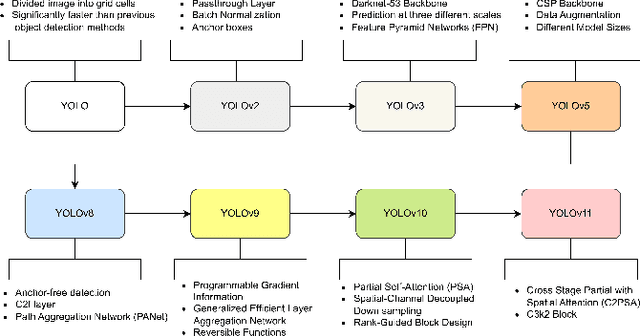
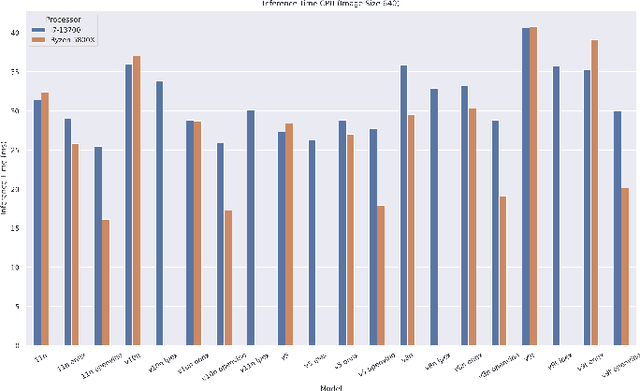
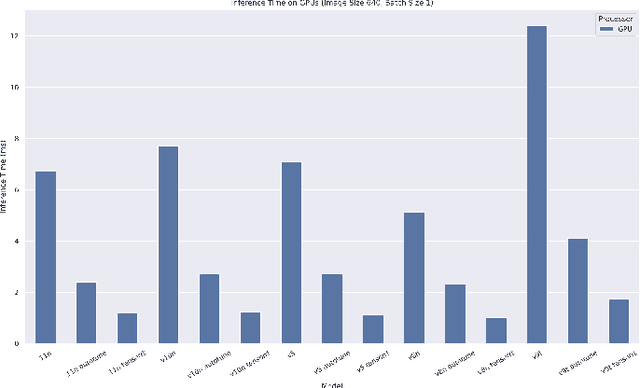
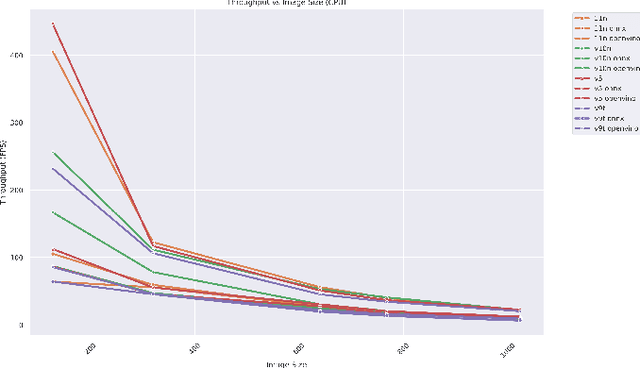
This paper provides an extensive evaluation of YOLO object detection models (v5, v8, v9, v10, v11) by com- paring their performance across various hardware platforms and optimization libraries. Our study investigates inference speed and detection accuracy on Intel and AMD CPUs using popular libraries such as ONNX and OpenVINO, as well as on GPUs through TensorRT and other GPU-optimized frameworks. Furthermore, we analyze the sensitivity of these YOLO models to object size within the image, examining performance when detecting objects that occupy 1%, 2.5%, and 5% of the total area of the image. By identifying the trade-offs in efficiency, accuracy, and object size adaptability, this paper offers insights for optimal model selection based on specific hardware constraints and detection requirements, aiding practitioners in deploying YOLO models effectively for real-world applications.