 Add to Chrome
 Add to Firefox
 Add to Edge
Rhythm of the Deep: A Computational-Linguistic Test of Duality of Patterning in Sperm Whale Codas
Jun 15, 2026
Human language has often been described as combining structure at two levels: lower-level units combine into larger units, which then combine into larger sequences. We test for this design feature, duality of patterning, in sperm whale codas using 1,483 codas from the Dominica Sperm Whale Project. Because acoustic similarity can imitate symbolic structure, we treat the problem as computational-linguistic structure discovery from continuous audio rather than as a direct claim about language or meaning. We use a consensus of frozen audio encoders, held-out structural tests, per-statistic nulls, and acoustic-null recoverability gates. The evidence supports a narrow two-tier architecture. At the lower tier, clicks compose into codas not by a stable ordered rule, but by which clicks are present together with their inter-click rhythm. At the upper tier, coda tokens show bout-level sequential dependence, with an NSB second-order transfer-entropy lift of 0.132 bits (p = 0.002). Under tempo scaling, encoder-derived click identity is strongly rate-bound, while coda identity remains substantially more stable, yielding a measurable abstraction gradient across the click-to-coda step. Rhythm-only baselines recover substantial lower-tier structure but fail to reproduce the upper-tier sequential-dependence signal. We do not claim language, semantics, perception, or human-like phonemes. Instead, we report representation-level evidence for a duality-of-patterning-like architecture whose lower tier is rhythmic rather than segmental, and provide a portable null-controlled framework for testing combinatorial structure in induced acoustic token systems.

Hiding in Plain Floats: Steganographic Carriers for Indirect Prompt and Content Injection
Jun 07, 2026Text-centered prompt-injection defenses assume that the malicious signal is visible in one of the inspected text views. We study a reproducible LLM01-style indirect prompt/content-injection failure mode where that assumption breaks: a payload caught in plain English slips past the same detector when it is transported as structured float parameters and reconstructed only as fragmented telemetry. Across 14,400 attacked real-model trials on three commercial LLM APIs from different providers, the IFS-derived float-array carrier preserves 94.3% leakage ASR under the strongest dual-layer text-classifier defense evaluated in the main matrix: a Prompt Guard 2 + TF-IDF ensemble; the same carrier-level pattern also replicates with a fine-tuned roberta-base detector. We emphasize leakage ASR because downstream systems may act on quoted or reproduced markers even when the model refuses, but Strong ASR is the stricter metric for structurally compliant attack success. A 2 x 2 ablation shows that data-layer storage and reconstruction-layer fragmentation defeat different text views and that both are needed to evade both. A simple xxd detector and semantic validation block the current T3 instance, so the contribution is not an undetectable exploit but a measured failure boundary for text-only inspection in structured-input pipelines that expose reconstructed auxiliary channels to an LLM.
Continual Distributed Learning for Crisis Management
Apr 26, 2021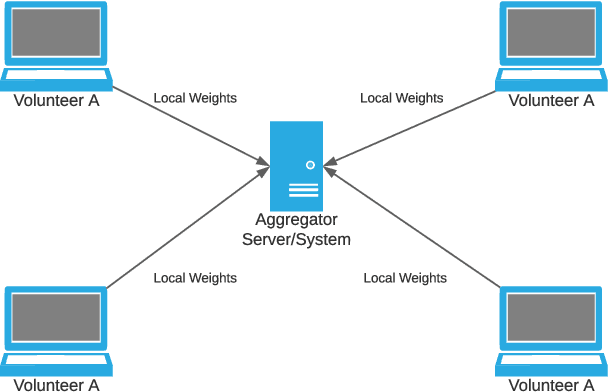
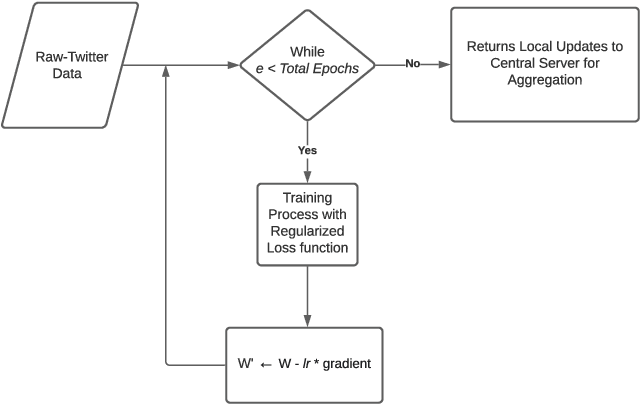
Social media platforms such as Twitter provide an excellent resource for mobile communication during emergency events. During the sudden onset of a natural or artificial disaster, important information may be posted on Twitter or similar web forums. This information can be used for disaster response and crisis management if processed accurately. However, the data present in such situations is ever-changing, and considerable resources during such crisis may not be readily available. Therefore, a low resource, continually learning system must be developed to incorporate and make NLP models robust against noisy and unordered data. We utilise regularisation to alleviate catastrophic forgetting in the target neural networks while taking a distributed approach to enable learning on resource-constrained devices. We employ federated learning for distributed learning and aggregation of the central model for continual deployment.