 Add to Chrome
 Add to Firefox
 Add to Edge
SaluNet: Enabling Total Plasticity in Normalization-Free Deep Networks
Jun 01, 2026
Normalization layers such as BatchNorm and LayerNorm have long been considered essential for stable training in deep networks. This work demonstrates that they can be fully replaced by a single learnable activation mechanism. We identify a plasticity suppression effect induced by standard normalization: learnable activation parameters rapidly lose adaptability when paired with normalization layers. Motivated by this observation, we introduce SALU (Saturated Adaptive Linear Unit), \[ \operatorname{SALU}(x;a,b) = \frac{a x}{\sqrt{1 + a b x^2}},\quad a>0,\; b>0 \] a bounded, learnable activation that provides intrinsic signal stabilization without relying on batch statistics or external affine parameters. Building on SALU, we propose SaluNet, a paradigm grounded in total plasticity: SALU replaces normalization layers, while SWALU and GALU replace standard activations. With ResNet-18, SaluNet-C-18 achieves 97.35\% on CIFAR-10 and 83.25\% on CIFAR-100 without normalization, maintaining 93.44\% and 76.23\% at batch size 1 where normalized architectures fail. For transformers, SaluNet-T improves over LayerNorm-GELU from 90.92\% to 91.01\% on CIFAR-10 and from 66.54\% to 68.10\% on CIFAR-100. SaluNet-C-50 reaches 78.67\% Top-1 on ImageNet-1K at $224\times224$, and $79.23\%$ at $288\times288$. These results suggest normalization layers suppress total plasticity, a property biological neurons inherently possess, enabling deep networks to learn effectively.

Neural Architecture based on Fuzzy Perceptual Representation For Online Multilingual Handwriting Recognition
Aug 01, 2019

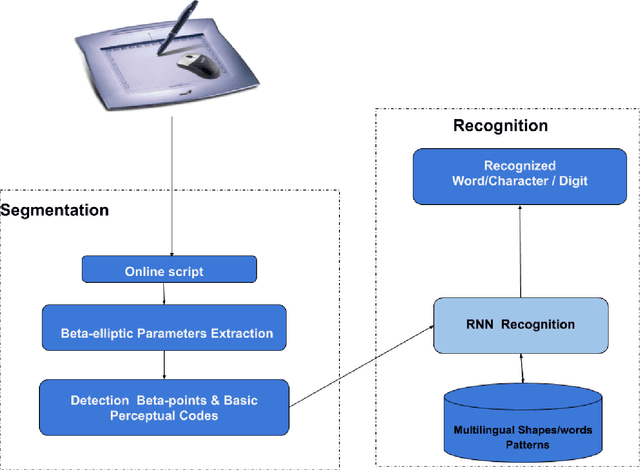
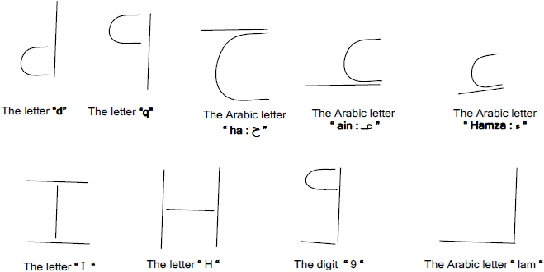
Due to the omnipresence of mobile devices, online handwritten scripts have become the most important feeding input to smartphones and tablet devices. To increase online handwriting recognition performance, deeper neural networks have extensively been used. In this context, our paper handles the problem of online handwritten script recognition based on extraction features system and deep approach system for sequences classification. Many solutions have appeared in order to facilitate the recognition of handwriting. Accordingly, we used an existent method and combined with new classifiers in order to get a flexible system. Good results are achieved compared to online characters and words recognition system on Latin and Arabic scripts. The performance of our two proposed systems is assessed by using five databases. Indeed, the recognition rate exceeds 98%.
* 15 pages; 17 figures
Multi-input Multi-output Beta Wavelet Network: Modeling of Acoustic Units for Speech Recognition
Nov 08, 2012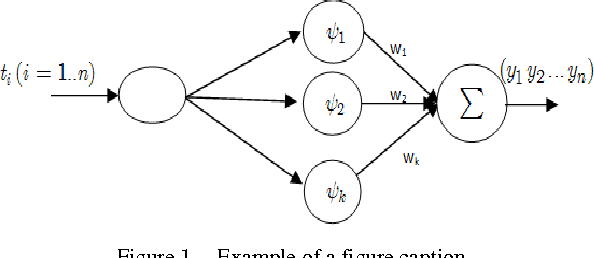
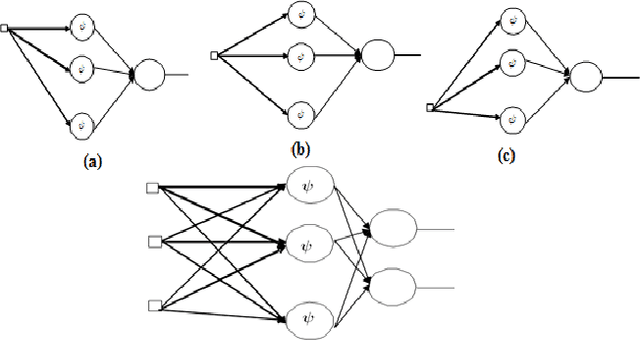
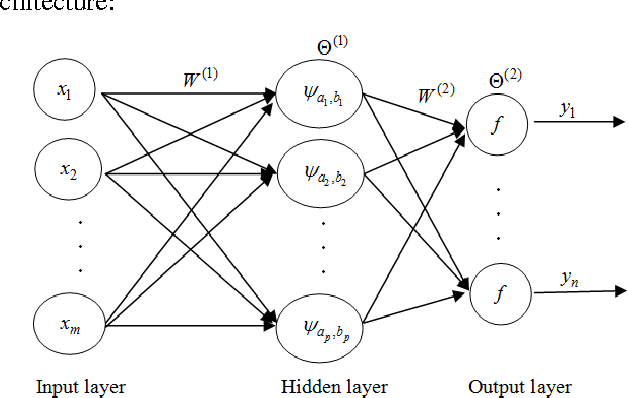
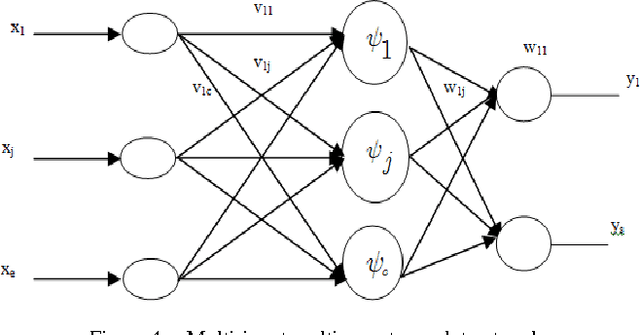
In this paper, we propose a novel architecture of wavelet network called Multi-input Multi-output Wavelet Network MIMOWN as a generalization of the old architecture of wavelet network. This newel prototype was applied to speech recognition application especially to model acoustic unit of speech. The originality of our work is the proposal of MIMOWN to model acoustic unit of speech. This approach was proposed to overcome limitation of old wavelet network model. The use of the multi-input multi-output architecture will allows training wavelet network on various examples of acoustic units.
* 7 pages, 10 figures