 Add to Chrome
 Add to Firefox
 Add to Edge
Martingale-Consistent Self-Supervised Learning
May 12, 2026
Self-supervised learning (SSL) is often deployed under changing information, such as shorter histories, missing features, or partially observed images. In these settings, predictions from coarse and refined views should be coherent: before refinement, the coarse-view prediction should match the average prediction expected after refinement. Martingales formalize this coherence principle, but standard SSL objectives do not enforce it. Unlike invariance objectives that pull views together, martingale consistency constrains only the expected refined prediction, allowing predictions to update as information is revealed while preventing systematic drift. We introduce a martingale-consistent SSL framework that closes this gap, with practical prediction- and latent-space variants and an unbiased two-sample Monte Carlo estimator based on stochastic refinement. We evaluate the approach on synthetic and real time-series, tabular, and image benchmarks under partial-observation regimes, in both semi-self-supervised and fully label-free settings. Across these experiments, our framework improves robustness and calibration under partial observation, yielding more stable representations as information is revealed.

Multimodal Survival Analysis with Locally Deployable Large Language Models
Mar 23, 2026We study multimodal survival analysis integrating clinical text, tabular covariates, and genomic profiles using locally deployable large language models (LLMs). As many institutions face tight computational and privacy constraints, this setting motivates the use of lightweight, on-premises models. Our approach jointly estimates calibrated survival probabilities and generates concise, evidence-grounded prognosis text via teacher-student distillation and principled multimodal fusion. On a TCGA cohort, it outperforms standard baselines, avoids reliance on cloud services and associated privacy concerns, and reduces the risk of hallucinated or miscalibrated estimates that can be observed in base LLMs.
Var-JEPA: A Variational Formulation of the Joint-Embedding Predictive Architecture -- Bridging Predictive and Generative Self-Supervised Learning
Mar 20, 2026The Joint-Embedding Predictive Architecture (JEPA) is often seen as a non-generative alternative to likelihood-based self-supervised learning, emphasizing prediction in representation space rather than reconstruction in observation space. We argue that the resulting separation from probabilistic generative modeling is largely rhetorical rather than structural: the canonical JEPA design, coupled encoders with a context-to-target predictor, mirrors the variational posteriors and learned conditional priors obtained when variational inference is applied to a particular class of coupled latent-variable models, and standard JEPA can be viewed as a deterministic specialization in which regularization is imposed via architectural and training heuristics rather than an explicit likelihood. Building on this view, we derive the Variational JEPA (Var-JEPA), which makes the latent generative structure explicit by optimizing a single Evidence Lower Bound (ELBO). This yields meaningful representations without ad-hoc anti-collapse regularizers and allows principled uncertainty quantification in the latent space. We instantiate the framework for tabular data (Var-T-JEPA) and achieve strong representation learning and downstream performance, consistently improving over T-JEPA while remaining competitive with strong raw-feature baselines.
A Perspective on Individualized Treatment Effects Estimation from Time-series Health Data
Feb 07, 2024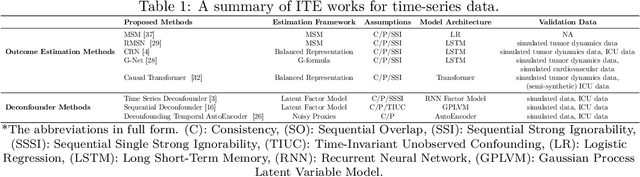
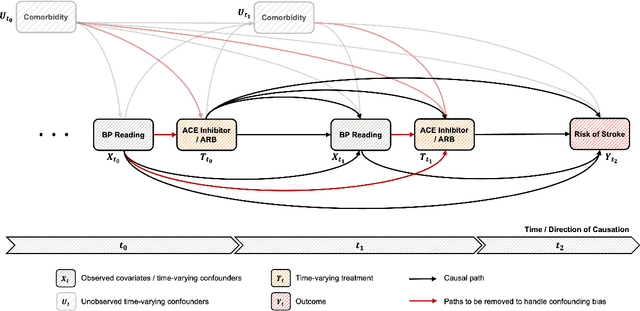
The burden of diseases is rising worldwide, with unequal treatment efficacy for patient populations that are underrepresented in clinical trials. Healthcare, however, is driven by the average population effect of medical treatments and, therefore, operates in a "one-size-fits-all" approach, not necessarily what best fits each patient. These facts suggest a pressing need for methodologies to study individualized treatment effects (ITE) to drive personalized treatment. Despite the increased interest in machine-learning-driven ITE estimation models, the vast majority focus on tabular data with limited review and understanding of methodologies proposed for time-series electronic health records (EHRs). To this end, this work provides an overview of ITE works for time-series data and insights into future research. The work summarizes the latest work in the literature and reviews it in light of theoretical assumptions, types of treatment settings, and computational frameworks. Furthermore, this work discusses challenges and future research directions for ITEs in a time-series setting. We hope this work opens new directions and serves as a resource for understanding one of the exciting yet under-studied research areas.