 Add to Chrome
 Add to Firefox
 Add to Edge
SuReNav: Superpixel Graph-based Constraint Relaxation for Navigation in Over-constrained Environments
Feb 06, 2026
We address the over-constrained planning problem in semi-static environments. The planning objective is to find a best-effort solution that avoids all hard constraint regions while minimally traversing the least risky areas. Conventional methods often rely on pre-defined area costs, limiting generalizations. Further, the spatial continuity of navigation spaces makes it difficult to identify regions that are passable without overestimation. To overcome these challenges, we propose SuReNav, a superpixel graph-based constraint relaxation and navigation method that imitates human-like safe and efficient navigation. Our framework consists of three components: 1) superpixel graph map generation with regional constraints, 2) regional-constraint relaxation using graph neural network trained on human demonstrations for safe and efficient navigation, and 3) interleaving relaxation, planning, and execution for complete navigation. We evaluate our method against state-of-the-art baselines on 2D semantic maps and 3D maps from OpenStreetMap, achieving the highest human-likeness score of complete navigation while maintaining a balanced trade-off between efficiency and safety. We finally demonstrate its scalability and generalization performance in real-world urban navigation with a quadruped robot, Spot.

An Empirical Evaluation of Four Off-the-Shelf Proprietary Visual-Inertial Odometry Systems
Jul 14, 2022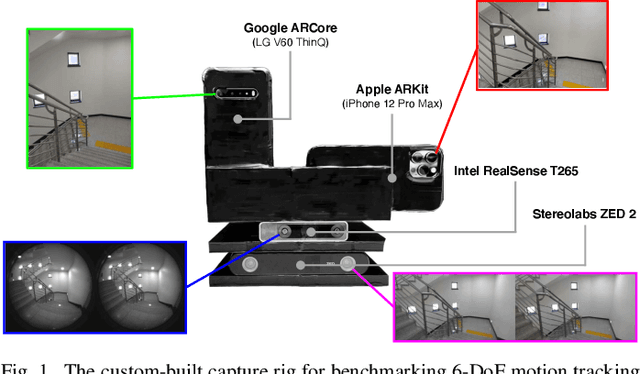
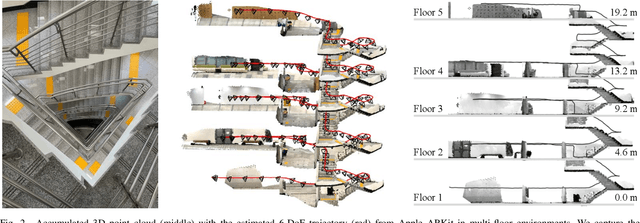
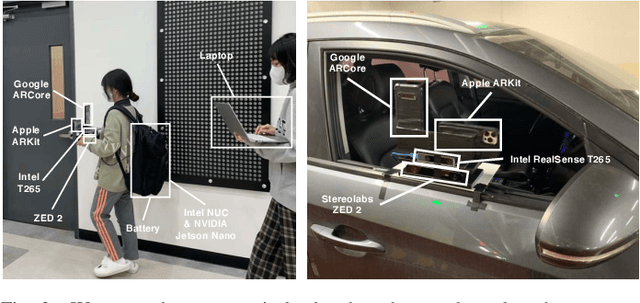
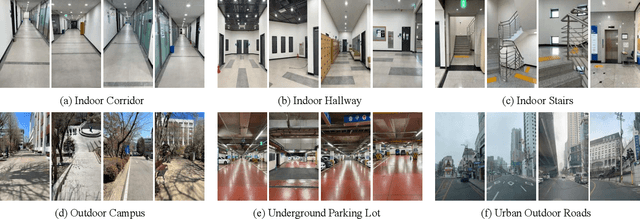
Commercial visual-inertial odometry (VIO) systems have been gaining attention as cost-effective, off-the-shelf six degrees of freedom (6-DoF) ego-motion tracking methods for estimating accurate and consistent camera pose data, in addition to their ability to operate without external localization from motion capture or global positioning systems. It is unclear from existing results, however, which commercial VIO platforms are the most stable, consistent, and accurate in terms of state estimation for indoor and outdoor robotic applications. We assess four popular proprietary VIO systems (Apple ARKit, Google ARCore, Intel RealSense T265, and Stereolabs ZED 2) through a series of both indoor and outdoor experiments where we show their positioning stability, consistency, and accuracy. We present our complete results as a benchmark comparison for the research community.