 Add to Chrome
 Add to Firefox
 Add to Edge
AlertStar: Path-Aware Alert Prediction on Hyper-Relational Knowledge Graphs
Apr 03, 2026
Cyber-attacks continue to grow in scale and sophistication, yet existing network intrusion detection approaches lack the semantic depth required for path reasoning over attacker-victim interactions. We address this by first modelling network alerts as a knowledge graph, then formulating hyper-relational alert prediction as a hyper-relational knowledge graph completion (HR-KGC) problem, representing each network alert as a qualified statement (h, r, t, Q), where h and t are source and destination IPs, r denotes the attack type, and Q encodes flow-level metadata such as timestamps, ports, protocols, and attack intensity, going beyond standard KGC binary triples (h, r, t) that would discard this contextual richness. We introduce five models across three contributions: first, Hyper-relational Neural Bellman-Ford (HR-NBFNet) extends Neural Bellman-Ford Networks to the hyper-relational setting with qualifier-aware multi-hop path reasoning, while its multi-task variant MT-HR-NBFNet jointly predicts tail, relation, and qualifier-value within a single traversal pass; second, AlertStar fuses qualifier context and structural path information entirely in embedding space via cross-attention and learned path composition, and its multi-task extension MT-AlertStar eliminates the overhead of full knowledge graph propagation; third, HR-NBFNet-CQ extends qualifier-aware representations to answer complex first-order logic queries, including one-hop, two-hop chain, two-anchor intersection, and union, enabling multi-condition threat reasoning over the alert knowledge graph. Evaluated inductively on the Warden and UNSW-NB15 benchmarks across three qualifier-density regimes, AlertStar and MT-AlertStar achieve superior MR, MRR, and Hits@k, demonstrating that local qualifier fusion is both sufficient and more efficient than global path propagation for hyper-relational alert prediction.

RAT: Reinforcement-Learning-Driven and Adaptive Testing for Vulnerability Discovery in Web Application Firewalls
Dec 13, 2023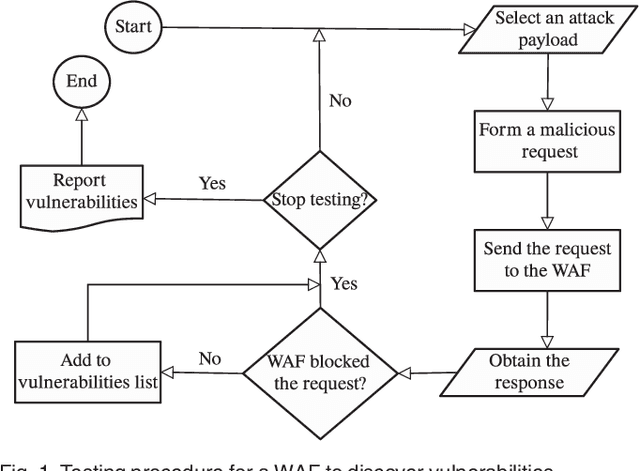

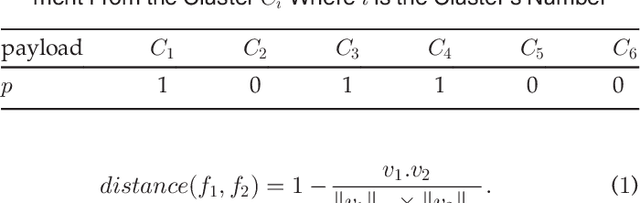
Due to the increasing sophistication of web attacks, Web Application Firewalls (WAFs) have to be tested and updated regularly to resist the relentless flow of web attacks. In practice, using a brute-force attack to discover vulnerabilities is infeasible due to the wide variety of attack patterns. Thus, various black-box testing techniques have been proposed in the literature. However, these techniques suffer from low efficiency. This paper presents Reinforcement-Learning-Driven and Adaptive Testing (RAT), an automated black-box testing strategy to discover injection vulnerabilities in WAFs. In particular, we focus on SQL injection and Cross-site Scripting, which have been among the top ten vulnerabilities over the past decade. More specifically, RAT clusters similar attack samples together. It then utilizes a reinforcement learning technique combined with a novel adaptive search algorithm to discover almost all bypassing attack patterns efficiently. We compare RAT with three state-of-the-art methods considering their objectives. The experiments show that RAT performs 33.53% and 63.16% on average better than its counterparts in discovering the most possible bypassing payloads and reducing the number of attempts before finding the first bypassing payload when testing well-configured WAFs, respectively.