 Add to Chrome
 Add to Firefox
 Add to Edge
Spatial Reasoning in LLM Game Agents: Impact of Causal Context and Multi-Step Planning
Jul 22, 2026
LLM-based game agents often perform poorly on more complex tasks. This work examines whether these failures are linked to limited spatial reasoning and evaluates whether causal prompt augmentation and multi-step planning can improve win-rates while managing response latency. Using the open-source Qwen3 model family, we conduct experiments across varying model scales, reasoning modes, and planning horizons. We further introduce a focused GVGAI benchmark consisting of three custom games with five difficulty levels to isolate spatial navigation. The evaluation follows two paradigms: an initial ``positioning experiment'' to test an agent's ability to find its exact coordinates, and a study of game-play success. Our results show that while larger models with an enabled thinking mode identify their positions more accurately, overall performance in coordinate matching remains limited for smaller models. Win rates decrease as game levels and layout complexity increase, validating the benchmark's difficulty scaling. Integrating causal context into the prompts tends to improve the agents' success rates, particularly for bigger models. While enabling thinking mode and longer planning horizons significantly improve performance, multi-step planning further reduces mean per-step response times, offering a practical trade-off between reasoning depth and execution speed.

From Gameplay Traces to Game Mechanics: Causal Induction with Large Language Models
Jan 30, 2026Deep learning agents can achieve high performance in complex game domains without often understanding the underlying causal game mechanics. To address this, we investigate Causal Induction: the ability to infer governing laws from observational data, by tasking Large Language Models (LLMs) with reverse-engineering Video Game Description Language (VGDL) rules from gameplay traces. To reduce redundancy, we select nine representative games from the General Video Game AI (GVGAI) framework using semantic embeddings and clustering. We compare two approaches to VGDL generation: direct code generation from observations, and a two-stage method that first infers a structural causal model (SCM) and then translates it into VGDL. Both approaches are evaluated across multiple prompting strategies and controlled context regimes, varying the amount and form of information provided to the model, from just raw gameplay observations to partial VGDL specifications. Results show that the SCM-based approach more often produces VGDL descriptions closer to the ground truth than direct generation, achieving preference win rates of up to 81\% in blind evaluations and yielding fewer logically inconsistent rules. These learned SCMs can be used for downstream use cases such as causal reinforcement learning, interpretable agents, and procedurally generating novel but logically consistent games.
Online Optimization of Curriculum Learning Schedules using Evolutionary Optimization
Aug 12, 2024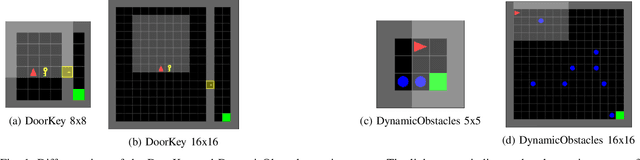
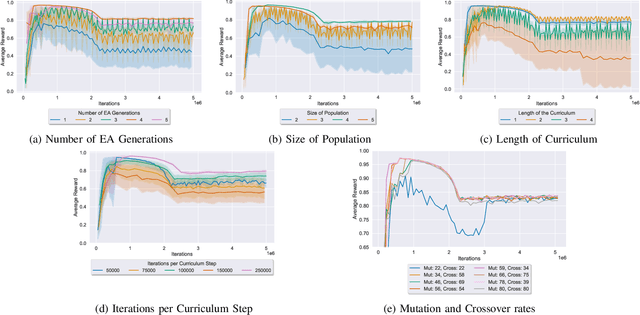
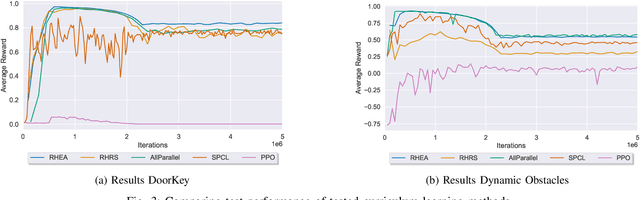
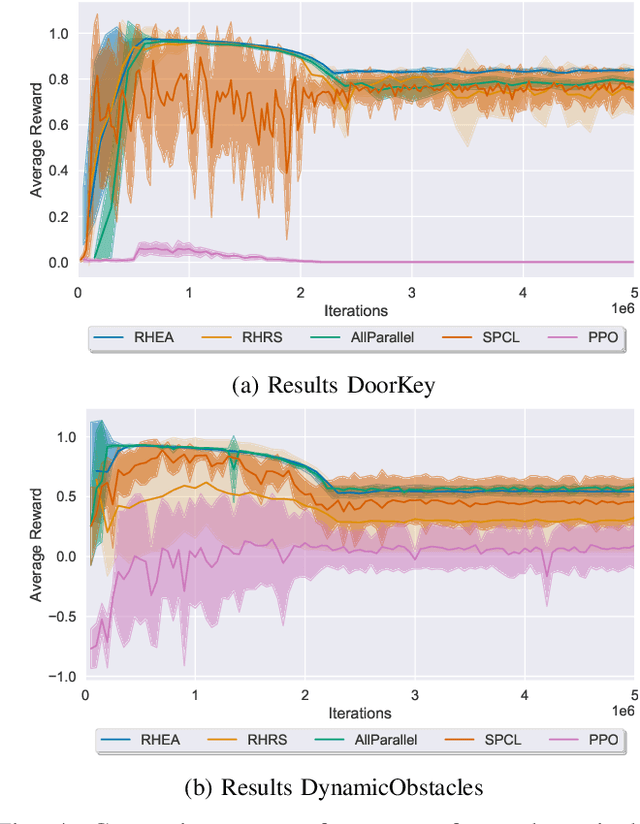
We propose RHEA CL, which combines Curriculum Learning (CL) with Rolling Horizon Evolutionary Algorithms (RHEA) to automatically produce effective curricula during the training of a reinforcement learning agent. RHEA CL optimizes a population of curricula, using an evolutionary algorithm, and selects the best-performing curriculum as the starting point for the next training epoch. Performance evaluations are conducted after every curriculum step in all environments. We evaluate the algorithm on the \textit{DoorKey} and \textit{DynamicObstacles} environments within the Minigrid framework. It demonstrates adaptability and consistent improvement, particularly in the early stages, while reaching a stable performance later that is capable of outperforming other curriculum learners. In comparison to other curriculum schedules, RHEA CL has been shown to yield performance improvements for the final Reinforcement learning (RL) agent at the cost of additional evaluation during training.