 Add to Chrome
 Add to Firefox
 Add to Edge
Current LLMs still cannot 'talk much' about grammar modules: Evidence from syntax
Mar 23, 2026
We aim to examine the extent to which Large Language Models (LLMs) can 'talk much' about grammar modules, providing evidence from syntax core properties translated by ChatGPT into Arabic. We collected 44 terms from generative syntax previous works, including books and journal articles, as well as from our experience in the field. These terms were translated by humans, and then by ChatGPT-5. We then analyzed and compared both translations. We used an analytical and comparative approach in our analysis. Findings unveil that LLMs still cannot 'talk much' about the core syntax properties embedded in the terms under study involving several syntactic and semantic challenges: only 25% of ChatGPT translations were accurate, while 38.6% were inaccurate, and 36.4.% were partially correct, which we consider appropriate. Based on these findings, a set of actionable strategies were proposed, the most notable of which is a close collaboration between AI specialists and linguists to better LLMs' working mechanism for accurate or at least appropriate translation.

The acquisition of English irregular inflections by Yemeni L1 Arabic learners: A Universal Grammar approach
Feb 14, 2026This study examines the acquisition of English irregular inflections by Yemeni learners of English as a second language (L2), utilizing a Universal Grammar (UG) approach. Within the UG approach, the study considers Feature Reassembly Hypothesis (FRH) (Lardiere, 2008, 2009) part of UG, focusing on the roles of first language (L1) transfer and L2 developmental influence. It analyzes learner errors across two developmental stages. Stage 1 data reveal a dominant influence of L1 transfer, particularly in phonological and structural mismatches, while stage 2 data demonstrate increased learner sensitivity to UG properties and morphological reconfiguration toward the target language. Findings reveal that errors in irregular inflectional morphology are attributed to both interlingual and intralingual sources, with overgeneralization of L2 rules as a common developmental strategy. Statistical analysis, including a one-way ANOVA, indicates significant improvement in the production of well-formed irregular inflections from stage 1 to stage 2, underscoring learners' continued access to UG. However, persistent difficulties with consonant change, zero-morpheme, and -a plural inflections suggest that limited exposure, ineffective input modeling, and insufficient instructional quality constrain full UG access. The study concludes that while L1 transfer and L2 developmental factors influence initial stages of acquisition, appropriate linguistic input and instruction are critical for facilitating UG-driven feature reassembly in adult L2 learners.
The Syntax of qulk-clauses in Yemeni Ibbi Arabic: A Minimalist Approach
Dec 26, 2025This study investigates the syntax of qulk-clauses in Yemeni Ibbi Arabic (YIA) within the Minimalist Program. The construction qulk-clause, a morphologically fused form meaning 'I said,' introduces embedded declarative interrogative, and imperative clauses, often eithout complementizer. The central proposal of this paper is that qulk-clauses are biclausal structures in which qulk functions a clause-embedding predicate sec;ecting a dull CP complement. By applying core minimalist operations, viz., Merge, Move, Agree, and Spell-out, the study provides a layered syntactic analysis of qulk-clauses, for illustrating how their derivation proceeds through standard computational steps and post-syntactic processes such as Morphological Merger. The proposal also accounts for dialect-specific features like bipartite negation, cliticization, and CP embedding. The findings offer theoretical contributions to generative syntax, specifically minimalism. The study concludes raising theoretical questions concerning extending the analysis to the addressee-clause kil-k 'you said'. It also provides insights into the possibility of the universality of minimalism.
Can ChatGPT capture swearing nuances? Evidence from translating Arabic oaths
Dec 03, 2024This study sets out to answer one major question: Can ChatGPT capture swearing nuances? It presents an empirical study on the ability of ChatGPT to translate Arabic oath expressions into English. 30 Arabic oath expressions were collected from the literature. These 30 oaths were first translated via ChatGPT and then analyzed and compared to the human translation in terms of types of gaps left unfulfilled by ChatGPT. Specifically, the gaps involved are: religious gap, cultural gap, both religious and cultural gaps, no gap, using non-oath particles, redundancy and noncapturing of Arabic script diacritics. It concludes that ChatGPT translation of oaths is still much unsatisfactory, unveiling the need of further developments of ChatGPT, and the inclusion of Arabic data on which ChatGPT should be trained including oath expressions, oath nuances, rituals, and practices.
Artificial intelligence contribution to translation industry: looking back and forward
Dec 02, 2024This study provides a comprehensive analysis of artificial intelligence (AI) contribution to translation industry (ACTI) research, synthesizing it over forty-one years from 1980-2024. 13220 articles were retrieved from three sources, namely WoS, Scopus, and Lens. We provided two types of analysis, viz., scientometric and thematic, focusing on cluster, subject categories, keywords, burstness, centrality and research centers as for the former. For the latter, we thematically review 18 articles, selected purposefully from the articles involved, centering on purpose, approach, findings, and contribution to ACTI future directions. The findings reveal that in the past AI contribution to translation industry was not rigorous, resulting in rule-based machine translation and statistical machine translation whose output was not satisfactory. However, the more AI develops, the more machine translation develops, incorporating Neural Networking Algorithms and (Deep) Language Learning Models like ChatGPT whose translation output has developed considerably. However, much rigorous research is still needed to overcome several problems encountering translation industry, specifically concerning low-source languages, multi-dialectical and free word order languages, and cultural and religious registers.
Non-native speakers of English or ChatGPT: Who thinks better?
Nov 30, 2024This study sets out to answer one major question: Who thinks better, non-native speakers of English or ChatGPT?, providing evidence from processing and interpreting center-embedding English constructions that human brain surpasses ChatGPT, and that ChatGPT cannot be regarded as a theory of language. Fifteen non-native speakers of English were recruited as participants of the study. A center-embedding English sentence was presented to both the study participants and ChatGPT. The study findings unveil that human brain is still far ahead of Large Language Models, specifically ChatGPT, even in the case of non-native speakers of an L2, here English. The study concludes that human brain's ability to process and interpret natural language data is unique and that ChatGPT still lags behind this human unique ability.
What fifty-one years of Linguistics and Artificial Intelligence research tell us about their correlation: A scientometric review
Nov 29, 2024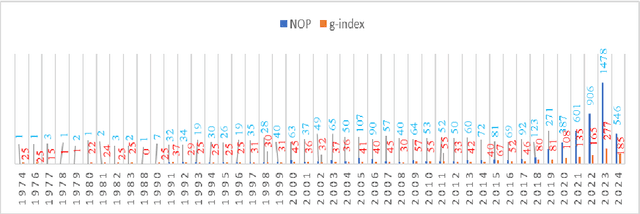

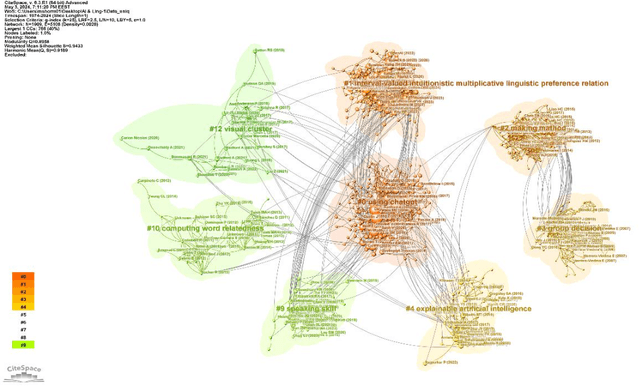

There is a strong correlation between linguistics and artificial intelligence (AI), best manifested by deep learning language models. This study provides a thorough scientometric analysis of this correlation, synthesizing the intellectual production during 51 years, from 1974 to 2024. It involves 5750 Web of Science-indexed articles published in 2124 journals, which are written by 20835 authors belonging to 13773 research centers in 794 countries. Two powerful software, viz., CiteSpace and VOSviewer, were used to generate mapping visualizations of the intellectual landscape, trending issues and (re)emerging hotspots. The results indicate that in the 1980s and 1990s, linguistics and AI research was not robust, characterized by unstable publication over time. It has, however, witnessed a remarkable increase of publication since then, reaching 1478 articles in 2023, and 546 articles in January-March timespan in 2024, involving emerging issues and hotspots, addressing new horizons, new topics, and launching new applications and powerful deep learning language models including ChatGPT.
Generative linguistics contribution to artificial intelligence: Where this contribution lies?
Oct 26, 2024This article aims to characterize Generative linguistics (GL) contribution to artificial intelligence (AI), alluding to the debate among linguists and AI scientists on whether linguistics belongs to humanities or science. In this article, I will try not to be biased as a linguist, studying the phenomenon from an independent scientific perspective. The article walks the researcher/reader through the scientific theorems and rationales involved in AI which belong from GL, specifically the Chomsky School. It, thus, provides good evidence from syntax, semantics, language faculty, Universal Grammar, computational system of human language, language acquisition, human brain, programming languages (e.g. Python), Large Language Models, and unbiased AI scientists that this contribution is huge, and that this contribution cannot be denied. It concludes that however the huge GL contribution to AI, there are still points of divergence including the nature and type of language input."