 Add to Chrome
 Add to Firefox
 Add to Edge
MixerSENet: A Lightweight Framework for Efficient Hyperspectral Image Classification
Jun 01, 2026
In this paper, a novel framework, MixerSENet, is introduced for hyperspectral image (HSI) classification, designed to address the challenges of computational efficiency and limited labeled data. The proposed model processes hyperspectral image patches while maintaining consistent size and resolution throughout the network, effectively decoupling the mixing of spatial and channel dimensions. Notably, MixerSENet is lightweight and computationally efficient, requiring fewer parameters compared to traditional models, making it suitable for resource-constrained environments. A squeeze and excitation block is incorporated into the model to refine feature extraction, enhancing the network's ability to capture more informative features. Experimental results on two benchmark datasets demonstrate that MixerSENet achieves superior performance, reaching an overall accuracy (OA) of 82.47% on Houston13 dataset and 96.70% on the Qingyun dataset, outperforming state-of-the-art methods including 3D-CNN, HybridKAN, HSIFormer, SimPoolFormer, and MorphMamba. Furthermore, a detailed analysis of computational efficiency shows that MixerSENet achieves a favorable balance between accuracy and efficiency, with only 53,146 parameters and an low inference time, confirming its practicality for real-world applications. At publication, source code will be publicly available at https://github.com/mqalkhatib/MixerSENet.

PolSAR Image Classification using a Hybrid Complex-Valued Network (HybridCVNet)
May 29, 2026Recently, convolutional neural networks (CNNs) have become popular for image classification due to their effectiveness in computer vision tasks. Now, researchers are exploring the potential of vision transformers (ViTs) in remote sensing and Earth observation. However, traditional Real-Valued networks often overlook important phase information in Complex-Valued (CV) data like polarimetric synthetic aperture radar (PolSAR) data. To address this, new CV deep architectures have emerged. HybridCVNet, a novel hybrid network, blends CV-CNN and CV vision transformer (CV-ViT) techniques. It efficiently combines CV 3D and 2D CNNs as feature extractors, enhancing PolSAR image classification by extracting complementary information and effectively leveraging interdependencies within the data. Experimental results from widely-used PolSAR datasets show HybridCVNet outperforms other methods, achieving an overall accuracy of 97.39% on the Flevoland dataset and showing promise even with just a 1% sampling ratio, with a Kappa value of 0.972 on the San Francisco dataset. Source code is accessible through https://github.com/mqalkhatib/HybridCVNet
DDF2Pol: A Dual-Domain Feature Fusion Network for PolSAR Image Classification
Apr 20, 2026This paper presents DDF2Pol, a lightweight dual-domain convolutional neural network for PolSAR image classification. The proposed architecture integrates two parallel feature extraction streams, one real-valued and one complex-valued, designed to capture complementary spatial and polarimetric information from PolSAR data. To further refine the extracted features, a depth-wise convolution layer is employed for spatial enhancement, followed by a coordinate attention mechanism to focus on the most informative regions. Experimental evaluations conducted on two benchmark datasets, Flevoland and San Francisco, demonstrate that DDF2Pol achieves superior classification performance while maintaining low model complexity. Specifically, it attains an Overall Accuracy (OA) of 98.16% on the Flevoland dataset and 96.12% on the San Francisco dataset, outperforming several state-of-the-art real- and complex-valued models. With only 91,371 parameters, DDF2Pol offers a practical and efficient solution for accurate PolSAR image analysis, even when training data is limited. The source code is publicly available at https://github.com/mqalkhatib/DDF2Pol
ConvVitMamba: Efficient Multiscale Convolution, Transformer, and Mamba-Based Sequence modelling for Hyperspectral Image Classification
Apr 20, 2026Hyperspectral image (HSI) classification remains challenging due to high spectral dimensionality, redundancy, and limited labeled data. Although convolutional neural networks (CNNs) and Vision Transformers (ViTs) achieve strong performance by exploiting spectral-spatial information and long-range dependencies, they often incur high computational cost and large model size, limiting practical use. To address these limitations, a unified hybrid framework, termed ConvVitMamba, is proposed for efficient HSI classification. The architecture integrates three components: a multiscale convolutional feature extractor to capture local spectral, spatial, and joint patterns; a Vision Transformer based tokenization and encoding stage to model global contextual relationships; and a lightweight Mamba inspired gated sequence mixing module for efficient content-aware refinement without quadratic self-attention. Principal Component Analysis (PCA) is used as preprocessing to reduce redundancy and improve efficiency. Experiments on four benchmark datasets, including Houston and three UAV borne QUH datasets (Pingan, Qingyun, and Tangdaowan), demonstrate that ConvVitMamba consistently outperforms CNN, Transformer, and Mamba based methods while maintaining a favorable balance between accuracy, model size, and inference efficiency. Ablation studies confirm the complementary contributions of all components. The results indicate that the proposed framework provides an effective and efficient solution for HSI classification in diverse scenarios. The source code is publicly available at https://github.com/mqalkhatib/ConvVitMamba
Hyperspectral Image Classification using Spectral-Spatial Mixer Network
Nov 19, 2025This paper introduces SS-MixNet, a lightweight and effective deep learning model for hyperspectral image (HSI) classification. The architecture integrates 3D convolutional layers for local spectral-spatial feature extraction with two parallel MLP-style mixer blocks that capture long-range dependencies in spectral and spatial dimensions. A depthwise convolution-based attention mechanism is employed to enhance discriminative capability with minimal computational overhead. The model is evaluated on the QUH-Tangdaowan and QUH-Qingyun datasets using only 1% of labeled data for training and validation. SS-MixNet achieves the highest performance among compared methods, including 2D-CNN, 3D-CNN, IP-SWIN, SimPoolFormer, and HybridKAN, reaching 95.68% and 93.86% overall accuracy on the Tangdaowan and Qingyun datasets, respectively. The results, supported by quantitative metrics and classification maps, confirm the model's effectiveness in delivering accurate and robust predictions with limited supervision. The code will be made publicly available at: https://github.com/mqalkhatib/SS-MixNet
SDF2Net: Shallow to Deep Feature Fusion Network for PolSAR Image Classification
Feb 27, 2024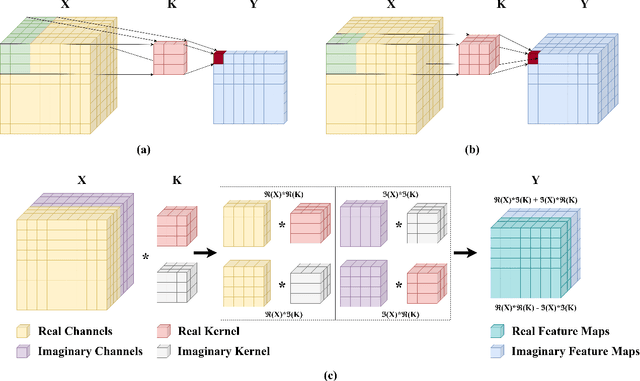
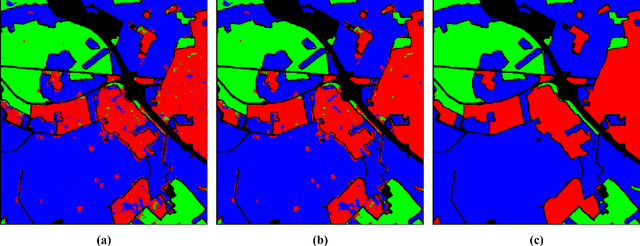
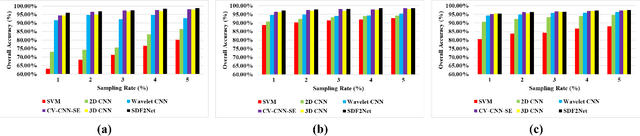
Polarimetric synthetic aperture radar (PolSAR) images encompass valuable information that can facilitate extensive land cover interpretation and generate diverse output products. Extracting meaningful features from PolSAR data poses challenges distinct from those encountered in optical imagery. Deep learning (DL) methods offer effective solutions for overcoming these challenges in PolSAR feature extraction. Convolutional neural networks (CNNs) play a crucial role in capturing PolSAR image characteristics by leveraging kernel capabilities to consider local information and the complex-valued nature of PolSAR data. In this study, a novel three-branch fusion of complex-valued CNN, named the Shallow to Deep Feature Fusion Network (SDF2Net), is proposed for PolSAR image classification. To validate the performance of the proposed method, classification results are compared against multiple state-of-the-art approaches using the airborne synthetic aperture radar (AIRSAR) datasets of Flevoland and San Francisco, as well as the ESAR Oberpfaffenhofen dataset. The results indicate that the proposed approach demonstrates improvements in overallaccuracy, with a 1.3% and 0.8% enhancement for the AIRSAR datasets and a 0.5% improvement for the ESAR dataset. Analyses conducted on the Flevoland data underscore the effectiveness of the SDF2Net model, revealing a promising overall accuracy of 96.01% even with only a 1% sampling ratio.
Attention based Dual-Branch Complex Feature Fusion Network for Hyperspectral Image Classification
Nov 02, 2023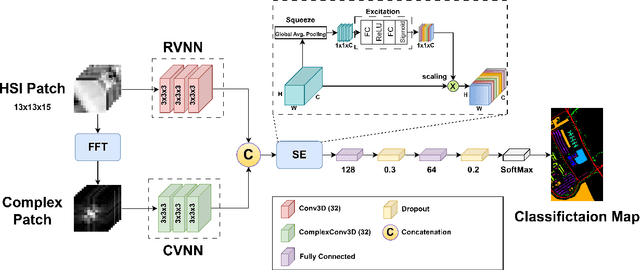
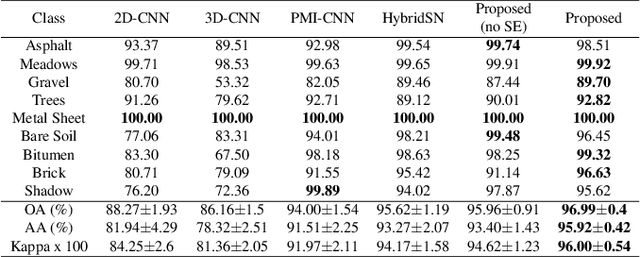
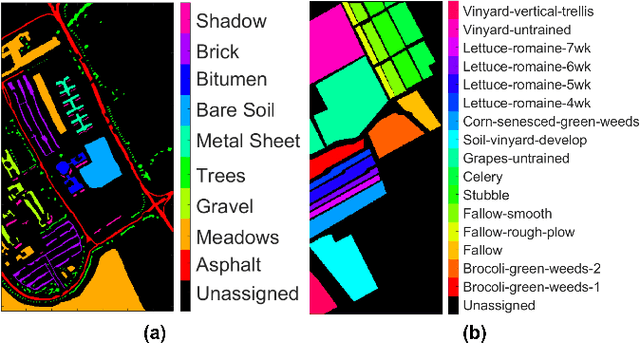
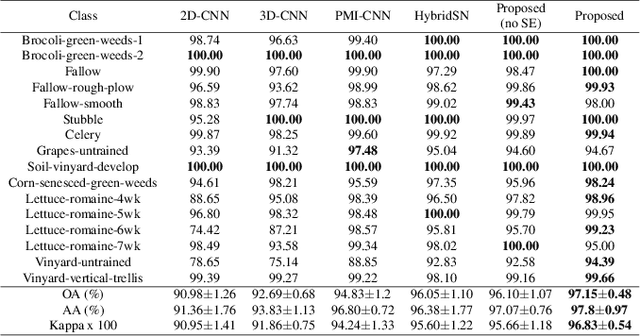
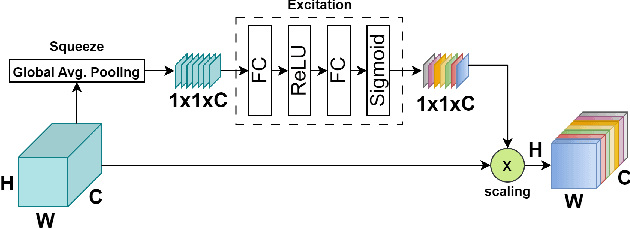
This research work presents a novel dual-branch model for hyperspectral image classification that combines two streams: one for processing standard hyperspectral patches using Real-Valued Neural Network (RVNN) and the other for processing their corresponding Fourier transforms using Complex-Valued Neural Network (CVNN). The proposed model is evaluated on the Pavia University and Salinas datasets. Results show that the proposed model outperforms state-of-the-art methods in terms of overall accuracy, average accuracy, and Kappa. Through the incorporation of Fourier transforms in the second stream, the model is able to extract frequency information, which complements the spatial information extracted by the first stream. The combination of these two streams improves the overall performance of the model. Furthermore, to enhance the model performance, the Squeeze and Excitation (SE) mechanism has been utilized. Experimental evidence show that SE block improves the models overall accuracy by almost 1\%.